

Joint Committee Formed to Address Customs and Transport Issues
The federal government and representatives of Pakistan’s goods transport sector have finalised several measures after two days of negotiations in Islamabad.
Federal Minister for Communications Abdul Aleem Khan led the talks with representatives of the All Pakistan Goods Transporters Alliance.
The discussions focused on long-running concerns involving customs procedures, weigh stations, petroleum pricing, axle-load restrictions and port operations.
A major outcome of the negotiations was the creation of a joint monitoring committee.
The committee will include Customs officials and representatives of the goods transport sector.
It is expected to monitor complaints, improve coordination and work on practical solutions to problems involving freight movement and customs procedures.
Aleem Khan said the government had attempted to provide the maximum possible relief to transport operators while keeping national requirements in view.
Federal Minister for Maritime Affairs Junaid Anwar also joined the discussions through video link.
He assured transport representatives that concerns connected with ports and maritime operations would receive government attention.
Senior officials from the Federal Board of Revenue also participated in consultations on proposals submitted by transport representatives.
Short-term and long-term measures involving Customs were discussed as both sides attempted to reduce operational difficulties faced by freight companies.
Modern Weigh Stations Planned Across Pakistan’s Motorways
Complaints about motorway weigh stations were another major issue during the negotiations.
Transporters have repeatedly raised concerns about weighing procedures, axle-load enforcement and the level of human involvement at checking points.
Aleem Khan assured the delegation that complaints involving weigh stations would be addressed on a priority basis.
The government plans to establish modern weigh stations across Pakistan’s motorway network.
According to the minister, the new facilities will use advanced technology and require minimal human intervention.
The objective is to make weight checks more transparent, efficient and consistent while reducing disputes between transporters and enforcement personnel.
A nationwide uniform policy for axle loads was also discussed.
Goods transporters have been demanding consistent axle-load rules because varying enforcement practices can create difficulties for freight companies operating across different provinces and routes.
Officials considered introducing a standardised system that could be implemented across the country.
Representatives from the Ministry of Maritime Affairs and Karachi Port Trust also briefed transporters about port-related matters.
Pakistan depends heavily on road freight to move imported goods, industrial raw materials and exports between ports, factories and markets.
The ongoing dispute has therefore raised concerns about wider disruption to domestic supply chains and export activity.
Fuel Pricing Concerns Remain Under Discussion
Petroleum pricing was another important subject during the two-day negotiations.
Transporters have opposed frequent diesel price adjustments, arguing that unpredictable fuel costs make it difficult to calculate freight charges and negotiate transport contracts.
Government officials assured the delegation that their concerns regarding petroleum price determination would be considered.
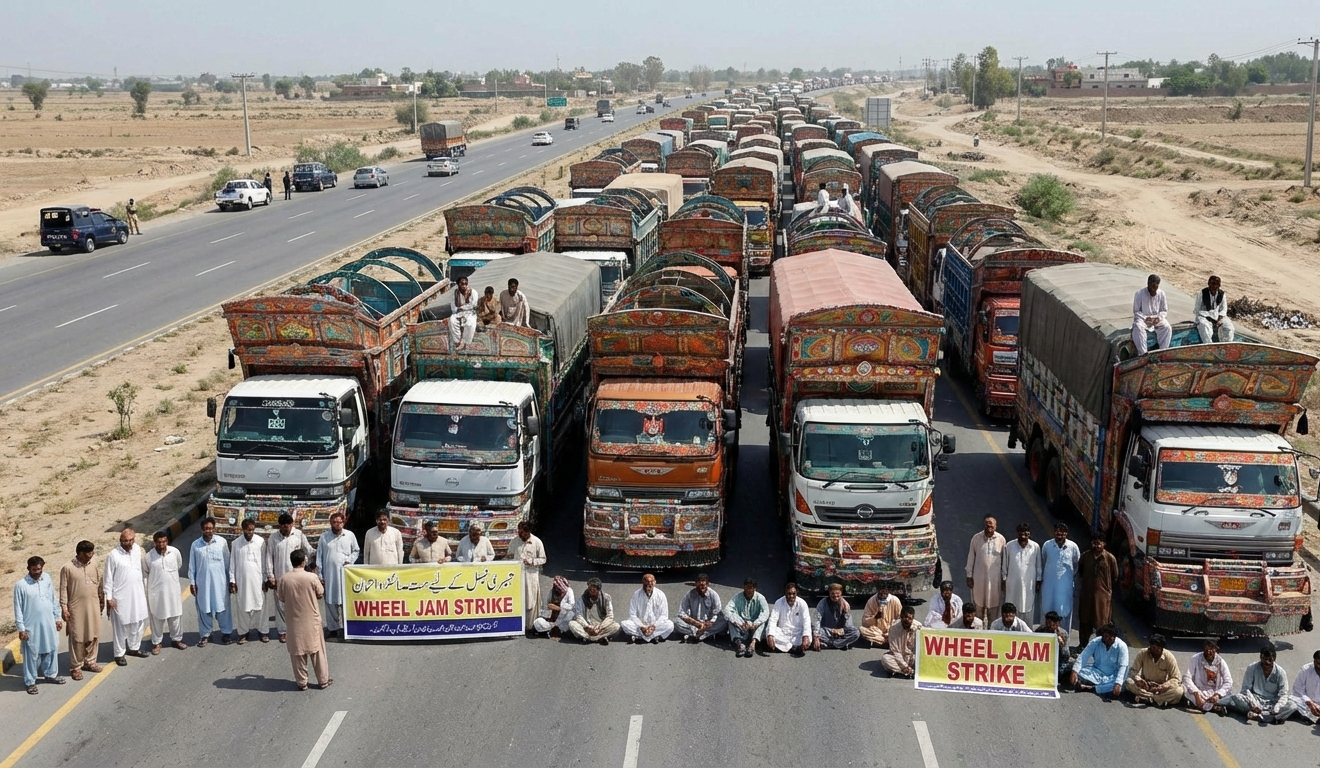
The latest talks follow several rounds of unsuccessful negotiations that led goods transporters to begin a nationwide wheel-jam strike on Saturday.
The shutdown affected the movement of freight vehicles across the country and raised concerns among manufacturers, exporters and businesses dependent on road transport.
Transport representatives including Malik Shahzad Awan, Nasir Jafri, Owais Chaudhry, Qamar-uz-Zaman, Bakhtawar Khan and Shabbar Malik participated in the latest negotiations.
Senior government officials attending the discussions included the federal secretary for communications, National Highway Authority chairman and senior Motorway Police officials.
The transporters’ delegation appreciated Aleem Khan’s approach and thanked him for efforts to resolve their concerns through negotiations.
However, reports published later on Tuesday indicated that some transport representatives were still saying the strike would continue until their demands were implemented in practical terms.
This means the latest government announcement represents an important breakthrough in negotiations, but it should not yet be interpreted as definitive confirmation that the nationwide freight strike has ended.
Further announcements from the transporters are expected to clarify whether the agreed measures are sufficient for trucks to return fully to the roads.

