
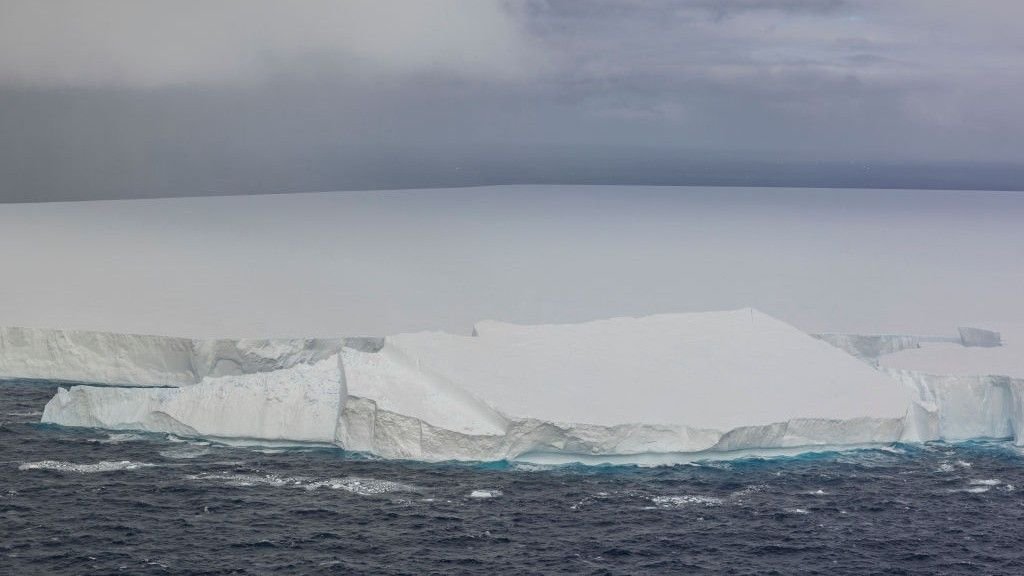

From Antarctic Giant to Ocean Fragments
The world’s largest iceberg, A-23A, has finally broken apart after nearly four decades. The massive ice structure disintegrated just days before marking its 40th year. Scientists confirmed the event after closely tracking its long and slow journey.
A-23A first formed in 1986 after breaking away from Antarctica’s Filchner Ice Shelf. It remained stuck on the seabed for around 34 years. However, in 2020, the iceberg broke free and began drifting across the ocean.
At its peak, A-23A covered about 1,540 square miles. This made it nearly the size of Greater London. It also weighed over a trillion tonnes, making it one of the largest ice masses ever recorded.
Over the years, the iceberg traveled nearly 2,000 miles. Its movement attracted global attention from scientists and climate experts. As a result, A-23A became one of the most closely monitored icebergs in history.
Satellite Tracking Reveals Dramatic Final Phase
The National Aeronautics and Space Administration confirmed the iceberg’s breakup in April 2026. Satellite data showed that A-23A had fragmented into smaller pieces in the South Atlantic Ocean.
Scientists observed rapid melting in its final months. The iceberg shrank significantly, reducing to around 66 square miles before breaking apart. This sharp decline highlighted the impact of ocean temperatures and environmental conditions.
Australian meteorologist Dr Jan Lieser played a key role in tracking the iceberg. He used advanced remote sensing technology to monitor its movement and condition.
Dr Lieser described the iceberg’s final days in a striking way. He noted that cloud cover often surrounded the melting ice mass. According to him, it felt as if nature was shielding the iceberg during its last moments.
Satellite images taken on April 3 captured the final fragments. These images showed scattered ice pieces drifting across the South Atlantic. Consequently, the once-mighty megaberg had completely lost its original form.
A-23A’s Legacy and Climate Significance
The story of A-23A offers valuable insights into polar ice dynamics. It highlights how icebergs can remain stable for decades before sudden movement. It also shows how quickly they can deteriorate once exposed to warmer waters.
Moreover, scientists believe such events are important indicators of climate patterns. Large icebergs like A-23A help researchers study ocean currents, melting rates, and environmental changes.
Although iceberg calving is a natural process, rising global temperatures may influence how often such events occur. Therefore, experts continue to monitor Antarctic ice shelves closely.
The breakup of A-23A marks the end of a remarkable natural journey. However, its legacy will continue to support scientific research for years to come.

