
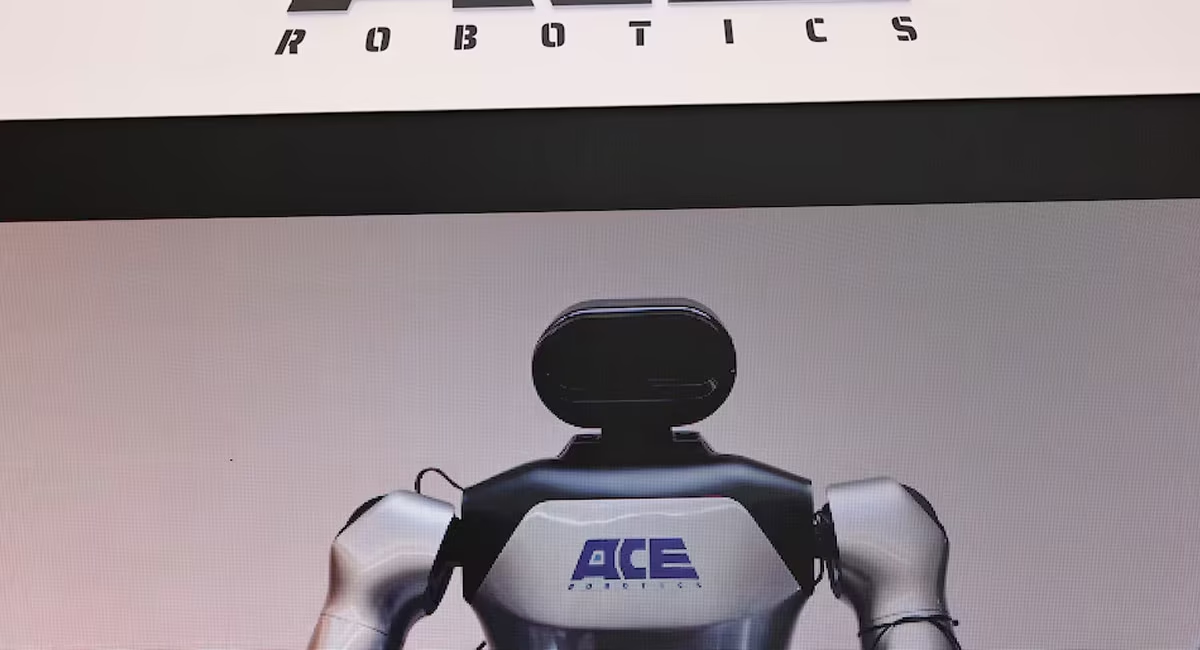

Humanoid robots could reach a major technological turning point by late 2027, according to ACE Robotics chairman Wang Xiaogang. He compared the expected development to the impact ChatGPT had on artificial intelligence. However, widespread commercial use could still take several years after that breakthrough.
“We expect to reach the ‘ChatGPT moment’ for embodied intelligence by the end of next year, driven by world models and environmental data capture,” Wang Xiaogang told Reuters.
“Even if we reach that inflection point by late 2027, it will likely take another four to five years to see broad commercial implementation of embodied world models across sectors,” said Wang, who is also a co-founder of Chinese AI visual recognition pioneer SenseTime.
Humanoid Robot Intelligence Faces Major Challenges
Large language models such as ChatGPT and DeepSeek have already entered workplaces and homes worldwide. However, robots still struggle to perform many tasks independently in unfamiliar environments.
Embodied AI models aim to bridge that gap. These systems help robots understand physical surroundings and respond to changing conditions in real time.
Unlike language models, embodied AI must connect perception with physical movement. Robots therefore need to understand their surroundings, plan actions and complete tasks safely.
Meanwhile, China’s growing humanoid robot industry is attracting significant investor interest. Investors are increasingly looking beyond demonstrations such as dancing and athletics.
Instead, companies must show how their robots can perform useful commercial tasks. Real-world deployment is becoming increasingly important for proving their economic potential.
ACE Robotics Expands Its AI Development
ACE Robotics was founded in July 2025 and has received backing from Ant Group and SenseTime. The company raised more than $100 million during the first half of this year.
Wang said the company plans to pursue an initial public offering “as early as permitted”. However, Chinese listing rules generally require companies to operate for at least three fiscal years.
ACE’s open-source Kairos-4B model has also gained attention through public benchmarks. The model reportedly ranks ahead of larger world models, including Nvidia’s Cosmos 3 and Ant Group’s Lingbot.
The model uses four billion parameters. Despite its relatively small size, it combines several capabilities needed for robotic intelligence.
These include perception, multimodal understanding, physical simulation and action planning. It can also produce long-term video and action predictions across multi-minute sequences.
Robot Training Data Remains a Bottleneck
Access to high-quality real-world training data remains one of the industry’s biggest challenges.
“Over the past few years, the entire industry has accumulated data of roughly 100,000 hours, which is far from enough to train embodied foundation models,” said ACE’s Wang.
ACE is therefore expanding its data collection efforts. The company uses people working on real production lines who wear lightweight sensors.
“The collection efficiency is extremely high … We expect to accumulate tens of millions of hours of data within two years,” Wang added.
Other companies are also developing methods to collect training data. Many use physical tele-operation, where workers wear exoskeletons and controllers.
Workers then repeat physical movements hundreds of times daily. These demonstrations provide robots with data for learning real-world tasks.
Humanoid Robots Move Into Commercial Settings
ACE is already testing its embodied AI models in several commercial environments. These include unmanned retail stores, hotels and instant-delivery warehouses.
The company is working with humanoid robots produced by Chinese manufacturers. These include Unitree, AgiBot and Fourier.
“We plan to deploy in at least 1,000 stores over the coming year, scaling to 10,000 stores in two years,” said Wang.
Such deployments could provide valuable real-world data while also testing the commercial usefulness of humanoid robots.
ACE is also using AI chips from Nvidia and Chinese manufacturers such as Rhino Tech and Digua Robotics.
“This diversifies our supply chain, because in the future, we will definitely need comprehensive intelligent hardware solutions, and their costs need to be significantly reduced,” said Wang.
The company’s plans highlight the rapid development of China’s humanoid robotics sector. However, turning promising AI models into reliable commercial robots will require more training data, lower hardware costs and broader real-world testing.
If ACE’s prediction proves accurate, the next major breakthrough in AI could move beyond screens and into the physical world by 2027. Still, widespread adoption may take several more years.

