
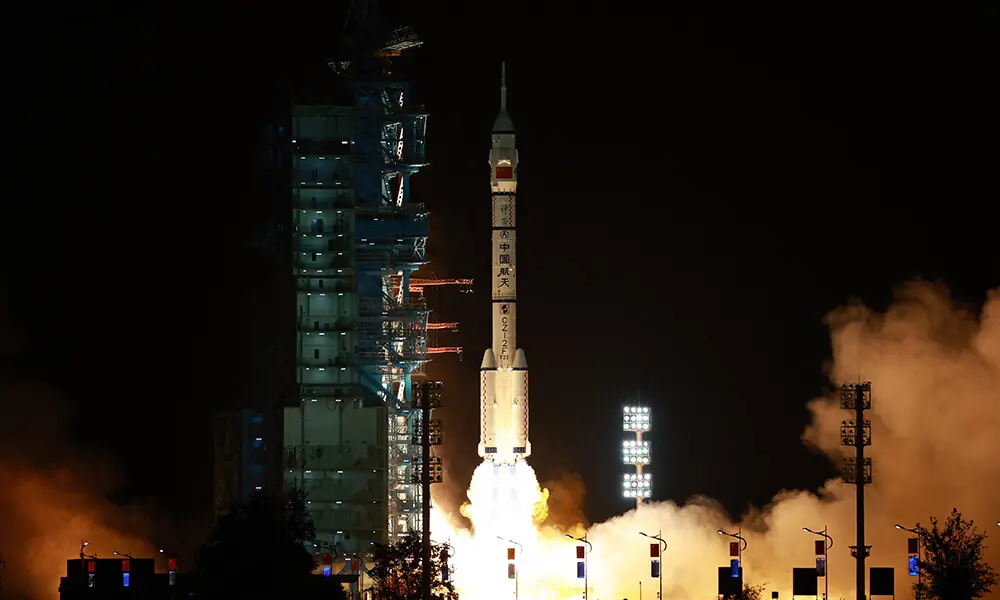

Mission Sends Crew Into Orbit for Scientific Research and Historic Milestone
China launched its Shenzhou-23 space mission on Sunday, taking another step in its long-term plan to expand human space exploration and support future lunar ambitions.
The Long March 2-F rocket lifted off from the Jiuquan Satellite Launch Center in the Gobi Desert at 11:08pm local time, carrying the crew into space aboard the Shenzhou-23 spacecraft.
According to Chinese authorities, the spacecraft separated successfully from the rocket approximately ten minutes after launch and entered its planned orbit.
Officials confirmed that all crew members remained in good condition and described the launch as successful.
Meanwhile, the mission also marked a historic achievement as it included the first astronaut from Hong Kong to participate in a spaceflight mission.
The crew includes Li Jiaying, a former police officer, along with Zhu Yangzhu and Zhang Zhiyuan.
Additionally, the astronauts will conduct scientific experiments involving life sciences, medicine, materials research, and fluid physics.
Year-Long Space Experiment Supports Future Moon and Deep Space Plans
A key objective of the mission involves a planned year-long stay in orbit by one crew member to examine the effects of extended exposure to microgravity.
Researchers aim to study issues including muscle loss, bone density changes, radiation exposure, and long-term health effects during prolonged missions.
Furthermore, the mission forms part of China’s broader preparation for future lunar and deep-space exploration programs.
China also plans to test its new Mengzhou spacecraft in 2026 as it advances efforts to place astronauts on the Moon before 2030.
Meanwhile, authorities also announced plans to host Pakistan’s first astronaut aboard the Tiangong space station in the future.

