
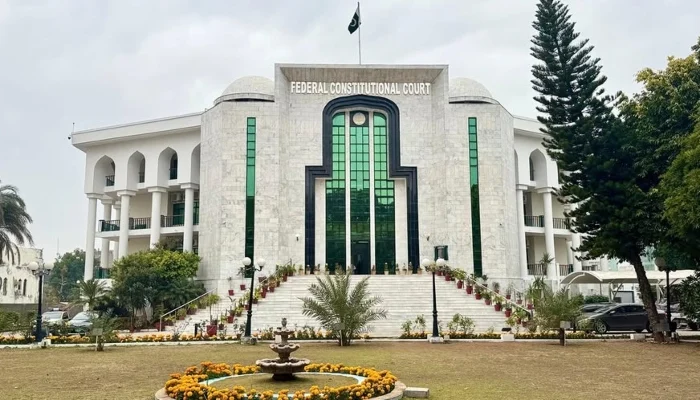

Pakistan’s Federal Constitutional Court (FCC) has clarified that outsourced employees cannot demand permanent jobs simply because they have served an organisation for several years.
The court ruled that regularisation must have a clear legal foundation. An applicable law, policy, rule or regulation must support the claim.
The 18-page majority judgment, authored by Justice Aamer Farooq, came in a case involving a dispenser working at the State Bank of Pakistan Banking Services Corporation (State Bank BSC).
How the Employment Dispute Reached the FCC
State Bank BSC hired Prime Human Resource Services (Private) Limited in December 2014 to provide staff on contractual terms.
The company assigned a dispenser to work at the bank’s premises. However, the contractor ended his services on November 13, 2017.
The worker challenged his termination before the National Industrial Relations Commission (NIRC). In May 2022, the commission ordered his reinstatement and regularisation as a permanent employee.
The State Bank and the contractor challenged that decision. However, the Sindh High Court also rejected their petitions.
The dispute eventually reached the FCC, which decided the appeals by a 2-1 majority.
Why the Court Rejected Automatic Regularisation
The majority held that the contractor was the dispenser’s actual employer. The company had provided his services, paid his salary and issued his termination letter.
Therefore, the State Bank could not be directed to make him a permanent employee without a supporting legal provision.
The court also examined the Industrial and Commercial Employment (Standing Orders) Ordinance, 1968.
Its provisions define a permanent workman with reference to work expected to continue for at least nine months and completion of the required probation period.
However, the majority clarified that completing nine months does not automatically create a right to permanent employment.
It added that regularisation requires specific support under applicable laws or employment policies.
One Judge Raises Concerns Over Workers’ Rights
Justice Syed Arshad Hussain Shah disagreed with the majority and issued a dissenting opinion.
He argued that courts should examine the actual working relationship instead of relying only on contractual arrangements.
He highlighted that bank doctors supervised the dispenser’s duties. The bank also provided medicines and equipment for its dispensary.
Justice Shah said these circumstances mattered when determining the organisation’s control and responsibility towards the worker.
He also referred to constitutional protections under Articles 3, 4 and 25. In his view, outsourcing arrangements should not weaken workers’ legal protections.
What the Decision Means for Contractual Employees
The ruling makes it harder for outsourced workers to secure permanent positions based solely on long service.
Employees may continue working at an organisation for years without automatically becoming its permanent staff. However, the judgment does not remove workers’ protections under applicable labour laws.
The decision also leaves an important distinction between contractual employment and regular government or organisational service.
For now, the FCC has set aside the earlier orders and dismissed the dispenser’s grievance petition. Its majority ruling makes legal provisions, rather than service duration alone, central to future regularisation claims.
For the latest updates, visit and follow The Truth International website (www.thetruthinternational.com) and subscribe to the YouTube Channel.

