
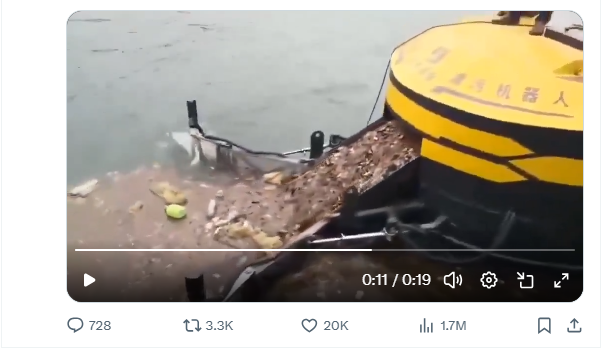

China has developed a new autonomous robot designed to clean pollution from rivers, lakes, and reservoirs, and its performance has quickly gone viral on social media. A widely shared video posted by an influencer shows the machine collecting large amounts of floating waste and micro-pollutants from the water surface, drawing global attention to its capabilities.
Advanced Cleanup Technology in Action
According to reports, the robot operates independently and targets plastic waste and other pollutants in freshwater bodies. It moves across the water surface and collects debris continuously, demonstrating an efficient approach to environmental cleanup. Moreover, the viral footage shows the machine absorbing and storing large quantities of pollution particles without interruption, which impressed viewers online.
🇨🇳 China has developed a robot designed to autonomously clean pollution in rivers, lakes, and reservoirs. pic.twitter.com/xsHpFiZcx7
— Jackson Hinkle 🇺🇸 (@jacksonhinkle) May 24, 2026
As a result, social media users described the technology as a practical solution for reducing plastic contamination in aquatic ecosystems. In addition, many highlighted how automation could help address long-standing challenges in water pollution management, especially in densely populated regions where waste accumulation increases rapidly. However, experts also emphasize that large-scale deployment and real-world testing will determine its long-term effectiveness.
Growing Interest in Environmental Robotics
Meanwhile, the video has sparked wider discussion about the role of robotics in environmental protection. Supporters argue that such innovations could complement traditional cleanup methods and reduce manual labor risks. Furthermore, they believe automated systems may improve efficiency in monitoring and cleaning hard-to-reach water bodies.
On the other hand, some analysts caution that no single technology can fully solve global plastic pollution without stronger waste management policies and public awareness. Nevertheless, the development marks another step toward integrating artificial intelligence and robotics into environmental conservation efforts.

