
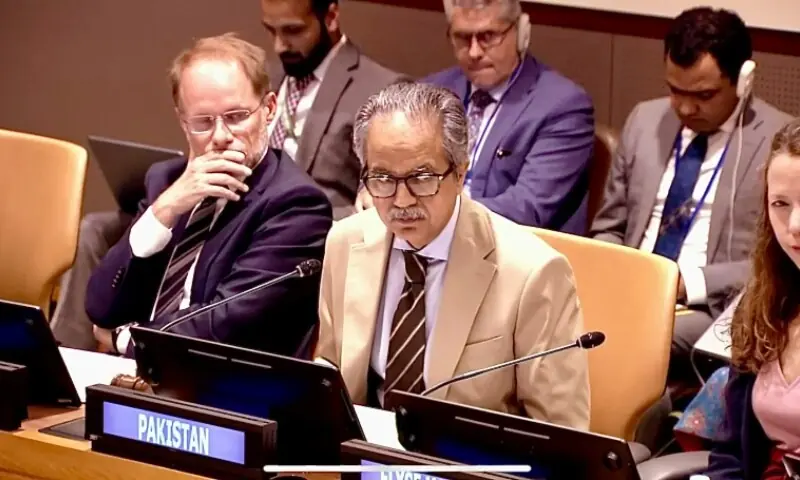

Pakistan has told the UN Security Council that it will defend itself against terrorist threats linked to Afghanistan when necessary. Ambassador Asim Iftikhar Ahmad said any response would follow international law.
The warning came during a Security Council meeting on Afghanistan. The session reviewed conditions in the country five years after the Taliban returned to power.
Pakistan Raises Terrorism Concerns
Ahmad said Pakistan had lost more than 4,700 citizens to terrorism emanating from Afghanistan over the past three years. He also accused Kabul of failing to take concrete and verifiable steps against militant groups operating from Afghan territory.
“Pakistan cannot sit idle in the face of this terrorist onslaught,” Ahmad told the council. “We will respond in self-defence, as and when needed and in accordance with international law.”
He also warned that groups including the banned Tehreek-i-Taliban Pakistan, Baloch Liberation Army, Islamic State-Khorasan and East Turkestan Islamic Movement remain active.
The latest UN report says terrorist groups continue to operate in Afghanistan. It also highlights restrictions on women and girls, economic pressures and weaknesses in basic services.
Pakistan Highlights Humanitarian Support
Ahmad said Pakistan had continued supporting Afghanistan despite concerns over Taliban policies. He pointed to humanitarian assistance, regional cooperation and continued access for aid shipments.
According to his statement, at least 687 humanitarian cargo trucks entered Afghanistan from Pakistan during the reporting period.
However, he said international hopes following the Taliban takeover had gradually turned into disappointment. He also described terrorism as being at the “core of Afghanistan’s problems.”
US Calls for Action Against Taliban
The United States also criticised the Taliban during the meeting. Ambassador Mike Waltz focused on detained American citizens, terrorism and restrictions on women and girls.
He urged the Security Council to demand the release of US citizens held by the Taliban. Waltz also cited UN reporting concerning arbitrary detention, torture, mistreatment and extrajudicial killings.
He further highlighted the continuing restrictions on girls’ education beyond sixth grade and limits on Afghan women working for the United Nations.
Russia and China Support Engagement
Russia presented a different approach, arguing that engagement with Afghanistan remained necessary. Ambassador Vassily Nebenzia called for pragmatic dialogue rather than pressure.
China also backed continued engagement while acknowledging concerns over restrictions affecting women and girls. Beijing urged Afghan authorities to protect the rights of all Afghans.
The meeting therefore exposed differing views within the Security Council over Afghanistan’s future. Pakistan focused on cross-border terrorism and security, while Russia and China stressed continued engagement.
For the latest updates, visit and follow The Truth International website (www.thetruthinternational.com) and subscribe to the YouTube Channel.

