
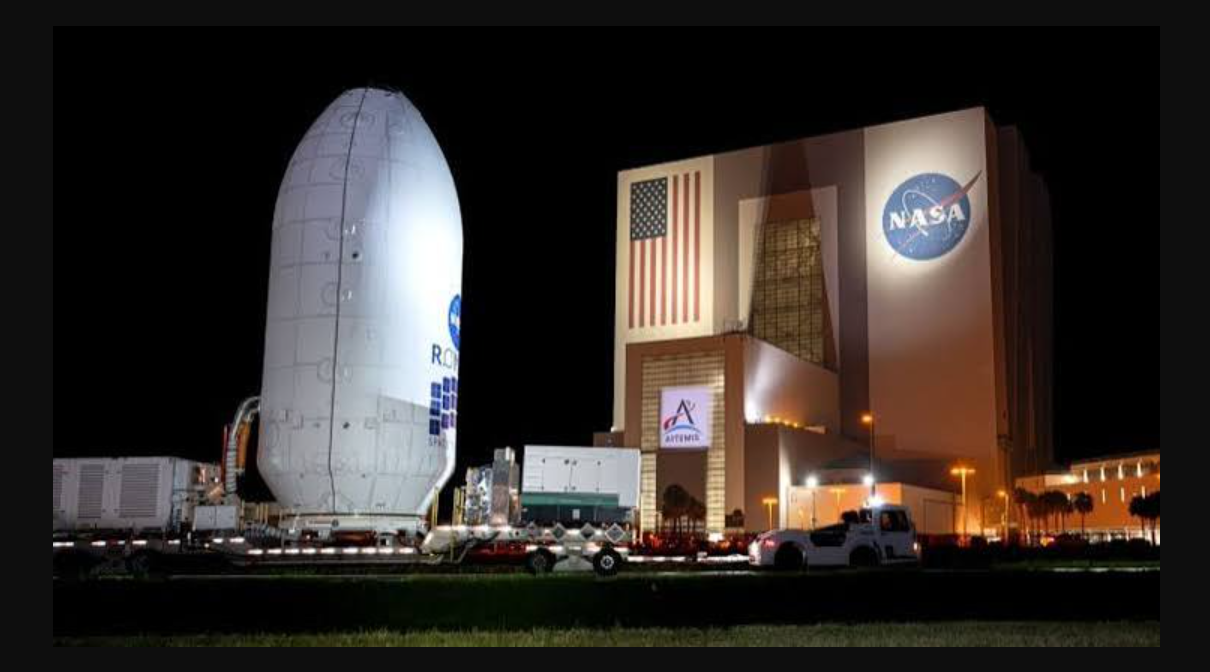

NASA’s new flagship astronomical observatory has begun its journey into space from Florida on a mission of cosmic discovery.
The Nancy Grace Roman Space Telescope launched aboard a SpaceX Heavy rocket from NASA’s Kennedy Space Center on Sunday.
The roughly $4 billion telescope will investigate some of the biggest unanswered questions in astrophysics and cosmology.
Among its key targets are dark energy, dark matter, gravity and planets beyond our solar system. The launch came despite earlier concerns about weather conditions around Florida.
However, the rocket lifted off successfully through blue skies and scattered clouds, carrying Roman toward its destination.
Roman Begins Journey Toward Deep Space
Following its launch, Roman will travel toward an orbital location known as Lagrange Point 2. The location sits about one million miles, or 1.6 million kilometres, from Earth.
NASA has planned Roman’s primary mission to last five years after reaching its operational location. However, the agency said the telescope could have enough fuel to continue working for another five years.
Therefore, Roman could potentially spend a decade gathering observations about the universe and its evolution. The telescope will build on the capabilities of earlier space observatories, including Hubble and James Webb.
Hubble launched in 1990, while the James Webb Space Telescope began its mission in 2021. Roman, however, has been designed to survey enormous portions of the sky much faster.
A Telescope Designed to See the Universe Differently
NASA scientists describe Roman as an observatory that will provide an exceptionally broad view of the cosmos. Nicola Fox, chief of NASA’s Science Mission Directorate, compared Roman with Hubble and Webb.
“It will be as if Hubble and James Webb kind of peered through a keyhole at the universe, while Nancy Grace Roman will kick the door down,” Fox said.
The comparison reflects Roman’s ability to survey wide areas rather than focusing primarily on narrow regions. Julie McEnery, Roman’s senior project scientist at NASA’s Goddard Space Flight Center, highlighted another major advantage.
“Roman has broadly the same sensitivity and sharpness of vision as Hubble, but we survey the sky much faster,” McEnery said.
According to McEnery, Roman could survey the entire Milky Way in only one month.
“One month of observations to survey our Milky Way galaxy would take about a century with Hubble,” McEnery said. Consequently, Roman could transform how scientists study large-scale structures throughout our home galaxy.
Wide-Angle Vision to Complement James Webb
Roman’s role will complement the capabilities of the James Webb Space Telescope rather than simply replace them. Webb has already transformed understanding of the early universe through its ability to examine distant objects.
Its observations have shown that primordial galaxies formed earlier and were larger than scientists previously understood. Webb can look across enormous distances because light takes time to travel from distant objects.
Roman will approach the universe differently by producing broad, panoramic views across large areas. NASA compares Roman to a camera’s wide-angle lens, while Webb functions more like a zoom lens.
“Webb is designed to be able to probe very deeply and with exquisite sensitivity into the universe, so we can find rare things in the early universe,” McEnery said.
She added that Roman would provide “the large vision that complements the deep views that Webb provides.” Together, the observatories can offer scientists different perspectives on distant galaxies and cosmic structures.
Roman Will Map More Than Two Billion Galaxies
One of Roman’s most ambitious goals involves understanding dark energy and dark matter.
The telescope will create what NASA describes as the most comprehensive three-dimensional map of the universe to date. Its main survey will take more than a year to complete and cover more than two billion galaxies.
That enormous survey could provide scientists with an unprecedented amount of information about cosmic structures. Scientists hope those observations will help explain how the universe has changed throughout its history.
The universe began with the Big Bang roughly 13.8 billion years ago and has expanded ever since. However, scientists discovered in 1998 that this expansion was accelerating.
They proposed an invisible force known as dark energy as the reason behind the accelerating expansion.
Roman will therefore examine how dark energy influences the universe across enormous distances.
At the same time, it will investigate how dark matter shapes galaxies and other cosmic structures.
Dark Matter and Dark Energy Remain Cosmic Mysteries
The universe contains ordinary matter, dark matter and dark energy, although scientists understand them very differently. Ordinary matter includes stars, planets, gas, dust and the familiar material found on Earth.
Scientists estimate that ordinary matter accounts for roughly five percent of the universe. Dark matter may account for around 27 percent, while dark energy may represent approximately 68 percent.
Unlike ordinary matter, dark matter cannot be observed directly through conventional methods.
Scientists instead detect its presence through its gravitational influence on galaxies and stars. Dark energy presents an even deeper mystery because scientists associate it with the accelerating expansion of the universe.
Roman will measure dark matter’s gravitational pull and dark energy’s influence across the cosmos. As a result, researchers hope the telescope will bring them closer to explaining both mysterious components.
Thousands of Exoplanets Could Be Discovered
Roman will also undertake one of the most comprehensive searches ever conducted for exoplanets. Exoplanets are planets that exist beyond our solar system and orbit other stars.
The telescope is expected to discover thousands of new exoplanets during its mission. Furthermore, Roman could provide the first statistical census of planetary systems resembling our own.
That information could help scientists understand how planetary systems form and how frequently different types occur.
The telescope’s wide field of view makes it particularly suited to searching large areas for these distant worlds. Its discoveries could also reveal unexpected planetary systems that scientists have not previously considered.
Discovery Potential Could Bring Unexpected Results
Roman’s scientific mission includes carefully planned surveys, but its greatest discoveries may not be fully predictable.
Cosmologist Mustapha Ishak described the telescope’s discovery potential as one of its most exciting features.
“One of the most exciting aspects of Roman is its discovery potential. Historically, major astronomical observatories have often made their most important breakthroughs in areas that scientists did not anticipate before launch,” Ishak said.
That possibility reflects the history of major astronomical observatories, which have frequently produced unexpected findings.
Roman’s broad surveys could therefore reveal phenomena that researchers have not specifically targeted. Its enormous field of view may allow scientists to identify patterns that smaller observations cannot easily capture.
Launch Comes After Funding Battles
Roman’s journey into space also follows years of political debate over its funding. President Donald Trump’s administration sought to reduce or eliminate funding for the telescope during both terms.
However, Congress preserved funding for the project and allowed its development to continue. NASA said Roman’s launch occurred nine months ahead of schedule.
The successful launch now moves the project into its next phase as the telescope travels toward Lagrange Point 2.
Once operational, Roman will begin surveying the universe with a mission focused on scale, speed and discovery.
Its observations could provide new clues about dark energy, dark matter, exoplanets and the evolution of the cosmos.
For scientists, the telescope represents another major step toward understanding a universe that still holds enormous unanswered questions.

