
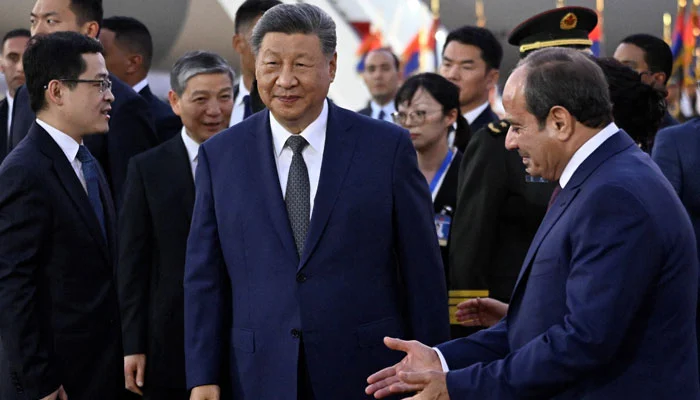

Chinese President Xi Jinping has urged Middle Eastern countries to resist external interference and consider reshaping the region’s security order during his visit to Egypt.
Xi arrived in Cairo on Wednesday for his first Middle East trip in four years as the US war against Iran continues to reshape regional alliances.
The conflict has disrupted trade and economies while prompting US partners to reconsider their long-term strategic relationships with Washington.
Egypt, a major US defence partner receiving about $1.3 billion in annual military aid, has also expanded economic and military cooperation with China.
China seeks stronger regional role
Egyptian President Abdel Fattah al-Sisi welcomed Xi with a military ceremony in Cairo.
According to China’s state news agency Xinhua, Xi said regional countries should become “masters of their own destiny” and explore a new security architecture.
He also said China was ready to cooperate with regional nations to protect shipping routes affected by disruptions around the Strait of Hormuz and Bab al-Mandeb.
The two countries agreed to strengthen security and counterterrorism cooperation. They also agreed to expand collaboration in data centres, semiconductors and critical minerals.
Additionally, Beijing and Cairo agreed to increase the use of their currencies in trade and investment.
Egypt deepens economic ties with China
For Egypt, stronger relations with China form part of a broader strategy to diversify its international partnerships.
Sisi described the approach as “strategic balance” amid increasing global competition.
China views Egypt as an important partner because of its large consumer market, regional diplomatic influence and strategic position connecting Asia, Africa and Europe.
Military cooperation has also expanded. Last month, Egypt and China conducted “Eagles of Civilization” exercises involving Chinese J-16 fighter jets and French-made Rafale aircraft.
Meanwhile, economic ties continue to grow rapidly.
Egypt imported about $10 billion worth of Chinese goods during the first half of this year. Chinese companies have also invested billions in ports, green hydrogen, industrial facilities and satellite production.
Egyptian authorities said the Suez Canal Economic Zone has attracted around $4 billion in Chinese investment.
Egypt announced plans to expand a Chinese-developed industrial area in the zone and ZC Rubber Group signed an agreement to study a $500 million tyre manufacturing complex.

