
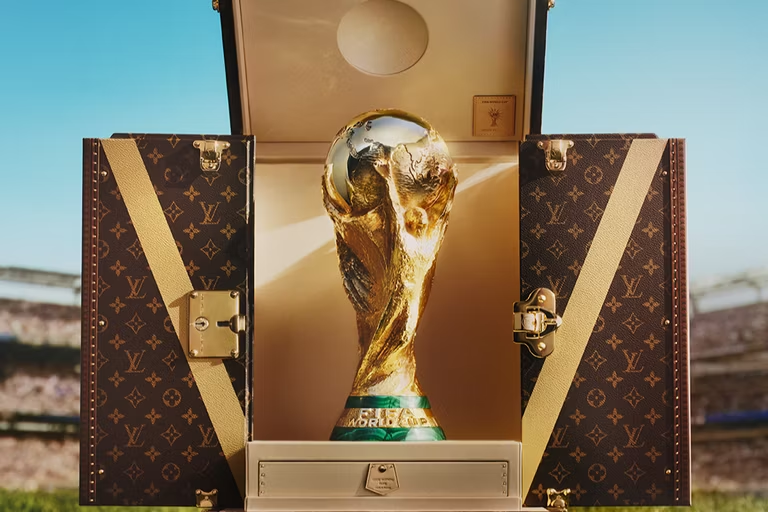

Spain and Argentina will compete for football’s biggest prize in the 2026 FIFA World Cup final. However, the championship match carries another major reward. It will also decide how the largest financial payout in World Cup history is distributed.
FIFA has announced a record financial package worth $871 million for the 48 national associations that qualified for the tournament in the United States, Canada, and Mexico.
The distribution includes performance-based prize money, preparation payments, and additional financial support for participating teams.
As a result, the final is not only about lifting the famous trophy. It also represents a multi-million-dollar financial opportunity for the winning federation.
Winning the Final Comes With a $50 Million Reward
The world champions will receive $50 million in prize money. Meanwhile, the runners-up will collect $33 million.
Therefore, the difference between winning and losing Sunday’s final amounts to $17 million.
The payments will be made directly to the Royal Spanish Football Federation or the Argentine Football Association, depending on the outcome.
However, individual players will not automatically receive equal shares of the prize money. Instead, player bonuses depend on separate agreements negotiated with their respective football federations.
Neither federation has publicly disclosed the complete bonus structure for its players.
FIFA Increases Overall Financial Distribution
FIFA originally announced a financial package worth $727 million in December 2025.
That package included $655 million in performance-related prize money. It also represented a 50 percent increase compared with the prize money awarded during the 2022 FIFA World Cup in Qatar.
Later, FIFA expanded the financial package after the commercial success of the enlarged 48-team tournament.
Consequently, the total amount available for participating associations increased to $871 million.
Participating Teams Receive Higher Guaranteed Payments
FIFA also increased financial support for every team participating in the tournament. Preparation funding for each national association rose from $1.5 million to $2.5 million.
Similarly, the guaranteed payment for qualifying increased from $9 million to $10 million. In addition, FIFA allocated more than $16 million in extra contributions.
These funds cover delegation expenses and increased ticket allocations for participating teams.
Every Knockout Stage Brings Higher Earnings
Prize money rises with every stage of the tournament. Teams finishing between 33rd and 48th receive $10 million under the revised payment structure. Those reaching the Round of 32 earn $11 million.
Round of 16 participants receive $15 million, while quarter-finalists collect $19 million. The fourth-placed team earns $27 million. Meanwhile, the third-placed nation receives $29 million.
As a result, reaching the final guarantees Spain and Argentina substantially larger financial rewards than teams eliminated in earlier rounds.
Clubs Also Benefit Financially
The World Cup also generates financial benefits for football clubs. FIFA operates a Club Benefits Program that compensates clubs for releasing players to their national teams. Payments depend partly on the number of days players spend at the tournament.
For the 2026 FIFA World Cup, FIFA increased funding for this programme to a record $355 million. By comparison, approximately $209 million was distributed through the same programme during the 2022 tournament.
Consequently, clubs from Spain, Argentina, and several other countries will also receive financial compensation for their players’ participation.
World Cup Success Brings Long-Term Commercial Value
Winning the FIFA World Cup delivers benefits beyond prize money. A successful campaign can strengthen a national federation’s commercial profile.
Moreover, it can increase sponsorship opportunities, merchandise sales, and overall global recognition.
For Argentina, victory would secure a second consecutive World Cup title and further enhance the commercial appeal of a team led by Lionel Messi.
Meanwhile, Spain would celebrate its first World Cup triumph since 2010. Such a victory could also boost the international profile of its emerging generation led by Lamine Yamal.
With history, prestige, and record prize money on the line, Sunday’s final promises to be one of the most significant matches of the 2026 FIFA World Cup.

