
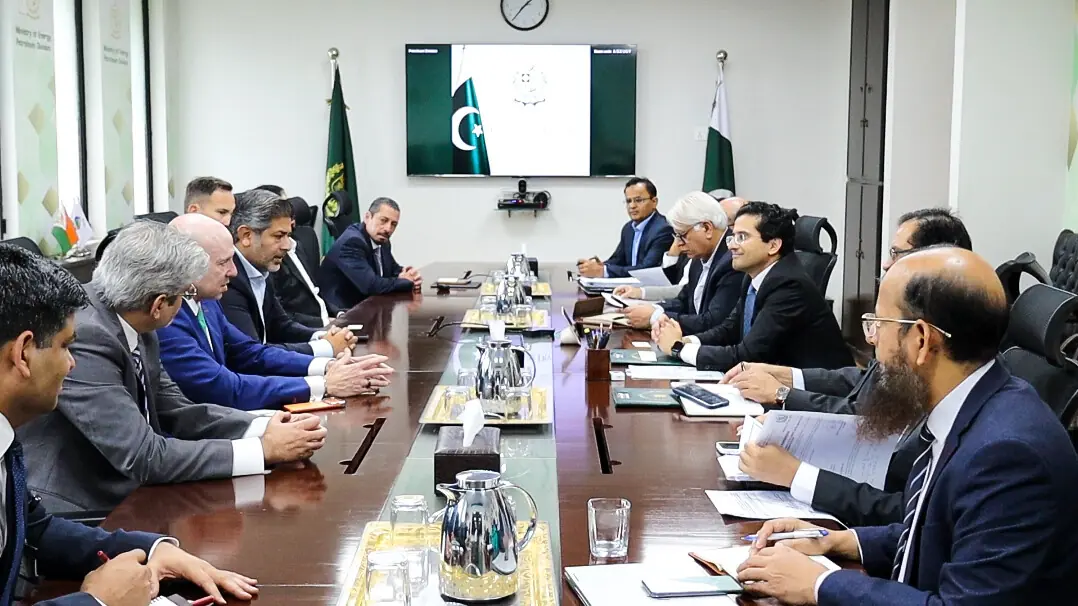

Pakistan’s energy sector has attracted fresh international attention after senior government officials held discussions with leading global energy companies on investment opportunities. The talks focused on expanding cooperation in critical minerals, oil and gas exploration, petroleum infrastructure, and long-term energy development.
Federal Minister for Petroleum Ali Pervaiz Malik met separately with representatives of major international firms to explore new investment prospects. The discussions highlighted Pakistan’s efforts to strengthen energy security while encouraging responsible foreign investment in key sectors of the economy.
US Energy Firm Explores Balochistan’s Critical Minerals Potential
During one meeting, Ali Pervaiz Malik held discussions with Gregory Bloom, President of Morgan Hughes Energy, a US-based energy company, and Ahmad Waleed, Chief Executive Officer of Tejara Capital. The meeting focused on expanding US investment in Pakistan’s energy sector, particularly in critical minerals and hydrocarbon development.
Bloom highlighted Balochistan’s significant potential for critical minerals development. He explained that Morgan Hughes Energy and Tejara Capital are working together to pursue minerals projects in the province. In addition, the companies are exploring opportunities in Pakistan’s oil and gas sector, with particular interest in field optimisation to increase production from existing energy assets.
The discussions reflected growing international interest in Pakistan’s untapped natural resources and their potential contribution to future economic growth.
Government Reaffirms Support for Foreign Investment
During the meeting, Petroleum Minister Ali Pervaiz Malik welcomed the companies’ interest in Pakistan’s energy sector. He reaffirmed the government’s commitment to increasing indigenous energy production while creating an investment-friendly environment for international partners.
The minister also emphasized that the government intends to facilitate responsible foreign investment through close coordination with relevant stakeholders. As Pakistan seeks to reduce reliance on imported energy, partnerships with international companies remain an important part of its long-term strategy.
Vitol Discusses Petroleum Projects and Gwadar Operations
In a separate meeting, the petroleum minister met with Kieran Gallagher, Chief Executive Officer of Vitol Asia, along with his delegation. Their discussions focused on ongoing cooperation in Pakistan’s petroleum sector and future investment opportunities.
Ali Pervaiz Malik congratulated Vitol on the successful commencement of bunkering operations at Gwadar. He also welcomed the company’s proposal to convert High Sulphur Fuel Oil (HSFO) into Very Light Sulphur Fuel Oil (VLSFO).
The minister assured the company of the government’s full support for the proposed project, which aims to strengthen Pakistan’s petroleum processing capabilities.
Bonded Storage Policy Opens New Investment Opportunities
The meeting also reviewed investment opportunities under Pakistan’s newly introduced bonded storage policy. The initiative forms part of the government’s broader strategy to modernize the country’s energy infrastructure and improve fuel logistics.
According to the discussions, Pakistan is currently engaging with leading international energy companies, including Vitol, regarding bonded storage infrastructure. These efforts aim to expand strategic fuel storage capacity while enhancing the country’s energy supply chain.
Furthermore, stronger storage facilities could improve operational efficiency and support future growth in the petroleum sector.
Pakistan Seeks Stronger Global Energy Partnerships
Both meetings reflected Pakistan’s continued efforts to strengthen cooperation with international energy companies. Government officials highlighted the importance of attracting foreign investment to support long-term economic growth and energy securitUS energy firms explore Balochistan minerals and Pakistan’s oil, gas sectors as investment talks advance with government officials together.
The discussions also demonstrated increasing interest in Pakistan’s natural resources, particularly Balochistan’s critical minerals and opportunities within the country’s existing oil and gas fields. At the same time, petroleum infrastructure projects, including bunkering operations and bonded storage facilities, remain key priorities for future investment.
As Pakistan continues expanding its international partnerships, the government aims to create new opportunities for sustainable energy development while improving domestic production and strengthening the country’s overall energy sector.

