
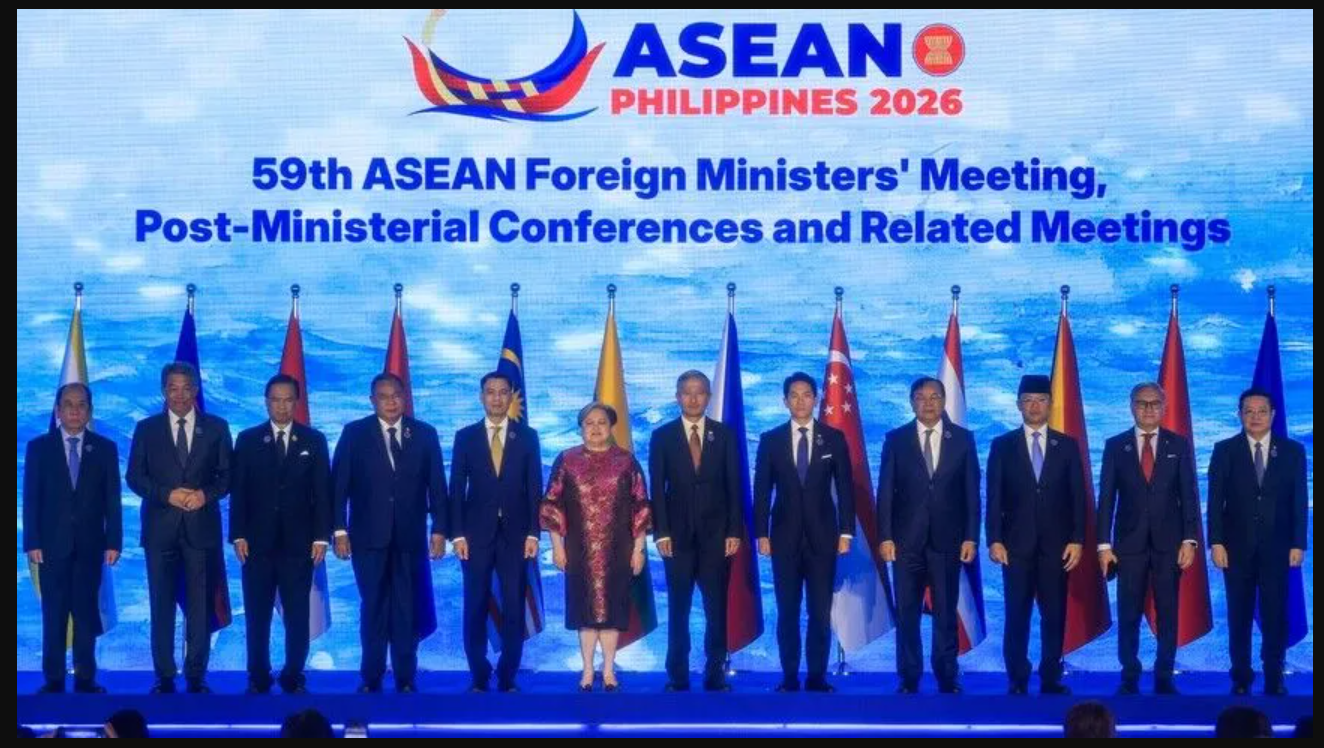

Foreign ministers from the Association of Southeast Asian Nations (ASEAN) opened their annual meeting in Manila on Tuesday. The high-level gathering comes at a time of growing geopolitical uncertainty, regional security concerns, and economic challenges.
During the opening session, Philippine Foreign Affairs Secretary Ma. Theresa P. Lazaro urged member states to strengthen cooperation and respond collectively to emerging regional and global issues. The meeting will continue until July 24 and will focus on security, economic resilience, and ASEAN’s long-term strategic goals.
ASEAN Calls for Unity During Uncertain Times
Opening the 59th ASEAN Foreign Ministers’ Meeting, Lazaro stressed the need for collective action as the region faces multiple challenges.
She said the current global environment is marked by “upheaval, uncertainty and unpredictability.” Therefore, she urged member countries to adopt “active, deliberate problem solving” when addressing difficult regional and international issues.
Lazaro also encouraged member states to pursue “creative solutions and viable pathways, even in the most difficult situations and during the most complex discussions.”
Referring to the Philippines’ 2026 ASEAN chairmanship theme, Navigating Our Future, Together, she stated, “We do not just drift with the tide; we steer the ship as we chart the course.”
Treaty of Amity and Cooperation Remains Regional Anchor
Lazaro described the Treaty of Amity and Cooperation (TAC), which marks its 50th anniversary this year, as ASEAN’s strongest foundation for regional stability.
She said the treaty continues to promote mutual respect for sovereignty, non-interference, and the peaceful settlement of disputes among member states.
Highlighting the importance of unity, she added, “In a fractured global landscape, no single nation can weather these storms alone. Our strength and resilience lie in our community.”
She further warned, “If we do not move forward as one, we risk being pulled apart.”
Ministers Review ASEAN’s Future Priorities
During the meeting, foreign ministers are expected to review progress across ASEAN’s political-security, economic, and socio-cultural pillars.
Their recommendations will later be presented to regional leaders during the ASEAN Summit scheduled for November.
In addition, discussions will focus on strengthening ASEAN centrality, advancing the ASEAN Community Vision 2045, and expanding cooperation with international partners.
Regional Security Issues Dominate Agenda
Security remains one of the main priorities of this year’s meeting.
Ministers are expected to discuss efforts to revive ASEAN’s peace initiative in Myanmar. They will also review ongoing negotiations with China regarding the proposed South China Sea code of conduct.
Furthermore, participants will examine the economic impact of conflicts beyond Southeast Asia, particularly disruptions affecting global energy supplies and international trade routes.
Dialogue Partners Join High-Level Meetings
The Manila meetings will also include sessions with ASEAN’s dialogue partners, the ASEAN Plus Three, the East Asia Summit, and the ASEAN Regional Forum.
Representatives from the United States, China, Russia, Japan, India, and the European Union are expected to participate in discussions on regional cooperation and shared security challenges.
As the meetings continue through July 24, ASEAN leaders aim to strengthen regional cooperation while addressing the evolving political, economic, and security landscape across Asia and beyond.

