
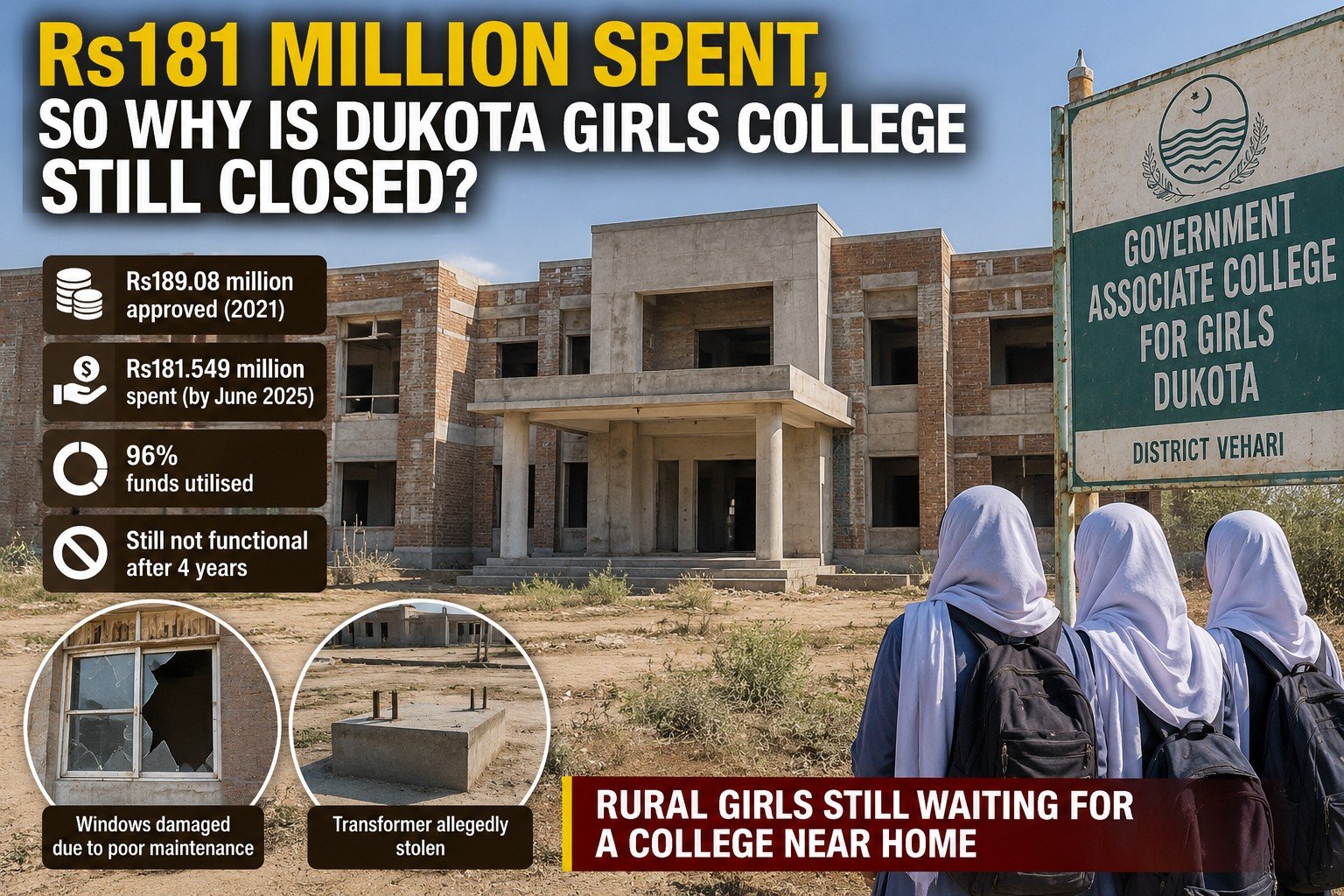

A government girls’ college project in Dukota has remained incomplete and non-functional nearly four years after its approval, despite millions of rupees being spent on its construction.
The Government Associate College for Girls, Dukota, was planned to provide higher education opportunities to female students in Dukota and surrounding rural areas of Mailsi.
The project was approved on July 27, 2021, with an initial estimated cost of Rs189.08 million.
Its foundation stone was laid on September 25, 2022.
However, the college has yet to become fully operational. The prolonged delay has left students in the area without the educational facility promised through the project.
Nearly 96% of Project Cost Already Spent
According to available government development records, Rs181.549 million had been spent on the college project by June 2025.
The amount represents nearly 96% of the approved project cost.
Despite the high level of expenditure, the college building has not been fully made available for academic activities.
The situation has raised questions about the project’s completion, monitoring and expenditure.
It has also raised concerns about why the facility remains non-functional after such a large portion of its approved budget has already been utilised.
Local residents say the delay is particularly concerning because the college was intended to address the shortage of higher education opportunities for girls in the area.
Building Faces Maintenance and Security Concerns
The prolonged delay has reportedly affected the partially completed facility.
Residents said some windowpanes had started breaking because of a lack of proper maintenance.
A transformer installed to provide electricity to the college was also allegedly stolen some time ago.
The reported theft has raised concerns about the protection and security of government property at the site.
If the transformer has to be replaced, additional public funds could be required before the college can begin regular academic activities.
The condition of the facility has further increased concerns among residents, who say the project should be completed and opened instead of remaining unused.
Students Forced to Travel Long Distances
Residents say the absence of a functional girls’ college has created serious difficulties for students seeking education after matriculation.
Families in Dukota and nearby villages often have to send their daughters to colleges in other towns.
Long journeys, transportation expenses and social concerns surrounding daily travel can make higher education difficult for female students.
Several local residents, including Muhammad Irfan Akram, Muhammad Bashir, Akbar Ali, Muhammad Ilyas and Muhammad Usman, said educational opportunities for girls remain extremely limited in the area.
They said a functioning college in Dukota could allow more students to continue their education without travelling long distances.
For families with limited incomes, the difference could be significant.
Families Struggle With Education Costs
Mehr Mumtaz Ahmed Azad, a small farmer from Chak 145-WB, said his daughter is currently studying in matriculation and hopes to become a teacher.
He said she is a bright student and needs better educational opportunities to pursue her ambitions.
According to him, a functional college close to home would make it easier for his daughter and other local girls to continue their studies.
Muhammad Shahid, a daily-wage worker from the area, said his daughter is studying in first year and travels to Mailsi, around 20 kilometres away, for her education.
He said daily travel by passenger bus is difficult and places an additional financial burden on the family.
For low-income households, transportation costs can become a major obstacle to continuing education.
Parents Demand Completion of College
Muhammad Aslam Sheikh, a rickshaw driver and father of three daughters, said two of his daughters are studying at a girls’ degree college in Tibba Sultanpur.
His third daughter is currently studying at the matriculation level.
He said his family is trying to provide the girls with quality education despite limited financial resources.
According to him, opening the Dukota college would reduce both travel-related difficulties and education expenses for families in the surrounding areas.
The project was originally intended to bring higher education closer to rural communities.
However, years after its approval and after most of its allocated funding has reportedly been spent, the college remains unavailable to the students it was designed to serve.
Residents are now seeking completion of the remaining work, protection of government assets and the early opening of the institution.
For families in Dukota and nearby villages, the issue is not simply about a delayed construction project. It is about whether young women in the area will finally receive a realistic opportunity to pursue higher education close to home.

