
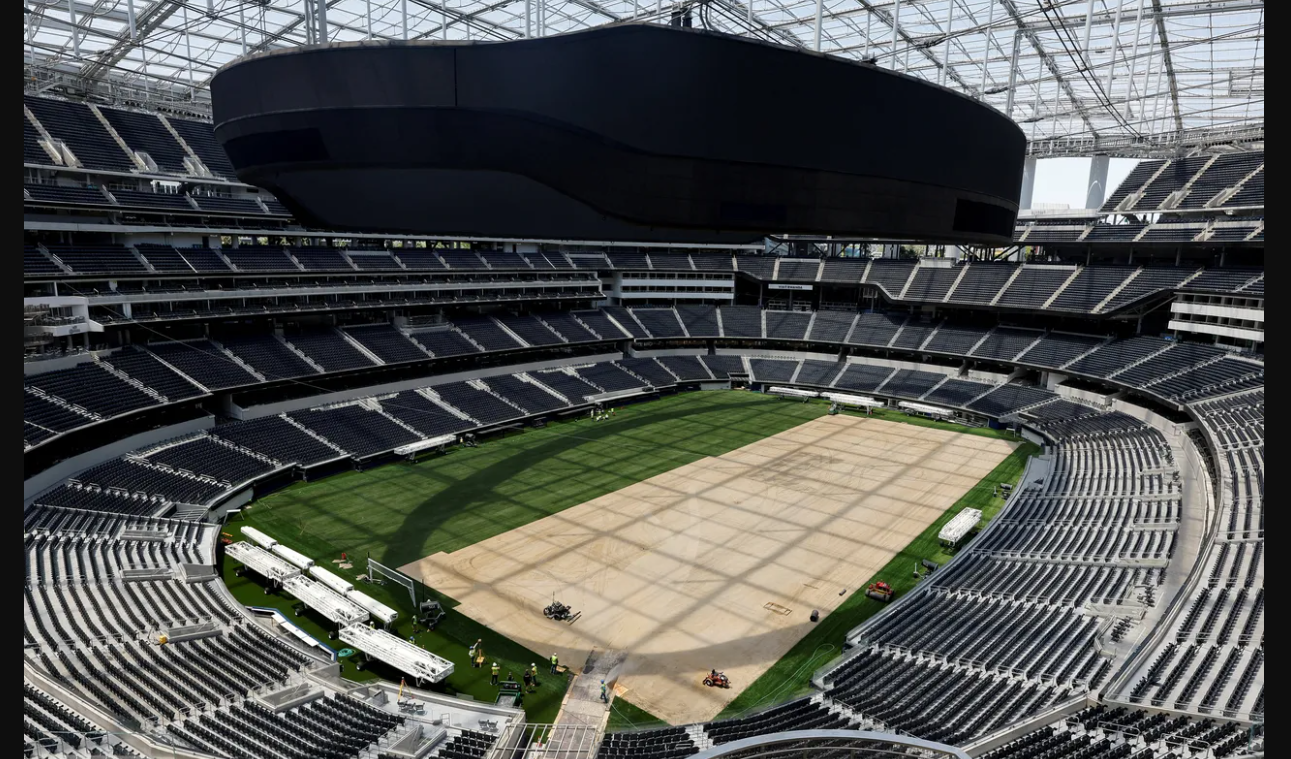

Thousands of stadium workers at SoFi Stadium have moved closer to a potential strike just days before the venue hosts its first FIFA World Cup match.
Members of UNITE HERE Local 11, a union representing more than 2,000 workers at the stadium, voted overwhelmingly to authorize strike action after contract negotiations failed to produce a new agreement.
The vote marks a significant development ahead of one of the biggest sporting events of the year, raising concerns about staffing and operations at a venue scheduled to host multiple World Cup matches.
Overwhelming Support for Strike Authorization
According to the union, workers approved the strike authorization by a decisive margin.
“SoFi Stadium cashiers, dishwashers, cooks, bartenders, concessions workers, and food attendants have voted 96 per cent in favour of authorising a strike, meaning workers could walk off the job at any moment if their demands are not met,” the union said in a press release.
The workers represented by the union perform many of the services required to operate the stadium during major events.
As a result, any work stoppage could create significant challenges for match-day operations.
Contract Talks Fail to Deliver New Agreement
The labor dispute has been developing for several months.
The previous agreement between the union and stadium operator Legends Global has already expired.
Despite several negotiation sessions, both sides have not yet reached a replacement contract.
However, discussions are expected to continue as officials attempt to avoid disruption before the opening matches.
“Negotiations are scheduled to continue on Monday ahead of the USA vs Paraguay match on June 12,” the union added.
If negotiators fail to reach an agreement, a committee of workers will decide when the strike should begin.
World Cup Matches Scheduled at SoFi Stadium
SoFi Stadium, which will be referred to as Los Angeles Stadium during the tournament, is one of the key venues selected for the FIFA World Cup 2026.
The stadium is expected to host eight matches during the competition.
Among them is the opening group-stage match for the United States Men’s National Team against Paraguay on June 12.
In addition, the venue will welcome group-stage fixtures involving Türkiye, Iran, Switzerland, Belgium, and other participating nations.
Because of its prominent role in the tournament, any labor disruption could attract significant international attention.
Union Raises Concerns Over Replacement Workers
The dispute also presents logistical concerns for tournament organizers.
FIFA requires background checks and security clearance for stadium personnel working during the competition.
Consequently, replacement workers brought in during a strike may not receive approval in time for scheduled matches.
This issue has become another point of concern as negotiations continue.
Workers Demand Restrictions on ICE Presence
Beyond contract negotiations, the union has also called for additional worker protections during the tournament.
Specifically, union leaders asked FIFA to ensure that agents from US Immigration and Customs Enforcement are not permitted inside World Cup venues.
The request stems from concerns among workers regarding safety and workplace security.
In its statement, the union said:
“Workers must have the right to walk off the job if federal immigration enforcement enters the stadium and creates a reasonable fear for their safety — no worker should have to choose between their job and their freedom.”
The demand has added another dimension to the ongoing labor dispute.
Pressure Mounts Ahead of Opening Match
With the United States set to begin its World Cup campaign at the venue, pressure is increasing on both sides to reach a resolution.
Organizers, workers, and stadium management now face a narrow window to settle outstanding issues before fans begin arriving in large numbers.
Meanwhile, the possibility of a strike continues to create uncertainty around preparations for one of the tournament’s most anticipated opening fixtures.
Conclusion
The threat of a strike at SoFi Stadium has emerged as a major concern ahead of the FIFA World Cup.
While negotiations remain ongoing, workers are demanding stronger protections, a new labor agreement, and guarantees regarding workplace safety before deciding their next steps.

