
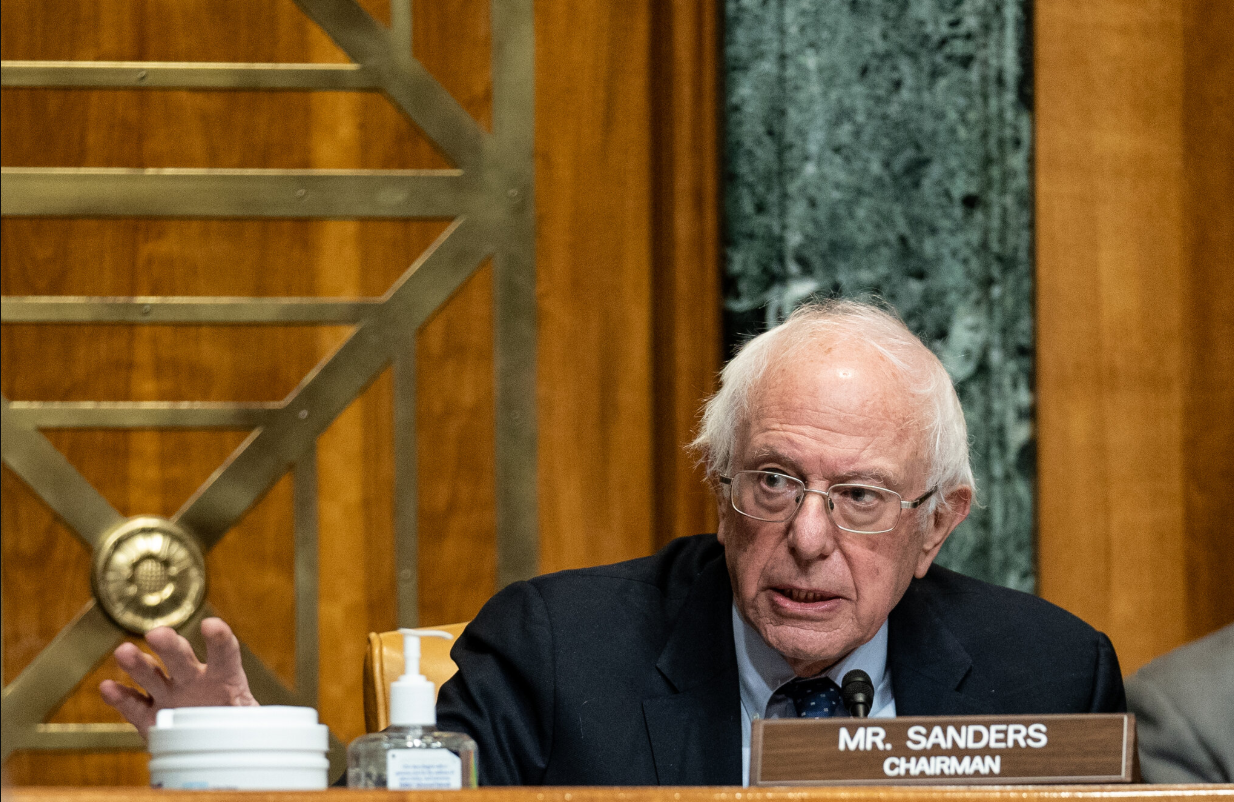

US Senator Bernie Sanders has announced that he will strongly oppose a provision in the National Defense Authorization Act that seeks deeper integration between US and Israeli defence industries.
He stated that the proposed measure represents an unprecedented level of military cooperation between the two countries.
Sanders argued that US policy should not continue supporting Israeli military operations through expanded defence funding and coordination.
“The United States should not be funding the Israeli military”
During remarks at the National Press Club in Washington, Sanders directly criticized US military assistance policies toward Israel.
“The United States should not be funding the Israeli military,” Sanders said.
His statement came as he outlined concerns over Section 224 of the defence bill, which proposes closer institutional coordination between US and Israeli defence systems.
He described the provision as a significant expansion of military-industrial cooperation between the two allies.
Concerns Over Section 224 of NDAA
The controversial section of the bill would require the US Secretary of Defense to appoint an “executive agent” responsible for synchronizing defence cooperation between the two countries.
This cooperation would include joint efforts in research, development, testing, evaluation, integration, and industrial defence projects.
Sanders warned that such a framework would deepen US involvement in Israeli military operations and decision-making structures.
He confirmed that he would actively work to block the provision during legislative proceedings.
“That is a provision which I will very strongly oppose,” he said.
Protests Interrupt Senate Remarks
Sanders’ address was briefly disrupted when at least two protesters interrupted his speech.
The protesters raised concerns about US policy toward Israel and the ongoing conflict in Gaza.
One protester accused the Israeli government of committing severe violations and questioned continued US support.
Sanders then continued his remarks, focusing on his long-standing position regarding US military aid to Israel.
During his speech, Sanders reiterated his criticism of the Gaza conflict and its humanitarian consequences.
“I hope most people in this room know — I led the effort in the United States Senate to end US military aid to Israel,” he said.
“I think what happened in Gaza is, in fact — and I say this reluctantly — genocide,” he added. “The suffering of the Palestinian people exists today.”
He further emphasized that his criticism was directed at broader policy decisions rather than a single administration.
“It’s not just the right-wing extremist racist government of Israel,” he said, “Our policy for the Middle East needs some fundamental changes.”
Gaza War Casualties and Ongoing Tensions
The Gaza conflict, which began in October 2023, has resulted in severe humanitarian consequences.
According to Palestinian figures, tens of thousands have been killed and injured, with women and children forming a significant portion of casualties.
Despite a ceasefire agreement that came into effect on October 10, 2025, reports indicate continued violence and periodic military strikes in the region.
Health authorities in Gaza report ongoing casualties from near-daily incidents following the ceasefire period.
Growing Debate Over US Foreign Policy
Sanders’ remarks reflect a broader political debate in the United States over military aid to Israel and defence cooperation agreements.
Supporters of the proposed NDAA provision argue it strengthens strategic alliances, while critics warn it deepens US involvement in foreign conflicts.
The issue has become increasingly contentious as humanitarian concerns and geopolitical tensions continue to rise.
Conclusion: Rising Political Pressure on Defence Policy
The proposed defence integration measure has intensified debate in Washington over the future of US–Israel military relations.
Sanders has positioned himself firmly against the provision, calling for a reassessment of US defence funding priorities.
The issue is expected to remain a major point of contention during ongoing discussions over the national defence bill.

