
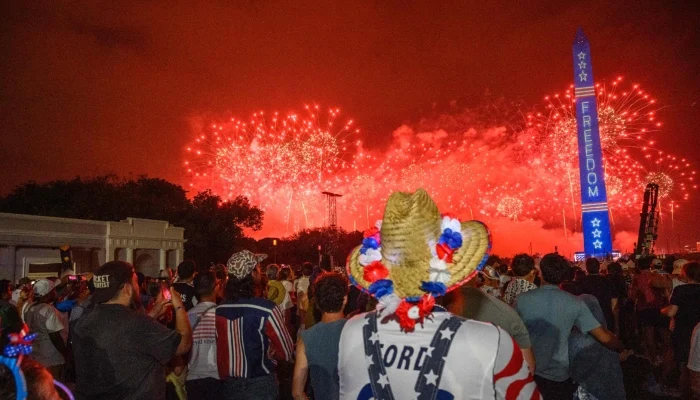

Washington was briefly the most polluted major city in the world after a massive Independence Day fireworks show. The Trump administration touted the grand spectacle as “awesome.”
Pyrotecnico, the company hired by the White House’s Freedom 250 organization, had set a clear goal. They wanted to break a world record by launching 850,000 fireworks. However, experts had warned that setting off so many explosives in just 40 minutes could pose serious health risks.
July 4 fell during a record-breaking heat wave. The extreme temperatures upended the parades, block parties, and traditional barbecues that mark America’s break from Britain.
Ultimately, the display of colorful explosives was delayed by over an hour due to a severe thunderstorm. The massive exhibition finally kicked off just before midnight, sending heavy smoke across the capital.
Pollution Monitors Record Unhealthy Spikes
Washington’s pollution monitors began registering spikes around 8 p.m. on Saturday. These initial numbers signaled various local fireworks displays across surrounding neighborhoods.
However, levels of fine particulate matter rose dramatically during the main show. The sudden accumulation left people watching downwind with an obscured view as thick smoke came billowing their way.
Fine particle pollution includes smoke and microscopic particles 2.5 micrometers in diameter. These small particles can penetrate deep into the lungs, causing acute injury and long-term disease.
This dangerous pollution peaked at over 200 micrograms per cubic meter at one monitoring site. The Environmental Protection Agency’s (EPA) 24-hour standard caps safe exposure at 35 micrograms per cubic meter.
Capital Region Blanketed by Code Purple Alerts
Because of the severe smoke accumulation, official environmental agencies issued emergency warnings. “Code Purple” alerts blanketed much of the city as well as the wider region.
These alerts denote air quality considered very unhealthy for everyone, not just at-risk groups. The dense smog layer expanded quickly into neighboring Virginia and Maryland.
According to data compiled by Swiss company IQAir, Washington became the world’s most polluted major city between 3 a.m. and 5 a.m. on Sunday, July 5. The city later dropped down to 41st position. Meanwhile, Jakarta, Kinshasa, and Addis Ababa occupied the first three spots on the global list.
Government Reaction and a Lucky Meteorological Break
When asked for comment regarding the air crisis, EPA press secretary Brigit Hirsch shared an optimistic view.
“Fireworks are awesome and we hope everyone enjoyed the incredible shows in and around our nation’s capital to celebrate 250 years of America.”
The EPA under Trump’s second term has frequently touted its deregulatory actions. Furthermore, the agency has consistently advocated on behalf of polluting industries.
Fortunately, heavy rain helped clear the lingering smoke by the next morning. Atmospheric conditions returned to normal by around noon on Sunday.
Scientists called the sudden weather shift a very lucky break for the local population. Russell Dickerson, an atmospheric scientist at the University of Maryland, evaluated the situation closely.
“We dodged a bullet. It was very bad, but it could have been substantially worse.”
Guinness World Records Reviews the Event
Ahead of the event, Pyrotecnico aimed to break the current world record for the largest firework display. The Philippines set the previous record on New Year’s Day 2016 with around 811,000 fireworks.
However, it was not immediately clear if the Washington event successfully achieved the milestone. A Guinness World Records spokesperson confirmed that the organization received an official application from the Washington event organizers.
“At this stage, we are not able to confirm whether the record has been achieved. We will only be able to do so once the evidence has been submitted and fully reviewed by our Records team.”

