
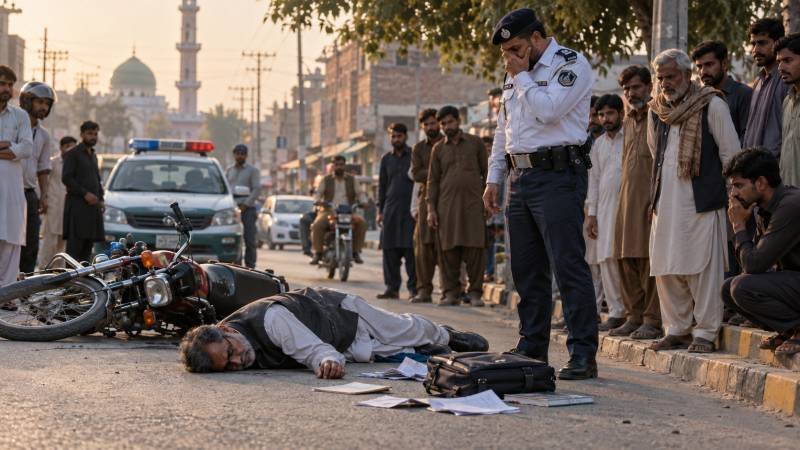

The death of schoolteacher Nawaz Bhatti in Karor Lal Esan has raised serious questions about traffic enforcement, police conduct and the use of official authority.
What began as a routine traffic check reportedly ended with the teacher losing his life after an argument with a traffic official.
According to the account provided, Nawaz Bhatti was stopped and asked to produce his driving licence and motorcycle documents. He reportedly presented the required documents to the official.
However, a dispute allegedly developed over the issuance of a traffic challan.
Argument Reportedly Turns Physical
The situation reportedly escalated when the traffic official allegedly pushed Bhatti to the ground during the argument.
The teacher suffered a fatal fall and died at the scene.
The exact circumstances surrounding the incident must be established through an impartial investigation. The available account raises questions about whether physical force was used and whether that force contributed to the teacher’s death.
A traffic challan is a legal mechanism for enforcing road regulations. Even when a traffic violation occurs, the prescribed response is normally a fine or other legal penalty.
The use of unnecessary physical force in a routine traffic matter can have serious consequences.
Authority Comes With Responsibility
The incident has renewed concerns about the relationship between citizens and law-enforcement officials.
Police and traffic officers are given legal authority to enforce regulations. However, that authority also comes with a responsibility to protect citizens and maintain public order.
A uniform does not place an officer above the law. Instead, it places greater responsibility on the person wearing it.
The issue also extends beyond the profession of the deceased. Every citizen, whether a teacher, labourer, doctor, farmer or businessperson, has the right to dignity and physical safety.
If an officer uses force simply because a disagreement becomes heated, a routine administrative matter can quickly become a life-threatening confrontation.
Calls for Transparent Investigation
The Punjab government and senior police authorities should ensure that the circumstances surrounding Bhatti’s death are investigated transparently.
Medical and postmortem evidence, eyewitness accounts, CCTV recordings, mobile phone footage and the complete sequence of events should be examined.
If the investigation establishes that unnecessary physical force caused or contributed to the teacher’s death, responsibility should be determined according to the law.
The matter should not be reduced to a suspension or routine departmental inquiry if evidence indicates criminal responsibility.
The incident also highlights the importance of de-escalation training for traffic and police personnel.
Officers frequently deal with angry, frustrated or argumentative citizens. Professional training should equip them to control such situations through communication, patience and lawful procedures rather than unnecessary confrontation.
Pakistan Needs Stronger Traffic Policing Standards
The incident also raises broader questions about the training and supervision of traffic personnel.
Traffic enforcement requires more than knowledge of road regulations. Officers need training in communication, conflict management, emotional control and the lawful use of force.
Clear guidelines should also define when physical intervention is justified and when it is prohibited.
Body cameras, stronger supervisory mechanisms and accessible complaint systems could help improve accountability.
Every serious incident involving injury or death during police or traffic enforcement should receive an impartial review.
The objective should not simply be to punish an individual after a tragedy. Institutions must also identify weaknesses that could allow similar incidents to happen again.
A Challan Must Never Become a Life-or-Death Encounter
The tragedy in Karor Lal Esan highlights a fundamental principle of public administration: enforcement of the law must remain within the boundaries of the law.
Traffic rules exist to protect lives, not put them at risk.
If the allegations surrounding Nawaz Bhatti’s death are established, the incident would raise serious questions about how official authority was exercised during what should have been a routine traffic encounter.
For the victim’s family, however, the issue is no longer about a traffic challan. It is about the loss of a life.
The authorities must establish the truth, ensure accountability where warranted and take steps to prevent similar tragedies in the future.
Public institutions can earn trust only when citizens know that authority is exercised with restraint, responsibility and respect for human life.

