
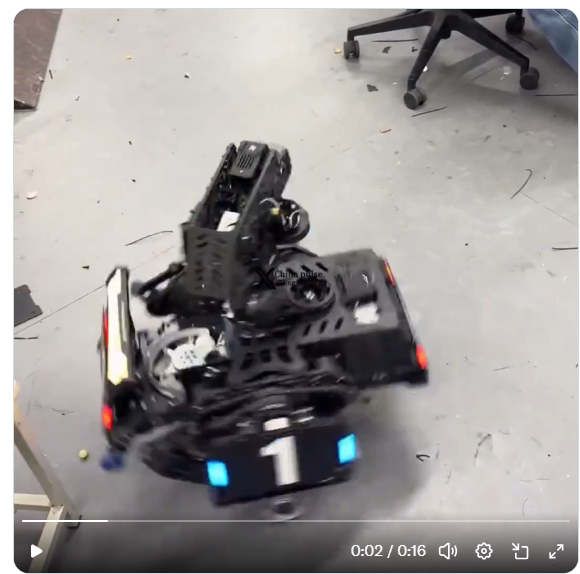

Hybrid robot
University students in Nanjing have developed an innovative hybrid robot that combines wheels and legs, showcasing advanced engineering skills and highlighting China’s growing strength in smart robotics and artificial intelligence research while reflecting strong hands-on training in robotics programs across Chinese universities and engineering institutes that emphasize applied research and real-world problem solving.
demonstrations, the robot can rotate, walk, and climb stairs smoothly, offering flexible movement that allows it to adapt to different environments with stability and precision during operations.
This multifunctional robot demonstrates potential for use in daily-life scenarios, including assisting with tasks, monitoring environments, and supporting automation processes in homes, industries, and educational research settings. Additionally, it showcases how modular robotic systems can improve efficiency in public services and industrial operations in the future significantly.
University students in Nanjing have developed an innovative robot equipped with both wheels and legs, capable of rotating, walking, and climbing stairs with impressive smoothness and flexibility — a clear reflection of China’s rapidly advancing smart‑robotics sector. pic.twitter.com/4DUYgotkVG
— China pulse 🇨🇳 (@Eng_china5) June 1, 2026
A social media influencer shared the video online, helping promote the innovation widely and attracting attention from technology enthusiasts across various digital platforms globally.
The development reflects rapid progress in China’s robotics industry, particularly in integrating mechanical design with artificial intelligence to create more adaptable and intelligent machines. Furthermore, it underscores national investment in STEM education and innovation ecosystems supporting emerging technologies across academic and industrial sectors collaboration.
Experts believe such innovations could transform industrial automation and service robotics, especially as universities continue to collaborate with technology companies on next-generation systems. These partnerships aim to accelerate deployment of intelligent robots in manufacturing, logistics, and healthcare environments worldwide rapidly expanding.
Overall, the project highlights how academic research and student-led innovation continue to drive advancements in intelligent robotic technology worldwide and strengthen collaboration between universities, industry partners, and global technology communities consistently over time.

