

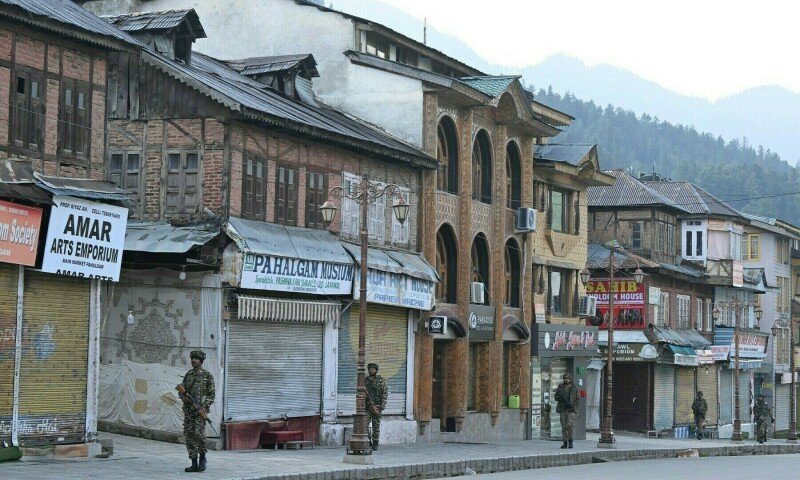

Pakistani security sources have accused India of once again conducting “fake encounters” under the pretext of counter-terrorism operations, with allegations that detained Pakistani nationals are being used in these staged killings. This claim was reported on Monday by Pakistan’s state-run Radio Pakistan, citing sources close to Pakistan’s security apparatus.
The accusations come in the wake of a recent announcement by the Indian Army’s Chinar Corps, which claimed to have killed three alleged “terrorists” during “Operation Mahadev” in Srinagar, Kashmir, an area under Indian control. Indian media reports, citing unnamed sources, have linked one of the deceased to the April 22 Pahalgam attack, though no official confirmation has been provided.
The Pahalgam attack, which took place in Indian-administered Kashmir, resulted in the deaths of 26 people and escalated tensions between nuclear-armed India and Pakistan. India blamed Pakistan for orchestrating the attack, a charge Islamabad vehemently denies while calling for an impartial investigation. Following this, India launched “Operation Sindoor,” which included strikes inside Pakistan on May 7.
Pakistani security sources allege that after the failure of Operation Sindoor to achieve its objectives, India initiated “Operation Mahadev” to conceal its setbacks. They assert that this operation involves staging fake encounters, where detained Pakistanis are forcibly and illegally used, portrayed falsely as cross-border terrorists.
The sources further claim that these actions are aimed at suppressing the growing freedom movement in Indian-held Kashmir and to boost the political credibility of Prime Minister Narendra Modi’s government, which they say is waning.
The sources also highlighted a pattern following the Pahalgam attack, stating that the Indian Army began a series of staged encounters, presenting them as military successes to deflect criticism. They cited a recent incident on April 24, where two citizens of Azad Jammu and Kashmir, Muhammad Farooq and Muhammad Deen, were killed in a “brutal encounter” after mistakenly crossing into Indian-controlled territory.
Since the Pahalgam incident, Indian security forces reportedly arrested over 2,000 Kashmiris and demolished homes belonging to pro-freedom activists. Pakistani military spokesperson Lt Gen Ahmed Sharif Chaudhry disclosed that 723 Pakistani nationals are currently detained in various Indian jails, with another 56 reportedly held in secret custody by Indian intelligence agencies.
The Pakistani sources accused Indian forces of coercing detainees into making anti-Pakistan statements and staged confessions to support official narratives. They said that following such fake encounters, Indian media circulates videos and photos of the deceased alongside planted weapons to reinforce the claims of terrorist activity.
India’s long history of fake encounters, dating back at least to 2015, has drawn criticism from human rights activists and organizations. The National Human Rights Commission of India documented 555 such cases between 2008 and 2013, though activists believe the true figure is higher.
Meanwhile, the Indian Army stated that it killed three suspected militants in a firefight near Dachigam National Park, close to Srinagar, earlier on Monday. The operation, part of ongoing counterterrorism efforts, occurred near the Amarnath shrine, a major Hindu pilgrimage site. Indian authorities identified the deceased as foreigners but did not release further details.
Despite ongoing clashes, the intensity of violence in Kashmir has decreased over the past five years, although local fighters remain active. The recent Global Peace Index 2025 report named Kashmir as a critical escalation hotspot, warning that the fragile ceasefire could collapse due to non-state militant actors.
On the political front, India’s Defence Minister Rajnath Singh asserted that India ended its military operations against Pakistan in May after achieving all its objectives, denying claims that the ceasefire was brokered under external pressure, specifically from then-US President Donald Trump. Singh emphasized that the decision to halt operations was independent and based on strategic considerations.
Opposition parties in India have criticized the government for failing to apprehend the terrorists responsible for the Pahalgam attack despite 100 days passing. They have also questioned the government’s intelligence handling and the loss of Indian jets during the conflict. India claimed to have shot down several Pakistani aircraft, while Pakistan asserts it downed six Indian planes in air combat.
The conflict and accusations between India and Pakistan continue to fuel tensions over the disputed Kashmir region, which remains a flashpoint between the two countries, each claiming full sovereignty over the territory.
