
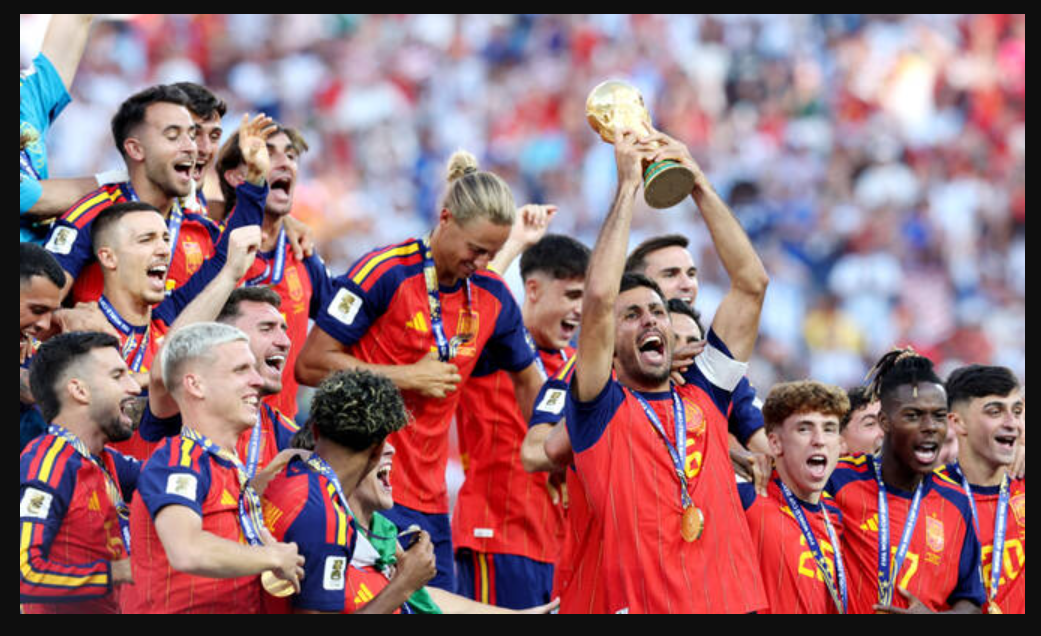

Spain lifted the FIFA World Cup 2026 trophy after defeating defending champions Argentina 1-0 in extra time. Ferran Torres scored the decisive goal to secure Spain’s second World Cup title and end Lionel Messi’s dream of a fairytale farewell.
The thrilling final took place before a packed crowd of 80,663 spectators at MetLife Stadium in East Rutherford. Football fans around the world watched as Spain produced a dominant display against an Argentina side that struggled throughout the contest.
Spain’s victory marked its second FIFA World Cup triumph after first winning the tournament in 2010.
Ferran Torres Delivers the Championship Moment
The breakthrough finally arrived in the 106th minute of extra time. Pedro Porro delivered a lofted cross toward the far post. Nico Williams met the ball with a header before directing it into the path of Ferran Torres.
The Barcelona forward struck a powerful finish that left Argentina goalkeeper Emiliano Martinez with no chance. The goal proved enough to crown Spain as world champions after more than 100 minutes of relentless pressure.
After the match, Torres dedicated the historic victory to his country.
“Ultimately, the goal belongs to 47 million people — not just me or the 26 players.”
He also praised his team’s confidence despite facing Lionel Messi.
“At the end of the day, all finals are tough; when you’re up against Messi, there’s a certain nervousness, but we always believed in our football and in ourselves.”
Argentina Struggles to Create Chances
Argentina entered the final hoping to defend its World Cup title and give Lionel Messi a memorable ending to his World Cup career.
However, Spain controlled possession for long periods and denied Argentina any meaningful attacking opportunities.
Remarkably, Argentina failed to register a single shot on target during the entire 120 minutes. The defending champions also failed to produce a shot off target for the first 115 minutes of the match.
Messi found little space as Spain’s organized defense limited his influence throughout the final. The result ended Argentina’s hopes of winning consecutive World Cup titles.
Physical Contest Dominates the Final
The match featured several tough tackles and heated moments. Early in the first half, Alexis Mac Allister challenged Dani Olmo with a studs-up tackle that resulted in a foul but no booking.
Shortly afterward, Alex Baena caught Messi with an elbow to the back during another physical exchange.
Argentina continued committing aggressive fouls throughout the contest as Spain patiently searched for an opening. Lisandro Martinez eventually received a yellow card after bringing down Mikel Oyarzabal.
Later in the match, Nicolas Tagliafico escaped punishment following another heavy challenge on Lamine Yamal.
Despite the physical nature of the contest, Spain maintained control and continued creating scoring opportunities.
Spain Continues to Apply Pressure
Spain dominated possession after halftime and repeatedly tested Argentina’s defense. Head coach Luis de la Fuente introduced Pedri and Ferran Torres during the second half to increase attacking intensity.
Soon afterward, Torres nearly scored with a downward header that Emiliano Martinez managed to stop. Pedri and Pau Cubarsi also tested the goalkeeper from distance.
Meanwhile, substitutes Nico Williams and Mikel Merino injected fresh energy into Spain’s attack. Argentina remained under constant pressure but continued resisting until extra time.
Red Card Adds to Argentina’s Problems
Argentina’s frustrations grew as the match progressed. Midfielder Enzo Fernandez received a yellow card for dissent before later being sent off during injury time.
His dismissal followed a dangerous challenge on Spain defender Pau Cubarsi, leaving Argentina with ten players entering extra time.
The numerical disadvantage further increased Spain’s dominance during the closing stages.
Controversial Moments Before the Winner
Spain thought they had taken the lead before Torres’ decisive goal. Nico Williams found the net during extra time, but the referee ruled out the goal after spotting a marginal foul on Nicolas Otamendi. The decision briefly delayed Spain’s celebrations.
However, only moments later, Torres finally produced the winning finish that settled the contest.
Argentina attempted one final attack after conceding, yet Spain’s defense comfortably protected its narrow advantage until the final whistle.
Spain Celebrates Second World Cup Triumph
The victory secured Spain’s second FIFA World Cup title, adding to the nation’s historic triumph in South Africa in 2010.
Throughout the tournament, Spain displayed consistent performances, disciplined defending, and effective attacking football. Their performance in the final reflected those strengths once again.
Meanwhile, Lionel Messi’s World Cup journey appears to have ended without the fairytale finish many supporters hoped to witness.
Although Argentina entered the final as defending champions, Spain’s dominance left little doubt about the deserved winner.
Ferran Torres’ extra-time strike ultimately wrote another memorable chapter in Spain’s football history and crowned La Roja as FIFA World Cup 2026 champions.

