
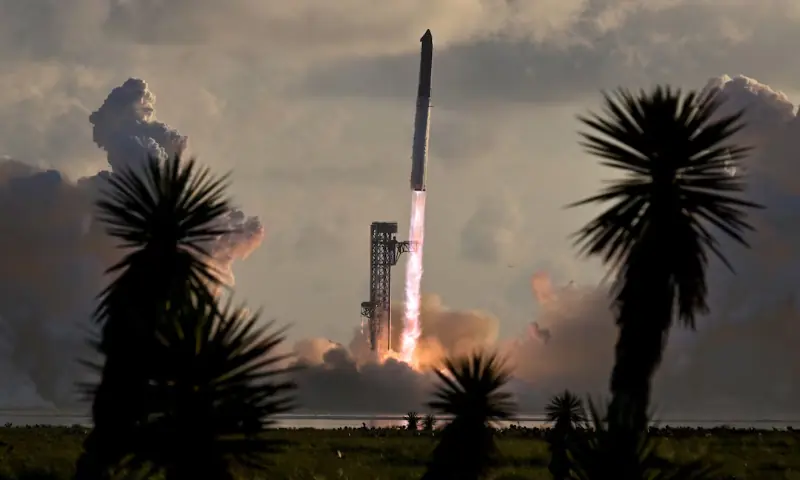

SpaceX’s next-generation Starship rocket reached orbit for the first time on Monday, overcoming an engine problem during its latest test flight.
The uncrewed 40-story rocket launched from SpaceX’s Starbase facility near Brownsville, Texas. It consists of a Super Heavy booster and an upper-stage Starship spacecraft.
During the flight, one of Starship’s three main engines shut down earlier than planned. SpaceX initially indicated that the problem could prevent the spacecraft from reaching orbit.
Engineers later confirmed that Starship could continue the mission. The spacecraft successfully performed an additional engine firing and reached orbit.
26 Starlink Satellites Deployed
After reaching orbit, Starship began deploying 26 next-generation Starlink satellites at an altitude of about 269 kilometres.
The satellites are part of SpaceX’s new V3 Starlink generation. The company says the new satellites can handle around 10 times more data than its previous V2 mini satellites.
SpaceX plans to use Starship to launch larger batches of V3 satellites. The company aims to begin routine Starship operations later this year.
Major Milestone for SpaceX
The successful orbital flight marks a major milestone after 13 previous Starship test flights remained limited to suborbital missions.
The Super Heavy booster also completed a controlled splashdown in the Gulf of Mexico. Starship was expected to complete six Earth orbits during a roughly 10-hour mission before returning toward the Pacific Ocean west of Chile.
Starship is central to SpaceX’s plans for faster Starlink deployment, future NASA lunar missions and lower launch costs.
The vehicle is designed to become fully reusable. However, SpaceX still faces the challenge of repeatedly launching, recovering and operating Starship at the scale envisioned by Elon Musk.

