
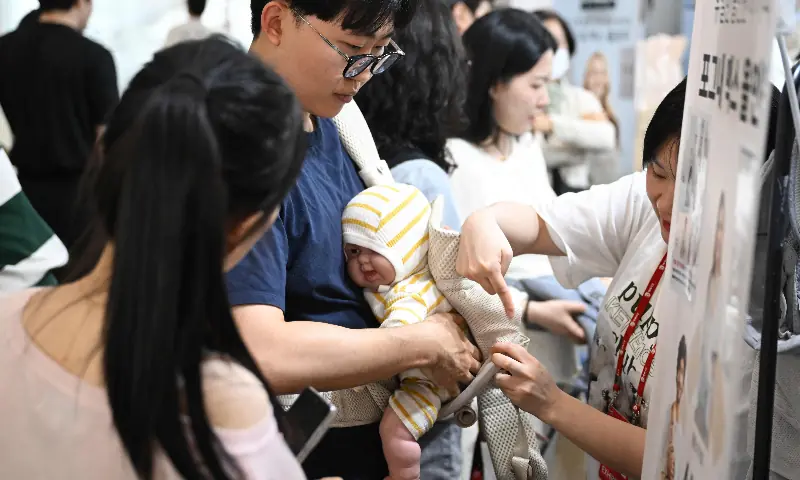

Small Increase in Births Brings Optimism After Years of Decline
South Korea is witnessing a modest rise in births after years of record-low fertility rates and demographic decline. The increase has offered cautious optimism to a country struggling with one of the world’s fastest-shrinking populations.
Official figures show South Korea’s fertility rate increased from 0.75 in 2023 to 0.8 last year. Although the rise remains far below the 2.1 level needed to maintain population stability, experts say the trend is still significant after years of continuous decline.
The number of births has also started increasing on a monthly basis. According to the statistics ministry, nearly 23,000 babies were born in February, marking the highest figure for that month in seven years.
Officials reported a 13.6 percent increase compared to the same month last year. It was the strongest February growth rate recorded since data collection began in 1981.
For many families, the decision to have children still involves financial pressure, career concerns, and uncertainty about the future. However, some young couples are choosing parenthood despite these challenges.
One such example is 32-year-old freelance music worker Kim Su-jin, who welcomed a daughter last year. She said she and her husband decided to focus on family happiness instead of fear about housing, education costs, and job insecurity.
Experts believe changing social attitudes and stronger family support programs may be contributing to the recent increase in births.
Government Spending and Family Policies Show Mixed Results
South Korea has spent billions of dollars over the years trying to increase birth rates and reduce the long-term effects of population decline. Authorities introduced financial incentives, childcare programs, housing support, and parental leave benefits to encourage families to have children.
The government currently provides a monthly allowance for parents during a baby’s first year. Families also receive payments connected to childbirth, maternity care, transportation, and post-natal support services.
Some employers have also started offering large bonuses to workers who become parents. Officials hope such policies can reduce financial pressure on young couples and make family planning more realistic.
Many experts believe these policies are beginning to influence public attitudes. Economics professor Hong Sok-chul from Seoul National University said the government focused on reducing direct and indirect costs rather than forcing marriage or childbirth.
According to him, the strategy helped make family decisions more financially manageable for younger generations.
Office worker Kim Woo-jin, who became a mother last year, said government assistance played a major role in helping her family handle expenses related to pregnancy and childcare.
However, not everyone believes financial incentives alone can solve the country’s demographic crisis. Some citizens argue that deeper social problems continue discouraging young people from starting families.
Critics point to expensive housing, intense education pressure, workplace stress, school bullying, and fears about artificial intelligence affecting future employment opportunities.
Kim Su-jin said financial support programs provide limited practical relief compared to broader economic and social challenges facing young couples today.
Experts Warn Population Challenges Are Far From Over
Demographers caution that the recent rise in births may not represent a permanent demographic recovery. Some experts believe the increase is partly linked to delayed marriages and childbirth during the pandemic years.
Others point to a larger generation born during the early 1990s, which is now reaching peak parenting age. This demographic factor may temporarily increase birth numbers before another decline appears later.
Analysts also note that younger South Koreans are showing slightly more positive attitudes toward marriage and family life compared to previous years.
Social stigma surrounding childbirth outside marriage has also weakened gradually. However, births outside marriage still represent a small percentage of total births nationwide.
Despite the recent improvement, experts agree South Korea continues facing a serious population challenge. The country’s aging population and shrinking workforce remain major economic and social concerns.
Researchers warn that without long-term policy support and broader social reforms, the current rise in births may only be temporary.
Government officials say they will continue expanding family support programs while encouraging stable employment, affordable housing, and improved childcare services.
The recent baby bump has provided hope for South Korea, but experts stress that reversing decades of demographic decline will require sustained effort and long-term commitment.

