

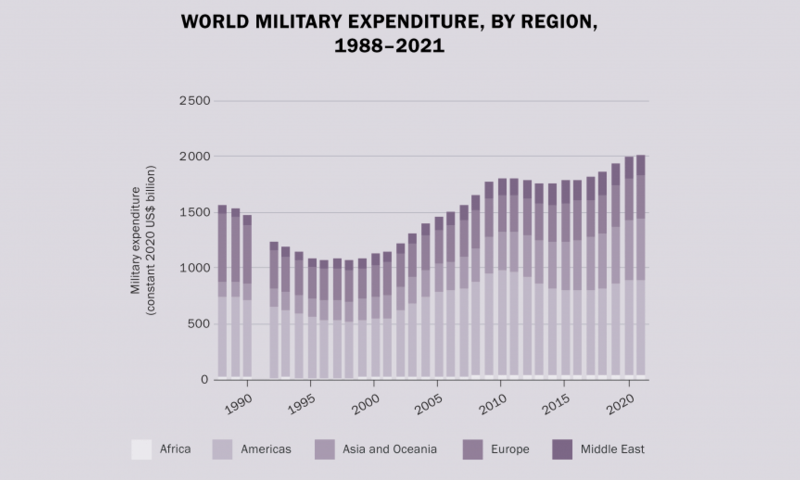

STOCKHOLM: Global military expenditure went up in 2021, reaching new records as Russia continued to bulk up its military before its invasion of Ukraine, analysts said on Monday, forecasting that the trend would continue in Europe in particular.
Despite the economic impact of the worldwide Covid epidemic, governments throughout the world upped their arsenals, with global military spending climbing by 0.7 percent last year, according to research by the Stockholm International Peace Research Institute (SIPRI).
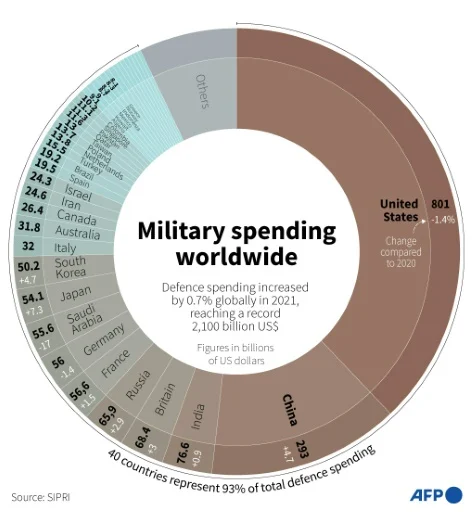
“In 2021, military spending climbed for the eighth straight period to reach $2.1 trillion. That is the biggest amount we have ever had,” Diego Lopes da Silva, senior researcher at Sipri, told AFP.
This is the third consecutive year that Russia’s spending has increased, totalling $65.9 billion.
4.1 percent of Russia’s GDP was devoted to military expenditures, “much more than the world average” and placing Moscow as the world’s fifth-largest spender, Lopes da Silva said. Increased oil and gas income made the country’s increased military spending possible. According to Lopes da Silva, Russia’s consumer spending increased dramatically at the year’s conclusion.
Before the Russian invasion of Ukraine in February, “Russia stockpiled forces near the Ukrainian border,” an academic researcher claimed.
Sanctions that are more severe
Because of the wave of sanctions imposed by the West in reaction to Russia’s aggressiveness in Ukraine, Lopes da Silva said it was impossible to anticipate if Russia could maintain its expenditure.
With the Crimea annexation and the fall in oil prices that occurred at the same time, it was impossible to determine how effective sanctions were on their own.
Russia can afford to sustain its military expenditure at the current level because of increasing oil costs, according to Lopes da Silva. “Now… we have even harder sanctions, that is for sure.”
Since the invasion of Crimea, Ukraine’s military spending has increased by 72 percent. Despite a decrease of nearly 8% in 2021 to $5.9 billion, Ukraine’s government spending still accounted for 3.2% of GDP. NATO members have also upped their spending as tensions have risen in Europe.
The aim of two percent of GDP for spending by member nations was met by eight countries last year, one less than in 2015, but up from just two in 2014.
Lopes da Silva predicted that European consumer expenditure will rise in the future. The United States, which spent $801 billion more than any other country, actually lowered its spending by 1.4 percent in 2021, opposing the worldwide trend.
‘Advantage of technology’
Research and development investment in the United States has increased by 24% over the previous decade, while arms procurement has decreased by 6.4%.
Even while 2021 saw a fall in both expenditures and research, the decrease in research was less noticeable, showing the country’s concentration “on next-generation technology.”
It is important to keep the US military’s technology advantage over its strategic rivals intact, another researcher at SIPRI, Alexandra Marksteiner, said in a statement.
At $293 billion, China is the world’s second-largest military spender. This year’s 4.7% rise marks the 27th consecutive year of rising military spending in China.
Japan has increased its military budget by $7 billion, the greatest yearly rise since 1972, as a result of the country’s military expansion, which has prompted its neighbours to do the same.
Military spending in Australia increased by 4% in 2021, to $31.8 billion.
A 0.9 percent rise in financing from the world’s third-largest spender, India, was announced in 2021.
A 3% rise in military spending to $68.4 billion saw the UK replace Saudi Arabia as the fourth-largest military spender, which had lowered its spending by 17%.
