
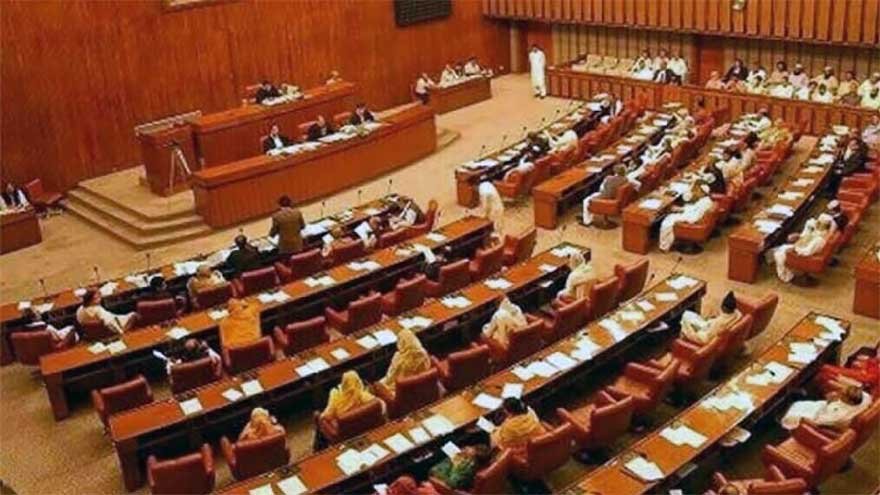

Pakistan’s Senate passed six private members’ bills on Monday, including a consumer protection amendment that faced resistance from government ministers. The Islamabad Consumers Protection (Amendment) Bill, 2026, secured 10 votes in favour and four against, sparking a heated debate over the government’s approach to private legislation.
Consumer Protection Bill Triggers Heated Senate Debate
Senator Samina Mumtaz Zehri introduced the Islamabad Consumers Protection (Amendment) Bill, 2026. However, Minister of State for Interior Talal Chaudhry opposed the legislation, prompting an exchange between lawmakers.
Zehri criticised the government for opposing private members’ bills, arguing that ministers neither completed their own work nor allowed others to proceed. She also questioned why the government resisted legislation presented in the House.
In response, Talal Chaudhry asked why the discussion had become personal. Meanwhile, Minister for Parliamentary Affairs Tariq Fazal Chaudhry maintained that ministers did not hold personal opinions on such matters.
Senator Faisal Saleem Rehman also challenged the government’s position, particularly when parliamentary committees had already approved legislation. He questioned the purpose of referring bills to committees if the government opposed them after their return to the House.
Furthermore, Zehri criticised the postponement of a bill concerning honour killings, stressing the importance of addressing the issue.
Following the debate, senators voted on the consumer protection amendment. The bill passed with 10 votes in favour and four against, despite the government’s opposition.
Which Six Bills Did the Senate Pass?
Besides the consumer protection amendment, the Senate approved five other private members’ bills through clause-by-clause consideration.
The approved legislation included:
- Islamabad Capital Territory (Prohibition of Plastic Book Covers) (Amendment) Bill, 2026
- Iqra Global University Bill, 2026
- Special Technology Zones Authority (Amendment) Bill, 2022
- Offence of Zina (Enforcement of Hudood) (Amendment) Bill, 2026
- Code of Criminal Procedure (Amendment) Bill, 2026
The six bills were moved by Senators Sherry Rehman, Mohammad Abdul Qadir, Sarmad Ali and Samina Mumtaz Zehri.
Seven New Bills Referred to Standing Committees
Meanwhile, lawmakers introduced seven additional private members’ bills during the session. Presiding Officer Senator Shahadat Awan referred all seven proposals to the relevant standing committees for detailed consideration.
These proposals included the Code of Criminal Procedure (Amendment) Bill, 2026, and the Islamabad Capital Territory Motor Vehicles (Regulation of Tinted Glass) Bill, 2026. The Iqbaliyat (Promotion in Educational Institutions) Bill, 2026, was also introduced.
Other proposals covered the protection of elderly parents and senior dependent family members, the de-colonisation of public administration, and the implementation of the Auditor General’s recommendations. The list also included the Elections (Amendment) Bill, 2026.
Senators Samina Mumtaz Zehri, Zarqa Suharwardy and Mohammad Abdul Qadir moved the proposed legislation.
At the same time, the House withdrew three private members’ bills. These concerned indecent advertisements, amendments to the Cannabis Control and Regulatory Authority, and protections for non-smokers.
Sunday Bazaar Fire Safety Concerns Raised
Separately, PPP Senator Rubina Khalid questioned the closure of Islamabad’s Sunday Bazaar over inadequate fire safety arrangements.
She noted that senators also purchased groceries from the market and asked whether major shopping malls and commercial plazas maintained sufficient fire safety measures. Consequently, the closure raised wider questions about the enforcement of safety requirements across Islamabad’s commercial establishments.
Senate Condemns India’s Occupation of Jammu and Kashmir
During the session, Federal Minister for Kashmir Affairs Amir Muqam presented a resolution condemning India’s occupation of Jammu and Kashmir.
The resolution described the occupation as illegitimate and stated that India had forcibly occupied Kashmir on October 27. It reaffirmed the Kashmiri people’s right to determine their own future.
Additionally, the resolution urged the United Nations to ensure the implementation of its resolutions on Kashmir. It also called on Pakistan’s government to continue providing diplomatic and moral support to the Kashmiri people.
For the latest updates, visit and follow The Truth International website (www.thetruthinternational.com) and subscribe to the YouTube Channel.

