
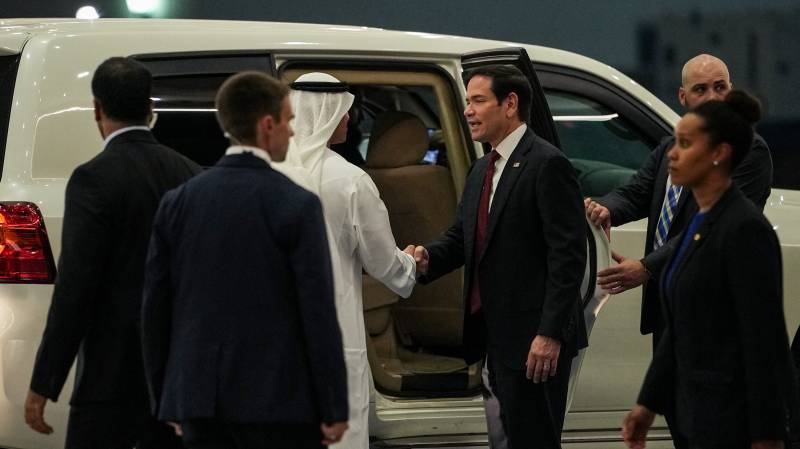

US Secretary of State Holds Talks in Kuwait
US Secretary of State Marco Rubio held talks with Kuwait’s Emir Sheikh Mishal Al-Ahmad Al-Sabah on Wednesday during a regional tour aimed at reassuring Gulf allies.
The visit came after Washington signed a memorandum of understanding with Tehran to reduce tensions after months of conflict.
Rubio also attended a flag-raising ceremony at the US embassy in Kuwait.
The ceremony marked the resumption of embassy operations after an Iranian strike during the Middle East war.
Rubio said Kuwait remains an important partner for regional security and stability.
He added that Washington looks forward to strengthening its partnership with Kuwait.
UAE Meeting Focuses on Iran Deal and Strait of Hormuz
Before arriving in Kuwait, Rubio met UAE President Mohamed bin Zayed in Abu Dhabi.
The two leaders discussed the Iran agreement, Gulf security and safe passage through the Strait of Hormuz.
Rubio reaffirmed the US commitment to the security of the United Arab Emirates.
He also praised the UAE’s resilience after Iranian attacks during the conflict.
The UAE was reportedly targeted by thousands of missiles and drones during the war.
Rubio also rejected any proposal to impose tolls or fees on vessels using the Strait of Hormuz.
He said the route is an international waterway and must remain open under international law.
Gulf Allies Seek Security Assurances
Rubio’s visit is the first by a senior US official to the Middle East since the Iran agreement was signed.
The Gulf region, which hosts several US military bases, was heavily affected during the conflict.
Kuwait, Bahrain and the UAE were among the countries hit during Iranian retaliation for US-Israeli strikes.
Gulf states have long urged Washington to address Iran’s missile programme and regional proxies.
However, the latest agreement has raised concerns because some of those issues remain unresolved.
After Kuwait, Rubio is expected to travel to Bahrain for a Gulf Cooperation Council meeting.
His tour is aimed at rebuilding confidence among allies and reinforcing Washington’s security commitments in the region.

