
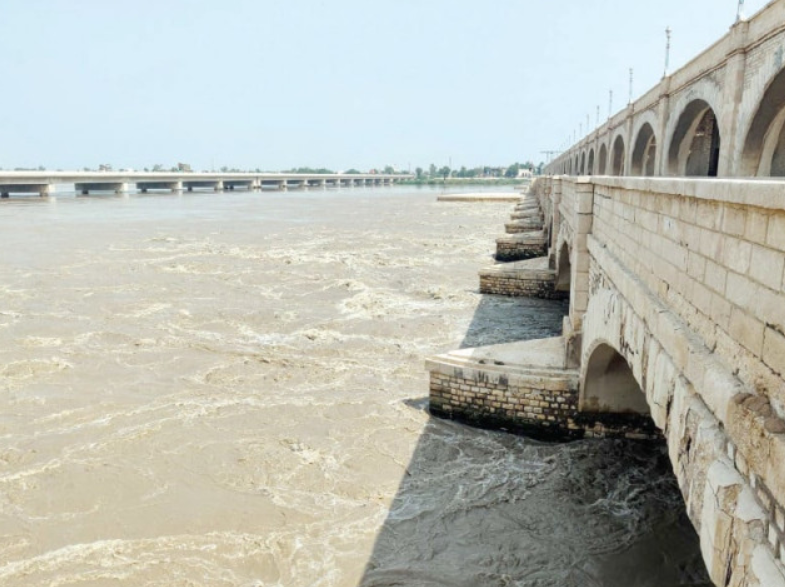

Heavy monsoon rains in Pakistan’s upper regions have increased water levels in the Indus River. Meanwhile, authorities have placed several districts on high alert as flood risks continue to grow.
Indus River Swells After Heavy Monsoon Rains
According to officials, Guddu Barrage recorded a 45,000-cusec increase in water flow during the past 24 hours. Consequently, authorities expect the barrage to remain at a low flood level over the next 48 hours.
Officials said additional water from the Punjnad and Taunsa rivers is moving towards Guddu Barrage. The current inflow stands at 217,045 cusecs, while the outflow has reached 182,185 cusecs.
At Sukkur Barrage, officials recorded an inflow of 126,380 cusecs and an outflow of 71,660 cusecs. Meanwhile, Kotri Barrage registered an inflow of 44,666 cusecs with 3,165 cusecs discharged downstream.
The Flood Forecasting Division also reported the Chenab River flowing at a medium flood level. However, the Ravi River currently remains at a low flood level.
Authorities Issue Alerts As Flood Risk Increases
The Flood Forecasting Division expects both rivers to rise during the next 24 hours. Furthermore, the Chenab at Marala, Khanki and Qadirabad could reach medium to high flood levels.
Similarly, the Ravi River may rise to medium or high flood levels at Balloki and Sidhnai. Meanwhile, the Indus at Kalabagh, Chashma and Taunsa continues flowing at low flood levels.
The Kabul River at Nowshera, Chenab at Trimmu and Ravi at Balloki and Sidhnai also remain at low flood levels. However, officials said other major rivers continue flowing within their normal ranges.
In response, district administrations in Lahore, Gujranwala, Sheikhupura, Sialkot, Narowal and Khanewal have been placed on high alert. Authorities said emergency teams remain prepared to respond quickly to any flood-related situation.

