
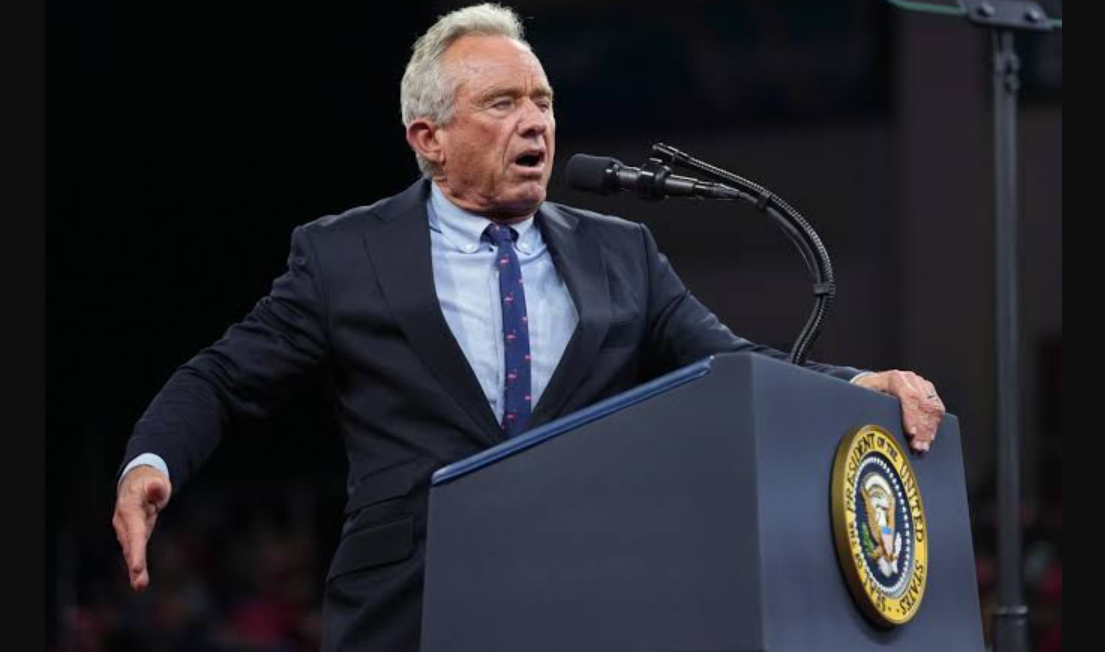

US Health and Human Services Secretary Robert F. Kennedy Jr. has sparked widespread criticism after making sweeping claims about Arab contributions to science and literature. His remarks at a Republican campaign event in Grand Rapids, Michigan, have triggered outrage and renewed scrutiny.
Kennedy made the comments while campaigning ahead of the US midterm elections. Critics have challenged his assertions as factually incorrect and racially biased, pointing to Arab Nobel laureates and centuries of scientific achievements.
“There’s 500 million Arabs in the world and yet they don’t produce science,” Kennedy claimed on the campaign trail, on Monday. “They don’t win the Nobel Prize. They don’t win the Fields Prize. They don’t win the Wolf Prize. They don’t produce literature.”
Arab Nobel Laureates Challenge Kennedy’s Claims
Several prominent award winners directly contradict Kennedy’s assertion that Arabs have made no significant contributions.
Egyptian scientist Ahmed Zewail won the 1999 Nobel Prize in Chemistry for his work on femtochemistry. His research transformed scientists’ understanding of extremely rapid chemical reactions.
Similarly, Egyptian writer Naguib Mahfouz received the 1988 Nobel Prize in Literature. His recognition established a major milestone for Arabic literature internationally.
Yemeni journalist, politician and human rights activist Tawakkol Karman shared the 2011 Nobel Peace Prize. She became the first Yemeni and the first Arab woman to receive the award.
Moreover, Egyptian diplomat Mohamed El Baradei shared the 2005 Nobel Peace Prize with the International Atomic Energy Agency. The award recognised efforts to prevent nuclear energy from being used for military purposes.
Jordanian-born Omar M. Yaghi received the 2025 Nobel Prize in Chemistry alongside two other scientists. He also won the 2018 Wolf Prize in Chemistry.
Other Arab figures have received Nobel recognition as well. Former Palestinian leader Yasser Arafat shared the 1994 Nobel Peace Prize for his “efforts to achieve peace in the Middle East.” Meanwhile, former Egyptian president Anwar al-Sadat shared the 1978 Nobel Peace Prize with Israeli Prime Minister Menachem Begin.
Additionally, mathematician Sir Michael Atiyah, of Lebanese descent, received the Fields Medal in 1966.
Why Did Kennedy Make the Controversial Remarks?
Kennedy spoke while campaigning for Michigan Republican Senate candidate Mike Rogers. Rogers has accused his Democratic opponent, Abdul El-Sayed, of having ties to the Muslim Brotherhood.
“Mike Rogers was talking about the Muslim Brotherhood. That’s something I can talk about,” Kennedy said.
Kennedy linked his claims about Arab scientific contributions to the influence of the Muslim Brotherhood. He also referenced Islamic civilisation’s historical contributions to literature.
However, his remarks overlooked both prominent modern achievements and the broader scientific legacy of earlier Arab scholars.
Critics Condemn Remarks as Inaccurate and Biased
The comments prompted criticism from advocacy groups, scientists and social media users. Brad Woodhouse, president of Protect Our Care, said Kennedy had previously “has trafficked in racism”, describing the latest episode as potentially his “ugliest episode yet.”
Woodhouse referred to Kennedy’s 2024 comments on the High Level Conversations podcast. Kennedy had suggested that Black children with ADHD taking medication should be “re-parented.”
Meanwhile, social media users highlighted Arab Nobel laureates and scientific terminology. One user, Jordan Guy, wrote:
“Naguib Mahfouz won the Nobel in Literature in 1988. Ahmed Zewail won the Nobel in Chemistry in 1999, after winning the Wolf Prize. Omar Yaghi won the Nobel in Chemistry in 2025,” X user Jordan Guy pointed out. “Algebra is an Arabic word. So is algorithm. The math on this claim doesn’t work.”
Dr Peter Hotez, founding dean of the National School of Tropical Medicine at Baylor and Texas Children’s Hospital, also criticised Kennedy’s remarks.
“God rest his soul he didn’t have to endure this, and of course RFK Jr forgets that it was the Arab scientists of the Middle Ages who kept Aristotle, Hippocrates, Galen alive to hand it down in the Renaissance.”
CAIR Calls for Kennedy’s Removal
The Council on American-Islamic Relations (CAIR) demanded Kennedy’s dismissal over his comments.
“To stand on a public stage as a sitting US cabinet official and dehumanise half a billion people – and millions of Muslim and Christian Arab Americans – with fabricated, white supremacist talking points is utterly disqualifying for public office,” CAIR said in a statement.
“His sweeping erasure of Arab contributions to humanity is not only maliciously false, but it also fans the flames of anti-Arab and anti-Muslim hate at a time when communities are already vulnerable to bigoted attacks from other public officials nationwide.”
Arab Scientific Contributions Extend Beyond Nobel Prizes
Historians and scientists have highlighted the influence of scholars during the Islamic Golden Age. Their work helped advance mathematics, astronomy, medicine and optics.
Scholars also preserved and developed important scientific knowledge, including works associated with Aristotle, Hippocrates and Galen. These contributions later influenced intellectual developments in Europe.
Saudi Arabian influencer Eyad Al-Hamoud also criticised Kennedy, citing scientific achievements associated with Arab and Islamic history.
He highlighted algebra, algorithms, trigonometry, observatories, surgery, anaesthesia, hospitals, optics and experimental chemistry. He also referenced Ibn al-Haytham’s contributions to optics and historical advances in distillation and water clocks.
Kennedy is scheduled to attend the “Make Iowa Healthy Again Rally” in Des Moines on Wednesday as a special guest. His remarks have intensified debate over historical accuracy, public accountability and anti-Arab prejudice during the US election campaign.
For the latest updates, visit and follow The Truth International website (www.thetruthinternational.com) and subscribe to the YouTube Channel.

