
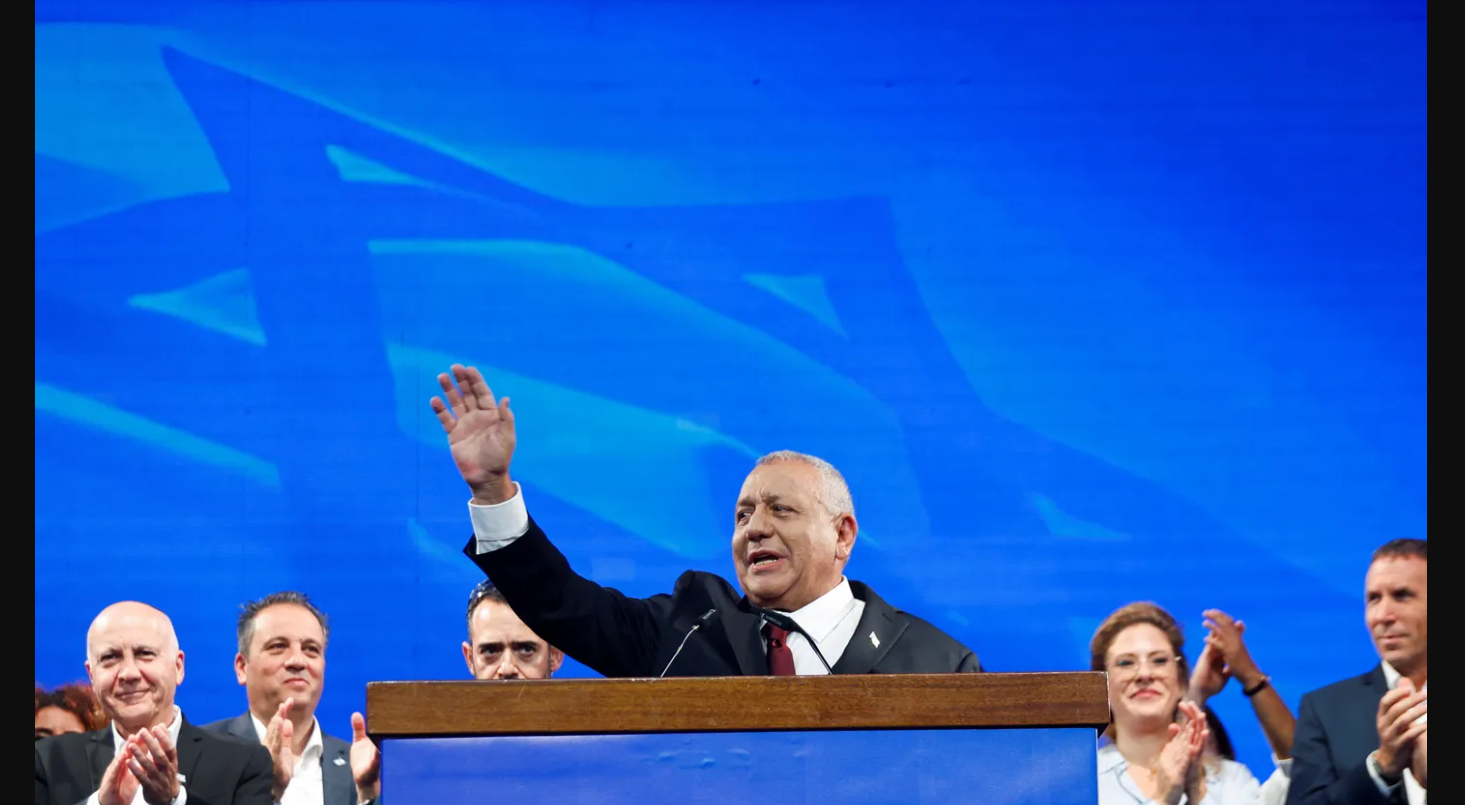

Israel’s election has delivered a tense political contest, with neither Benjamin Netanyahu nor opposition leader Gadi Eisenkot securing a clear path to power. Although updated projections placed Netanyahu’s bloc ahead, the opposition vowed to challenge his leadership and form a new government.
Gadi Eisenkot, leader of the Yashar party and former army chief of staff, called on Netanyahu to leave politics. Speaking to supporters early Wednesday at his party’s headquarters in Tel Aviv, Eisenkot said Israelis had voted for change.
He also pledged to build a broad governing coalition, arguing that another election would serve little purpose.
“It would be a mistake to hold another election, and it is my duty to do everything possible to carry out the will of the people,” Eisenkot said.
Eisenkot Challenges Netanyahu Over Israel’s Security
Eisenkot directly warned Netanyahu against using national security for political purposes. He told the prime minister, “Do not dare use Israel’s security for your political needs”.
Furthermore, Eisenkot addressed Israel’s security chiefs, reminding them that Netanyahu leads an interim administration.
“Remember that you serve only the interests of Israel’s citizens”.
His remarks highlighted the opposition’s determination to challenge Netanyahu, even as election projections shifted in the prime minister’s favour.
Netanyahu Seeks a Strong Right-Wing Government
Netanyahu addressed supporters after 3:00 am, calling for a government built exclusively around right-wing parties. However, he stopped short of declaring an outright victory.
“We must put in place a strong government of the right,” Netanyahu said, pointing to Likud’s projected position as the largest party.
He also ruled out relying on Arab parties for parliamentary support.
“The Jewish and Zionist majority must unite. It is out of the question to have a government that is backed by Arab parties.”
His comments signalled an effort to consolidate right-wing support as coalition negotiations loom.
Election Projections Shift as the Contest Tightens
Updated exit poll projections showed Netanyahu’s right-wing bloc moving ahead of Eisenkot’s opposition bloc.
The latest figures placed Netanyahu’s bloc at 52 seats, compared with 49 seats for Eisenkot’s camp. Arab-list parties were projected to win 19 seats.
Earlier projections had presented a much closer contest, with both rival blocs standing at 51 seats each. Arab parties were then projected to secure 18 seats.
Initial estimates had also given Eisenkot’s camp an early lead, placing the opposition bloc at 53 seats against 50 for Netanyahu’s side.
The changing projections have underscored the uncertainty surrounding the election outcome. However, exit polls do not establish the final distribution of parliamentary seats.
Neither Bloc Reaches the Majority Mark
Israel’s Knesset has 120 seats, meaning a government needs at least 61 seats for an outright parliamentary majority.
Neither Netanyahu’s bloc nor Eisenkot’s opposition camp reached that threshold in the reported projections. Therefore, both sides face a difficult coalition-building challenge.
Arab-list parties, projected to win 19 seats in the latest estimates, could prove significant to the parliamentary arithmetic. However, Netanyahu has explicitly rejected a government backed by Arab parties.
Record Turnout Adds Weight to Israel’s Election
Voter turnout reached 77.7 percent, marking the highest participation since 1999, according to the Central Elections Committee.
The figure represented a 7.1-percentage-point increase compared with the 2022 election. Polling stations closed at 10 pm local time on Tuesday, after which authorities began counting ballots.
As projections continue to shape expectations, Israel faces another critical stage in its political contest. Netanyahu’s bloc has gained ground in the reported estimates, yet the opposition remains determined to pursue a change in leadership.
For the latest updates, visit and follow The Truth International website (www.thetruthinternational.com) and subscribe to the YouTube Channel.

