

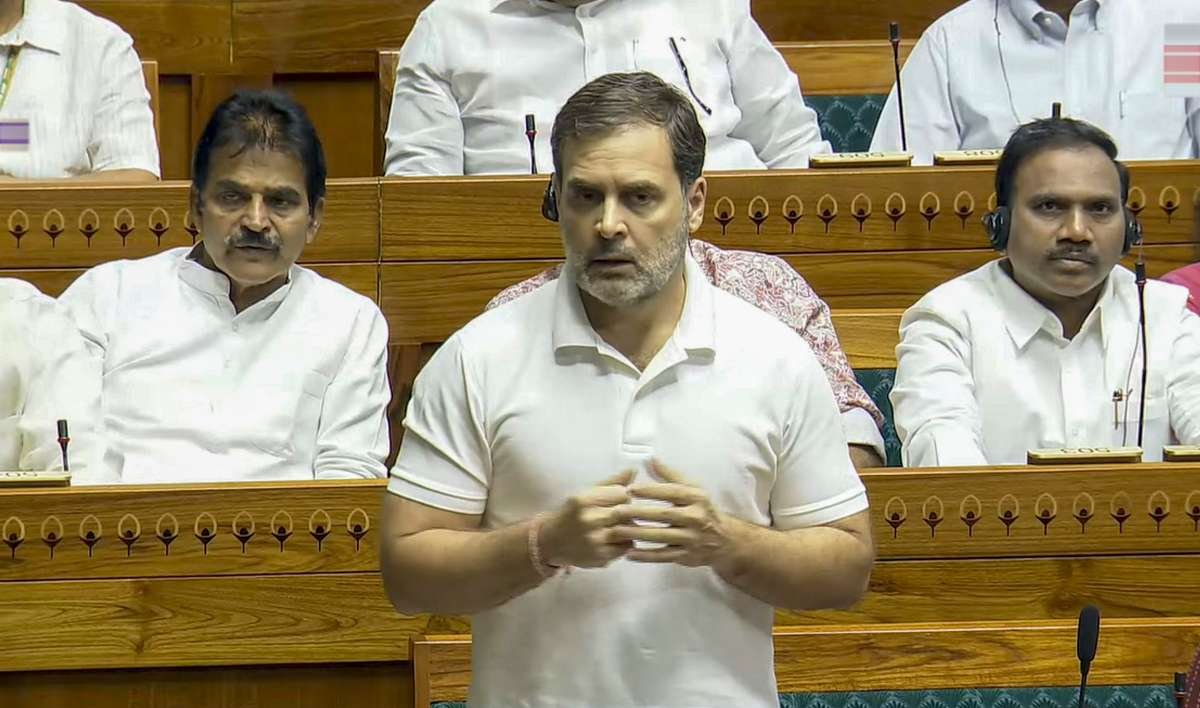

NEW DELHI: In a stormy session of India’s parliament on Tuesday, the political atmosphere turned electric as opposition leader Rahul Gandhi sharply criticized Prime Minister Narendra Modi’s handling of the recent military standoff with Pakistan.
Amid jeers, accusations, and emotional speeches, the Bharatiya Janata Party (BJP) government praised itself for a forceful response to the April 22 attack in Pahalgam, in which 26 Hindu tourists lost their lives. Yet, the opposition presented a very different narrative.
Rahul Gandhi, taking the floor with a charged tone, accused Modi of demonstrating cowardice by not authorizing direct military engagement with Pakistan at the outset of hostilities. According to Gandhi, the Indian government explicitly ordered its military not to target strategic or military installations across the border in a move that he claimed undermined India’s deterrence and morale.
He argued that the political leadership’s refusal to allow a full-scale strike exposed the armed forces to unnecessary risk and signaled weakness. “India,” Gandhi declared emphatically, “cannot afford Modi as prime minister.”
Responding to the criticism, Prime Minister Modi delivered a speech filled with theatrical pauses and nationalistic fervor. Speaking in Hindi, he applauded his administration’s response to the Pahalgam killings and claimed credit for a swift retaliatory operation.
Modi revealed that within 22 minutes of the attack, Indian forces struck what he described as “terror bases deep inside Pakistan.” He claimed that Pakistan’s “sabre-rattling,” including nuclear threats, had failed to deter India’s response. According to him, India’s action showed the world it would no longer be restrained by fear of escalation.
The Indian premier declared that this demonstrated a fundamental shift in India’s strategic posture. He asserted that Pakistan’s nuclear bluff had been called and its deterrence exposed as ineffective. “India responds on its own terms; bullets will be met with cannons,” Modi said. He claimed that only three countries spoke in Pakistan’s favor at the United Nations but did not specify how many supported India.
Home Minister Amit Shah followed Modi’s address by announcing that three of the attackers involved in the Pahalgam massacre had been killed, with two identified as members of the now-defunct Lashkar-e-Taiba (LeT). However, veteran Kashmiri leader Farooq Abdullah responded cautiously, questioning whether the men killed were indeed those responsible for the attack.
While Modi emphasized his administration’s military and diplomatic successes, including a claimed boost to India’s defence exports under “Operation Sindoor,” he notably avoided addressing questions about India’s losses during the conflict. Multiple opposition members had asked for transparency on the number of aircraft lost, including the high-profile Rafale fighter jets.
Rahul Gandhi took particular aim at this silence, quoting the Indian Defence Attache to Indonesia, Captain Shiv Kumar, who allegedly confirmed that Indian aircraft were lost during the operation—losses Gandhi claimed were the direct result of government-imposed operational limitations.
He further alleged that Defence Minister Rajnath Singh admitted in parliament that the government instructed the military not to escalate the conflict, even going so far as to contact Pakistan requesting a ceasefire only 30 minutes after the operation began.
Gandhi also challenged Modi over U.S. President Donald Trump’s claim of having personally stopped the war between India and Pakistan. “If Trump is lying, let Modi say he is lying,” Gandhi demanded, framing it as a test of the prime minister’s credibility on the international stage.
Throughout Modi’s speech, he lauded his leadership for enhancing India’s image globally and blamed past leaders like Jawaharlal Nehru for policies he claimed weakened India—such as the Indus Waters Treaty. Referring to the 1960 agreement, Modi said it was unjust to Indian farmers and reiterated his long-standing line: “Blood and water cannot flow together.”
Despite the prime minister’s confident assertions, the opposition remained unconvinced. For them, the government’s decision to avoid direct confrontation with Pakistani military assets was less a demonstration of strategic maturity and more an admission of political hesitation. The fiery exchange in parliament underscored the deep divide in India’s political discourse over national security, leadership, and the price of perceived restraint.
