
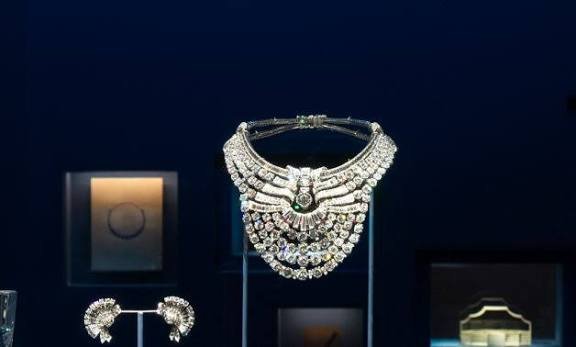

A priceless necklace once worn by Egypt’s Queen Nazli has been stolen from a museum in Vienna after two men smashed a display case and fled with the historic jewellery.
The dramatic robbery took place at the Museum of Applied Arts (MAK) in Vienna, Austria. Police have launched an international manhunt for the suspects, who were reportedly captured on security cameras during the theft.
Two Men Smash Display Case and Escape
According to Austrian police, two men entered the museum after purchasing tickets. They reportedly remained unmasked while carrying out the robbery.
The suspects allegedly attacked a display case shortly after the museum opened and removed the valuable necklace.
Police said one of the men was suspected of carrying an object resembling a firearm.
After taking the jewellery, the suspects fled from the museum towards Vienna’s Stadtpark area.
Investigators are reviewing surveillance footage and other evidence as they attempt to identify the men and determine whether additional people were involved in the operation.
The museum has since reopened to visitors, but the stolen necklace remains missing.
Historic Necklace Contains 673 Diamonds
The stolen piece is a spectacular platinum necklace featuring 673 diamonds, with the stones weighing a combined total of around 200 carats.
The necklace was created by the renowned French jewellery house Van Cleef & Arpels.
Its value extends far beyond the diamonds themselves because of its royal history.
The necklace once belonged to Queen Nazli of Egypt, the wife of King Fuad I and mother of King Farouk.
Queen Nazli famously wore the necklace during the 1939 wedding of her daughter, Princess Fawzia, to Iran’s Crown Prince Mohammad Reza Pahlavi.
Mohammad Reza Pahlavi later became the Shah of Iran.
The jewellery subsequently entered the international art and collectibles market. It was sold by Sotheby’s in New York in 2015 for $4.3 million.
The piece has been described as a masterpiece of white jewellery because of its intricate platinum setting and extensive collection of diamonds.
Another Major European Museum Heist
The Vienna robbery has raised fresh concerns over the security of Europe’s museums and their most valuable collections.
The theft comes amid a series of high-profile museum robberies across Europe.
Major cultural institutions have increasingly become targets for criminals seeking valuable jewellery, historical artefacts and works of art.
Europol has previously warned that museum thefts are becoming more aggressive, with criminals increasingly relying on force and violence.
Authorities have also raised concerns about the involvement of sophisticated criminal networks in cultural property theft.
The Vienna incident is therefore being closely watched by European law-enforcement agencies.
Police Launch International Manhunt
Austrian authorities are continuing their investigation and have appealed for information that could help identify the suspects or locate the stolen necklace.
The fact that the men were reportedly unmasked could provide investigators with important evidence from surveillance footage.
Police are also expected to examine possible escape routes, communications and links to organised criminal groups.
Recovering the necklace could prove particularly difficult because its individual diamonds and precious-metal components could potentially be separated or altered to make the jewellery harder to identify.
For the museum, however, the loss is not simply financial.
The necklace represents an important chapter in Egyptian royal history and 20th-century jewellery design.
MAK Director General Lotti Hollein said the robbery had deeply affected the institution and stressed that security precautions had been implemented with previous museum thefts in mind.
Despite those measures, the historic necklace was still taken in a rapid and highly targeted operation.
The exhibition has reopened, but one of its most important pieces is now missing as Austrian investigators work to recover the royal treasure and bring those responsible to justice.

