
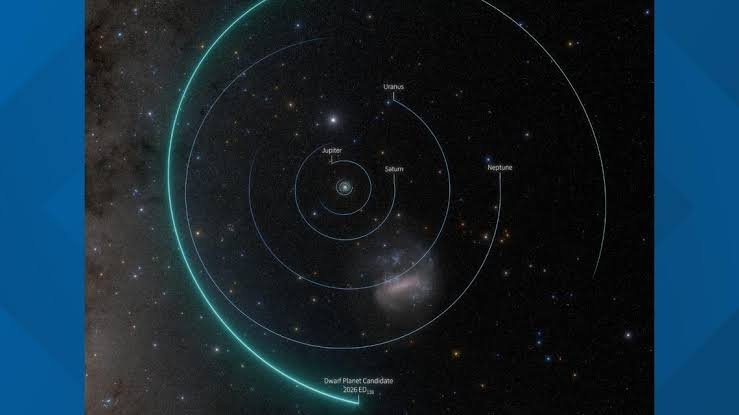

Astronomers have identified a distant icy object beyond Pluto that could become the sixth officially recognised dwarf planet in the solar system. The object, provisionally named 2026 ED138, was detected using observations from the Vera C. Rubin Observatory in Chile.
Researchers estimate that the object measures between 600 and 1,500 kilometres in diameter. It orbits approximately 46 times farther from the Sun than Earth, placing it beyond Pluto’s average orbital distance of about 40 astronomical units.
If confirmed, the discovery could expand scientists’ understanding of the distant regions of the solar system.
Scientists Investigate the Distant Object
Astrophysicist Matthew Holman of the Center for Astrophysics at Harvard and Smithsonian identified the object while analysing astronomical observations. Researchers subsequently examined additional records to verify its movement and establish its orbital path.
The object remained difficult to detect because it lies in a crowded region of the sky near the plane of the Milky Way. The dense concentration of stars makes it challenging for astronomers to identify distant objects moving against the background.
Scientists believe the object could be large enough for its own gravity to give it a rounded shape. However, they still need more information about its physical size and composition before confirming its classification.
Further Observations Needed for Confirmation
Astronomers plan to conduct additional observations to determine the object’s size more accurately. Studying the heat it emits at longer wavelengths could help researchers distinguish between a smaller, highly reflective object and a larger, less reflective one.
Currently, the International Astronomical Union recognises five dwarf planets: Pluto, Ceres, Eris, Haumea and Makemake. If scientists confirm 2026 ED138’s status, it would join this group.
The discovery also highlights the potential of the Rubin Observatory, which is designed to repeatedly survey the sky and identify previously undetected celestial objects. Researchers expect its ongoing observations to reveal more objects in the outer solar system in the coming years.
For the latest updates, visit and follow The Truth International website (www.thetruthinternational.com) and subscribe to the YouTube Channel.

