
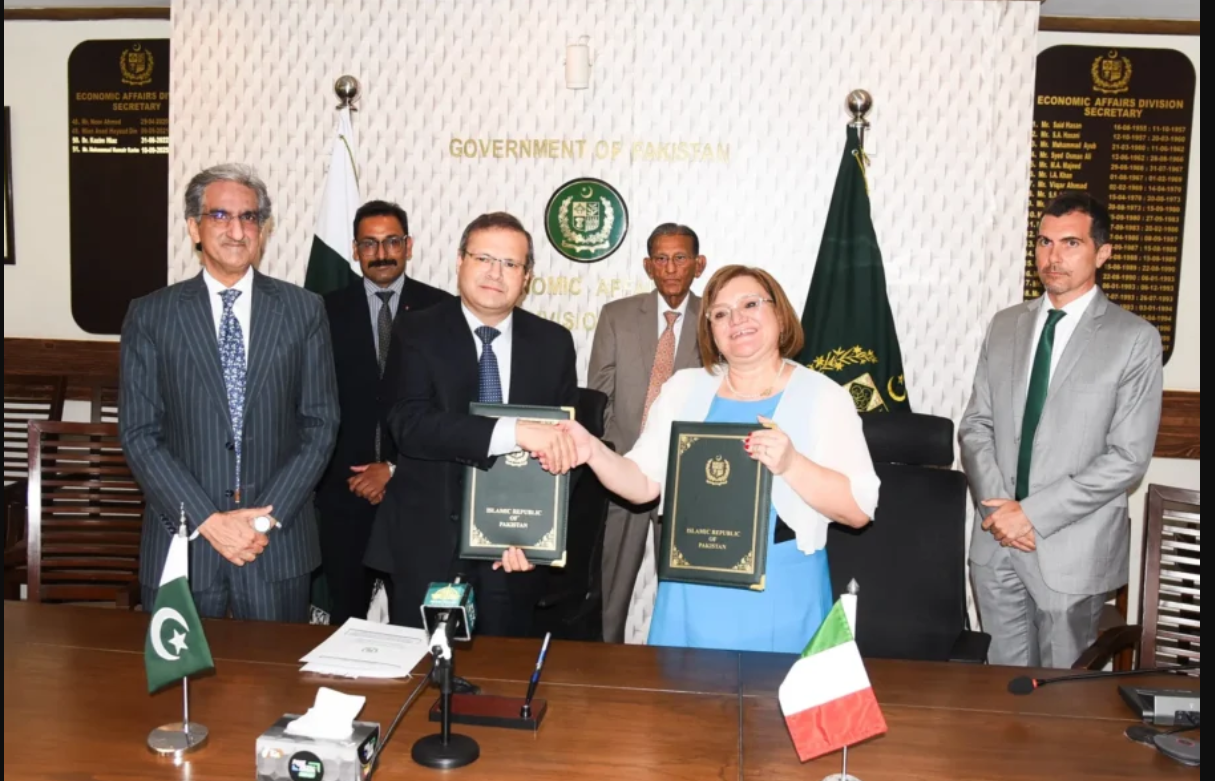

Pakistan and Italy have signed a concessional loan agreement worth €20 million, equivalent to nearly Rs6.3 billion, to strengthen professional capacity building in agriculture under Pakistan’s Technical and Vocational Education and Training (TVET) National Reform Programme.
The agreement reflects continued cooperation between both countries in improving agricultural skills, increasing productivity, and supporting long-term rural development.
Officials expect the initiative to help modernise agricultural training while creating stronger links between technical education and practical farming needs.
What Does the New Pakistan–Italy Agreement Include?
The agreement was formally signed by Secretary of the Ministry of Economic Affairs, Muhammad Humair Karim, and Italian Ambassador Marilina Armellin.
Senior representatives from the Italian Agency for Development Cooperation, the Ministry of National Food Security and Research, and provincial agriculture departments also attended the signing ceremony.
Through this programme, Pakistan aims to strengthen its TVET framework with a particular focus on the agriculture sector.
At the same time, the initiative seeks to improve professional skills, expand technical certification opportunities, and encourage innovation throughout agricultural value chains.
Focus on Skills Development and Modern Agricultural Practices
The programme will run for 42 months and target different groups connected to agricultural production.
Farmers, extension workers, trainers, and other stakeholders will receive training designed to meet modern market requirements.
Additionally, the programme intends to improve productivity while encouraging sustainable farming methods and stronger rural livelihoods.
Officials said the training approach will remain demand-driven and aligned with practical industry needs.
As a result, participants are expected to gain skills that can directly support agricultural output and long-term sector growth.
High-Value Crops Receive Special Attention
A major component of the initiative focuses on the development of high-value crops and agro-food value chains.
Training programmes will include horticulture production, processing techniques, and agricultural marketing practices.
Several crop categories have been identified for specialised support.
These include olives, pistachios, dates, mushrooms, cherries, grapes, peaches, and almonds.
The project will also draw on Italian experience and expertise in modern agronomic practices to support agricultural improvement.
Consequently, authorities expect better quality production and stronger market competitiveness.
Thousands Expected to Benefit Across Pakistan
According to programme details, the initiative will deliver 720 training courses during implementation.
These courses are expected to benefit approximately 18,398 participants.
The targeted beneficiaries include farmers, women, youth, trainers, and individuals connected to agricultural activities.
Furthermore, the project includes the development of 11 standardised training curricula to support structured learning and consistent skill delivery.
Officials believe this approach can improve long-term institutional capacity within the agriculture sector.
Infrastructure Projects Included in the Programme
Alongside training, the agreement includes several infrastructure development components.
Authorities plan to establish 12 model orchards and nurseries across selected areas.
The programme will also introduce eight eco-villages equipped with climate-resilient technologies.
Additionally, five agro-food processing units will be developed to support value-added agricultural activities.
Two National Centres of Excellence are also planned.
These centres will focus on citrus and date crops and will be established in Sargodha, Punjab, and Turbat, Balochistan.
The programme will be implemented by the Pakistan Oilseed Department in coordination with provincial agriculture departments.
Through training, infrastructure, and technical support, the initiative aims to create stronger foundations for Pakistan’s agricultural future.

