
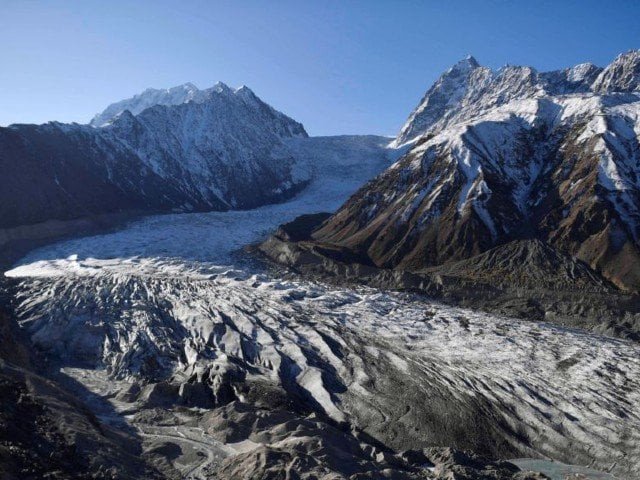

Pakistan and China have called for stronger regional action to protect glaciers and mountain ecosystems from climate change.
The two countries discussed joint scientific research, green investment, and shared climate platforms at the 5th China Xizang Trans-Himalaya Forum for International Cooperation.
Federal Minister for Climate Change and Environmental Coordination Dr Musadik Malik represented Pakistan at the forum in China’s Xizang Autonomous Region.
The event brought together policymakers, scientists, experts, and regional stakeholders. Discussions focused on sustainable development, ecological conservation, and the growing threats facing mountain communities.
Pakistan Warns of Rapid Glacier Loss
Musadik Malik said Pakistan and China share deep geographical and ecological links through the Himalayan and Trans-Himalayan mountain systems.
He noted that Pakistan is home to around 13,500 glaciers. This makes the country highly vulnerable to rising temperatures and accelerated glacial melting.
He warned that increasing greenhouse gas emissions are rapidly changing mountain ecosystems. Melting glaciers are raising the risk of flash floods, glacial lake outburst floods, and long-term water shortages.
Pakistan has already experienced repeated climate disasters. Heavy flooding is often followed by prolonged drought, damaging agriculture, infrastructure, education, and public health.
According to the minister, nearly 6,000 people have died in flood-related disasters in Pakistan during the past 15 years.
Around 20,000 people have also been injured or left with disabilities. Nearly 40 million people have faced displacement because of major floods.
He added that climate disasters have caused an estimated 1.8 billion lost school days. Children in affected communities often remain without access to education for extended periods.
Musadik Malik said glaciers support rivers, agriculture, energy production, and entire civilizations. Their protection is essential for regional stability and economic security.
He stressed that countries must choose cooperation over competition when managing shared natural resources.
Three Green Initiatives Proposed for Regional Cooperation
Pakistan proposed three major initiatives to improve climate cooperation across the Trans-Himalayan region.
The first proposal is a Virtual Green University. The platform would connect universities, researchers, students, and climate experts from different countries.
It would support joint research on glaciers, climate change, renewable energy, and sustainable mountain development.
The initiative could also promote data sharing and coordinated scientific studies. This would help governments understand changing weather patterns and glacier behaviour.
The second proposal is called Green Fields. It would connect young entrepreneurs with investors and financial institutions.
The platform would support climate-focused businesses working in renewable energy, battery technology, clean transport, and resilient infrastructure.
Musadik Malik said young innovators need easier access to funding. Many climate solutions fail to grow because entrepreneurs cannot secure investment.
The third proposal is a Green Cloud. It would provide open access to publicly funded climate and environmental research.
Scientists, businesses, students, and innovators could use the platform to develop practical climate solutions.
The minister said valuable research often remains unavailable to the public. Open scientific information could speed up innovation and improve regional planning.
China’s Mountain Development Model Praised
Musadik Malik also praised China’s efforts to combine environmental protection with economic development.
He referred to his visit to villages in Xizang. He said the region demonstrated how mountain communities could achieve development without ignoring ecological conservation.
The minister described China as a trusted partner of Pakistan. He said Beijing had supported Islamabad during both prosperous and difficult periods.
He also thanked the Chinese government for hosting the Trans-Himalaya Forum and promoting regional dialogue.
However, he highlighted a major gap in cross-border scientific cooperation.
Several countries are conducting separate studies on glaciers and climate change. Yet there is limited coordination between nations sharing the same mountain ecosystem.
Musadik Malik said climate threats do not recognise national borders. Floods, droughts, glacier loss, and water shortages can affect the entire region.
He urged participating countries to jointly collect data, develop policies, and create climate-resilient infrastructure.
The minister concluded that protecting glaciers requires shared responsibility. Development policies must also remain aligned with environmental protection.
He said regional countries must work together to protect mountain ecosystems for future generations.

