
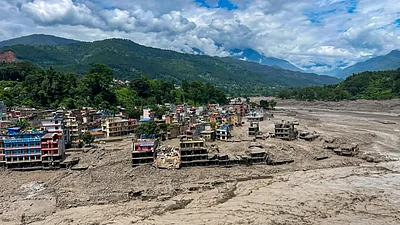

KATHMANDU: Nepal is facing one of its worst disasters in years after catastrophic flash floods struck areas near the Nepal-China border, leaving hundreds dead and thousands missing.
Nepal’s government said on Saturday that 626 bodies had been recovered, while around 2,400 people remained unaccounted for inside Nepal. When missing people reported in Tibet are included, the overall number approaches 3,000.
The disaster began on August 26 after a massive collapse of ice, rock and debris in the Himalayan region sent a powerful surge into rivers and downstream settlements.
Glacier Collapse Triggered Massive Flooding
The floods struck communities along the Nepal-Tibet border with extraordinary force. The sudden flow carried mud, rocks, ice and other debris into populated areas.
The Trishuli River reportedly rose dramatically within minutes, sweeping away homes, roads, bridges and other infrastructure.
Authorities are still investigating the precise sequence of events that triggered the disaster. Initial reports linked the flooding to a collapse in the high Himalayan region, with scientists examining the role of unstable glaciers, landslides and changing mountain conditions.
The scale of destruction has made several areas extremely difficult to reach. Thick mud, damaged roads, unstable terrain and poor weather have repeatedly disrupted rescue operations.
Rescue Teams Search for Thousands
Nepal has mobilised large numbers of security personnel and emergency workers to search for survivors and recover victims.
Helicopters are being used where weather conditions allow, but difficult conditions have prevented rescuers from reaching some of the worst-hit locations.
Nepal has also requested specialised technical assistance from other countries. India and China have sent teams and equipment to assist with difficult rescue operations, while other international partners have provided humanitarian support.
Officials say the immediate priority remains finding missing people, rescuing survivors and providing emergency assistance to affected communities.
Among those missing are hundreds of foreign nationals. Many were travelling in the Himalayan region, including people on pilgrimage and tourism trips.
Families Wait for News of Missing Relatives
The disaster has left families across Nepal and other countries desperately waiting for information about relatives who remain unaccounted for.
In several affected areas, rescue teams are searching through mud and debris for people who may be trapped beneath collapsed structures or swept away by the floodwaters.
The identification of recovered bodies has also become a major challenge. Authorities have faced difficulties preserving and identifying remains because of the scale of the disaster and limited facilities in some affected areas.
Nepalese authorities have indicated that DNA collection may be required before unidentified bodies are buried, allowing families to establish the identities of victims later.
Newly Formed Lake Raises Additional Concerns
The disaster has also created a new lake behind a large accumulation of debris in the affected mountain region.
The formation initially raised fears that another sudden release of water could trigger additional flooding downstream.
Rescue operations were temporarily disrupted because of concerns over the stability of the barrier. Authorities have since continued monitoring the situation as the lake begins to drain naturally. Experts have warned that the debris holding the water is unstable and requires close observation.
Infrastructure Devastated Across the Region
The floods have caused extensive damage to Nepal’s infrastructure.
Roads and bridges have been destroyed, while buildings, schools, power facilities and other essential infrastructure have been damaged or swept away.
Some communities have effectively been cut off because roads and bridges connecting them to other areas have disappeared under mud and debris.
The destruction of hydropower infrastructure has also created additional challenges for electricity supplies and reconstruction.
Nepal’s government estimates that rebuilding the damaged infrastructure could require between $4 billion and $5 billion.
The scale of the destruction has led officials to compare the disaster with Nepal’s most severe recent national emergencies.
As rescue teams continue searching for survivors, authorities face a second major challenge: restoring transportation, communications, electricity and basic services in communities devastated by the floods.
The death toll and missing-person figures remain subject to change as rescuers reach previously inaccessible areas and authorities reconcile lists from Nepal and Tibet.

