

Prime Minister Promises Swift Punishment for Paper Leaks
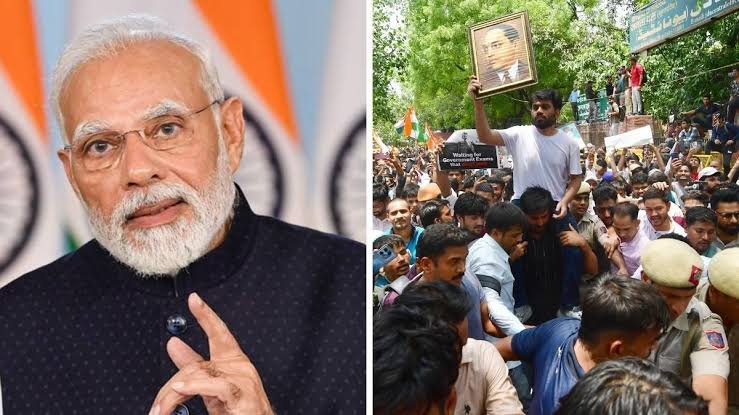
Indian Prime Minister Narendra Modi has announced special fast-track courts to prosecute people involved in examination paper leaks.
The announcement came on Thursday, July 23, 2026, after days of large student-led demonstrations.
Protesters are demanding accountability over repeated examination failures. They are also calling for Education Minister Dharmendra Pradhan to resign.
Modi said protecting the welfare and future of young people remained a national priority.
He promised swift and strict punishment for anyone attempting to damage students’ careers through leaked examination papers.
The announcement marked Modi’s first direct public response to the rapidly expanding protest movement.
Fast-track courts are designed to hear cases more quickly than India’s regular courts. The country’s judicial system faces a heavy backlog, and ordinary criminal proceedings can continue for several years.
India has previously created special courts for terrorism, money laundering, crimes involving lawmakers, and sexual offences against women and children.
The government hopes the new courts will speed up investigations, prosecutions, and convictions in examination leak cases.
However, Modi did not announce a timetable for establishing the courts. The government also did not immediately explain how many courts would be created or which cases would receive priority.
Protesters Reject Plan and Demand Minister’s Resignation
The announcement failed to satisfy student leaders and opposition parties.
The Cockroach Janta Party, known as CJP, said fast-track courts would only deal with offenders after examination papers had already been leaked.
Its leaders argued that the government must explain why leaks continue to happen and why existing security systems repeatedly fail.
CJP founder Abhijeet Dipke said the protests would continue until Education Minister Dharmendra Pradhan stepped down.
The youth-led movement began as an online satirical campaign. It initially attracted only a few hundred participants.
However, it quickly developed into a major national protest movement.
The immediate trigger was the cancellation of the National Eligibility cum Entrance Test, known as NEET.
Around two million students took the medical entrance examination on May 3, 2026.
Authorities later cancelled the examination after discovering that question papers had been leaked.
A new examination was held in June.
Reports have also linked several student suicides to the cancellation and the intense pressure surrounding the controversy.
NEET is the main entrance examination for undergraduate medical courses across India.
Millions of students compete for fewer than 150,000 available places. Many candidates spend years preparing for the test.
The leak therefore created widespread anger among students who had invested significant time and money in examination preparation.
Protesters are demanding stronger safeguards, transparent investigations, compensation for affected families, and action against officials responsible for the failure.
They also want the government to address broader concerns surrounding unemployment, limited university places, and repeated leaks in recruitment examinations.
Examination papers for police, teaching, and other public-sector jobs have previously been leaked in different parts of India.
The latest controversy has therefore become part of a larger debate about fairness, accountability, and opportunity for young Indians.
Parliament Disrupted as Delhi Protests Turn Violent
India’s main opposition Congress party has supported the protesters’ demand for Pradhan’s resignation.
Congress leader Rahul Gandhi accused Modi’s government of damaging the future of young people.
Opposition lawmakers protested outside parliament with placards before disrupting proceedings inside both chambers.
Their slogans and interruptions forced repeated suspensions for a fourth consecutive day.
Lawmakers from Modi’s Bharatiya Janata Party and its political allies organised a counter-demonstration.
They called for a formal parliamentary discussion on examination leaks.
Government ministers accused opposition parties of avoiding a debate while using the protests for political pressure.
The unrest also intensified on the streets of New Delhi.
More than 10,000 people reportedly gathered at the Jantar Mantar protest site late on Wednesday.
Some demonstrators threw stones and plastic bottles at police, according to Delhi authorities.
Several officers were injured and taken to hospital.
Police responded with tear gas and batons to disperse the crowd.
Thousands of protesters returned to the area on Thursday despite heavy security.
They carried anti-government posters and continued chanting for the education minister’s resignation.
The Delhi Metro Rail Corporation closed 16 stations in and around central New Delhi because of security concerns.
The closures affected thousands of commuters and represented the second major disruption to metro services during the week.
Protests have also spread beyond the capital.
Demonstrations have been reported in Mumbai, Bengaluru, Kolkata, Goa, Guwahati, Ahmedabad, Jammu, and Thiruvananthapuram.
The government has held one round of talks with CJP representatives.
Officials assured protest leaders that their demands would be considered and changes to the examination system would be introduced.
However, no agreement has been announced.
The expanding movement has become the largest youth-led challenge to Modi since he first became prime minister in 2014.
It has also developed into one of the most serious political crises of his third term, which began after the 2024 general election.
Modi’s Bharatiya Janata Party failed to secure an outright parliamentary majority in that election and remained in power with support from political allies.
The latest protests have given opposition parties a major opportunity to challenge the government on an issue affecting millions of students and families.
Young voters have traditionally formed an important part of Modi’s political support.
Continued unrest over examination leaks, unemployment, and limited educational opportunities could therefore create wider political pressure.
For now, Modi’s fast-track court plan has not ended the demonstrations.
Protest leaders say punishment alone is insufficient.
They want preventative reforms, ministerial accountability, and a transparent examination system capable of protecting students before another leak occurs.

