
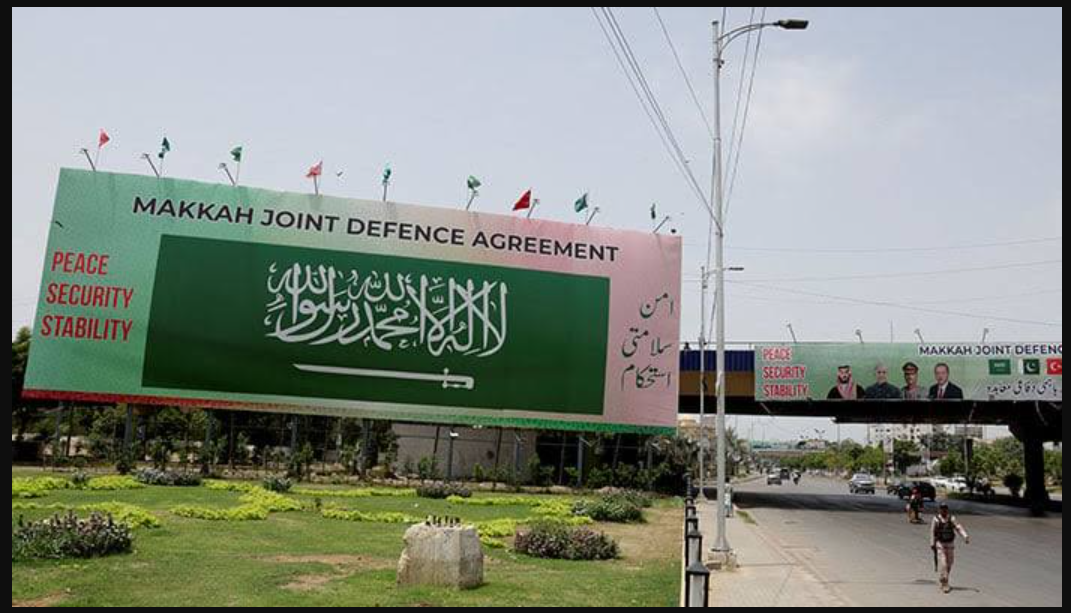

Pakistan has clarified that the Makkah Joint Defence Agreement remains open to countries willing to uphold its core principles.
Deputy Prime Minister and Foreign Minister Senator Ishaq Dar said the agreement remains defensive in nature and targets no country.
Instead, he said, the pact seeks to promote peace, stability and prosperity across the wider region.
His remarks came after Pakistan, Saudi Arabia and Turkiye signed the joint defence agreement in Makkah.
The agreement establishes a collective security framework among the three countries.
Under the pact, an armed attack against any one member will be considered an attack against all three.
Dar Explains the Purpose of the Makkah Accord
In a statement posted on Sunday, Ishaq Dar described the Makkah Accord as a reflection of the deep-rooted ties among Pakistan, Saudi Arabia and Turkiye.
He said the agreement resulted from years of discussions and coordination between the three countries.
Those efforts focused on strengthening strategic cooperation and addressing shared peace and security challenges.
Dar also clarified that the agreement does not cancel or replace existing bilateral or multilateral agreements.
Instead, the pact works alongside the existing arrangements involving the three participating countries.
He further pointed to Article 51 of the United Nations Charter in explaining the agreement’s collective defence provision.
Under the accord, an armed attack against one signatory would be regarded as an attack against all.
This arrangement remains consistent with the right to individual and collective self-defence.
Makkah Accord Not Directed Against Any Country
Dar stressed that the agreement has no specific country as its target and is defensive in nature.
He said its purpose is to strengthen existing efforts aimed at regional peace, stability and prosperity.
The clarification comes as Pakistan, Saudi Arabia and Turkiye seek closer coordination over shared security concerns.
At the same time, Dar said the agreement could accommodate other countries that accept its fundamental principles.
He said the pact remains open to countries in the region prepared to uphold those principles.
Such countries would also need to resolve differences through mutual respect, cooperation and peaceful means.
The foreign minister said the approach reflects Pakistan’s broader foreign policy principles.
He also reaffirmed Islamabad’s commitment to working with regional partners to peacefully resolve conflicts.
According to Dar, this cooperation can help build a more secure and prosperous future for the region.
Pakistan, Saudi Arabia and Turkiye Strengthen Security Cooperation
The defence agreement was signed during the Makkah Al-Mukarramah Summit for Joint Defence.
Saudi Crown Prince and Prime Minister Mohammed bin Salman attended the summit alongside Turkish President Recep Tayyip Erdoğan.
Prime Minister Shehbaz Sharif also attended the gathering, accompanied by the foreign and defence ministers.
The signing marked a significant step in the three countries’ efforts to strengthen collective security cooperation.
Moreover, the agreement provides for enhanced defence cooperation across multiple areas among Pakistan, Saudi Arabia and Turkiye.
The three countries have described the framework as part of their shared commitment to regional peace and stability.
Pact Comes Amid Wider Regional Security Concerns
The agreement comes against a backdrop of heightened security tensions across the region.
The US-Israel war on Iran, which began on February 28, has significantly affected the regional security environment.
The conflict has also drawn several Gulf countries into the wider crisis.
Meanwhile, maritime traffic through the strategic Strait of Hormuz has faced major disruption.
These developments have increased attention on regional security arrangements and cooperation among neighbouring states.
Within this environment, Pakistan, Saudi Arabia and Turkiye are seeking stronger coordination through the new defence framework.
Turkiye has NATO’s second-largest military, while Saudi Arabia is the strongest Gulf state.
Saudi Arabia also remains one of the world’s leading oil exporters.
Pakistan, meanwhile, is the only nuclear-armed Muslim country.
Together, the three countries bring significant military, economic and strategic weight to the new security arrangement.
Turkiye Signals Possibility of Wider Alliance
Following the agreement’s signing, Turkish Foreign Minister Hakan Fidan said President Recep Tayyip Erdoğan wanted the alliance to expand.
Fidan also identified Egypt as a potential candidate for joining the arrangement, among other countries.
Dar’s latest remarks similarly indicate that the agreement is not necessarily limited to its three founding members.
However, potential participants would need to accept the accord’s fundamental principles.
They would also be expected to support cooperation and peaceful mechanisms for resolving differences.
This condition places emphasis on shared principles rather than simply expanding the agreement’s membership.
Pakistan Reaffirms Collective Security Commitment
Pakistan has remained closely involved in regional diplomatic efforts since the conflict began.
Islamabad has also played the role of a key mediator between the United States and Iran during the crisis.
Against this backdrop, the new defence agreement adds another dimension to Pakistan’s regional engagement.
The Foreign Office said the pact reflects the three countries’ shared commitment to strengthening collective security.
It also reaffirmed their commitment to promoting peace, security and stability in the region and beyond.
“The agreement is intended to strengthen collective deterrence against any act of aggression, and stipulates that any armed attack against any one of the three states shall be regarded as an attack against them all,” it added.
The Foreign Office further said the agreement would enhance all aspects of defence cooperation among the three countries.
The framework therefore combines collective deterrence with broader defence coordination while maintaining its stated defensive character.
Makkah Pact Builds on Earlier Pakistan-Saudi Defence Agreement
The new agreement also follows an earlier mutual defence arrangement between Pakistan and Saudi Arabia.
Pakistan signed that agreement with Saudi Arabia a year ago, committing both sides to treat aggression against either country as an attack on both.
The latest pact expands the collective security framework to include Turkiye.
Consequently, Pakistan, Saudi Arabia and Turkiye now have a trilateral mechanism for responding to armed aggression against any member.
At the same time, the agreement does not replace existing defence arrangements involving the three countries.
Instead, according to Dar, it complements those existing bilateral and multilateral commitments.
What the Makkah Accord Means for Regional Security
The Makkah Joint Defence Agreement places collective security at the centre of cooperation between Pakistan, Saudi Arabia and Turkiye.
Its central provision treats an armed attack against one member as an attack against all three.
However, Pakistan has made clear that the pact is defensive rather than directed against another country.
Dar’s comments also leave the door open for additional regional countries to join.
Those countries would first need to uphold the accord’s principles and pursue peaceful means for resolving disputes.
For Pakistan, the agreement also reinforces its stated commitment to collective security and regional cooperation.
As security challenges continue to shape the region, the Makkah Accord provides Pakistan, Saudi Arabia and Turkiye with a formal framework.
The three countries can now deepen defence coordination while continuing to emphasise peace, stability and peaceful conflict resolution.

