

LG and Nvidia are taking their artificial intelligence partnership into new territory. The companies now plan to develop humanoid robots, AI factories and autonomous vehicles.
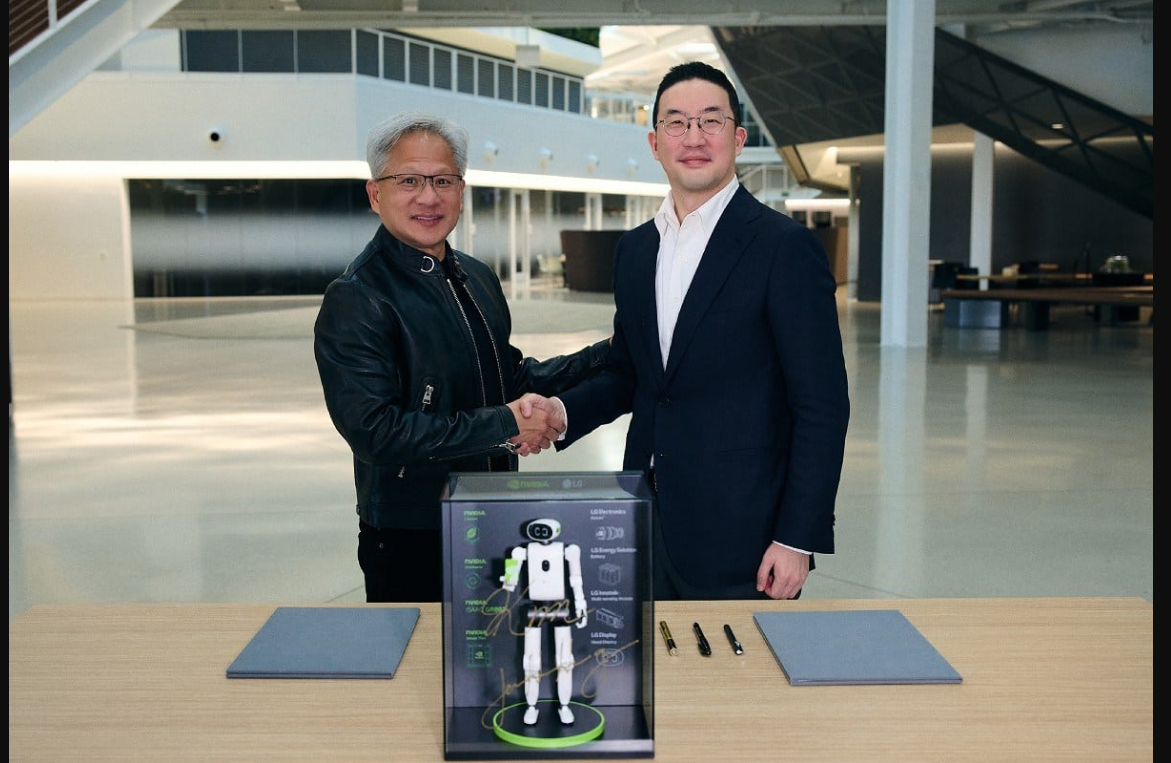
The companies signed a new memorandum of understanding at Nvidia’s headquarters in Santa Clara, California, on August 13.
LG Corp. Chairman and CEO Kwang Mo Koo met Nvidia founder and CEO Jensen Huang to formalise the agreement. The new deal expands their existing AI cooperation into real-world development and deployment.
LG Targets Humanoid Robot Launch in 2027
One of the partnership’s biggest developments is a next-generation bipedal humanoid robot. LG plans to publicly unveil the robot during the first quarter of 2027.
The machine will use Nvidia Jetson Thor for onboard computing. It will also use the Isaac GR00T open humanoid foundation model.
The system will support the robot’s reasoning and control capabilities. Meanwhile, Nvidia’s Halos for Robotics safety system will also form part of the platform.
LG plans to combine technologies from across its business. These include actuators, sensors and batteries from LG Electronics, LG Innotek and LG Energy Solution.
The approach could allow LG to bring several in-house technologies together within one robotic platform.
CLOiD Robot Heads to Factory Floor
LG is also preparing to expand the use of its wheeled CLOiD robot. The company plans to deploy CLOiD at its washing machine manufacturing facility in Tennessee before the end of 2026.
The facility will provide a real-world environment for testing and improving the robot. Afterward, LG plans to expand the technology to other global factories, commercial spaces and homes.
The companies also plan to develop a robot data factory using LG CNS’ PhysicalWorks platform. The platform will support data collection, synthetic-data generation, training and validation.
Moreover, the resulting data will help LG develop its own Robot Foundation Model. LG will continue using Nvidia Isaac GR00T alongside its own development.
LG Eyes AI-Powered Vehicles
The partnership will also move into autonomous vehicles. LG plans to develop a high-performance platform for next-generation AI-Defined Vehicles.
The platform will use Nvidia DRIVE Hyperion. It will combine Nvidia’s autonomous-driving technology with LG’s automotive software and in-vehicle infotainment.
LG ultimately aims to provide global automakers with integrated hardware and software solutions. These solutions would combine autonomous-driving capabilities with AI-powered services inside vehicle cabins.
Therefore, the partnership extends LG’s AI ambitions from factories and homes into the automotive sector.
A Larger AI Factory Is Also Planned
LG also plans to establish an AI factory reference site during the first half of 2027. The facility will use Nvidia’s DSX architecture and its upcoming Vera Rubin platform.
Experience from the reference project will support plans for a much larger AI facility in Cheonan, Chungcheongnam-do.
The planned 80MW LG AI Factory is targeted for completion during the first half of 2028. The facility will provide computing infrastructure for physical AI and robot foundation model development.
LG also intends to use the project to demonstrate its “One LG” strategy.
The strategy will bring together computing infrastructure, cooling, power, batteries, sensors and other technologies.
LG also plans to offer validated turnkey AI data centre packages to other companies.
LG and Nvidia Push Into Physical AI
LG Chairman and CEO Kwang Mo Koo said the companies now have clearer goals around AI factories and physical AI. He added that they intend to accelerate deployment through industry-leading reference projects.
Nvidia CEO Jensen Huang said physical AI could enable machines to understand the real world, reason and act safely alongside people.
The partnership will therefore cover multiple environments, including homes, factories and vehicles.
LG’s move also comes as Samsung expands its own robotics ambitions. Samsung recently established its Robotics eXperience division to accelerate humanoid and industrial robot development.
At the same time, Samsung’s Harman subsidiary maintains a significant presence in automotive electronics. With its latest agreement, LG is positioning itself across several fast-growing areas of physical AI.
The focus now stretches from humanoid robots and factory automation to AI-powered vehicles and large-scale computing infrastructure.

