
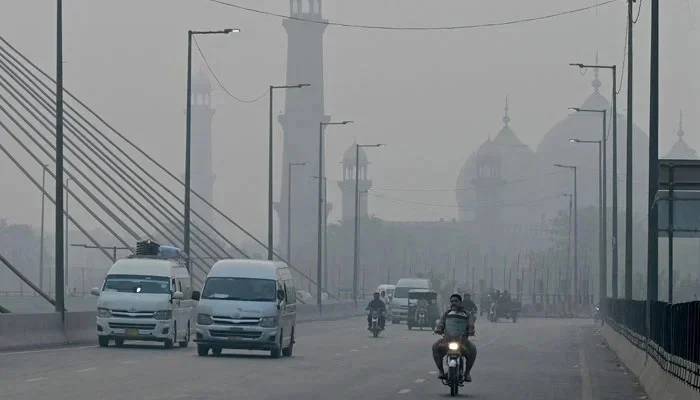

Lahore’s worsening air quality has raised fresh concerns as Punjab moves closer to the peak winter smog season. The city ranked second among the world’s most polluted major cities on Monday, recording an Air Quality Index (AQI) of 199.
According to IQAir’s live air quality tracker, pollution levels remained a concern across Punjab, with readings fluctuating throughout the day. Meanwhile, monitoring data from the Punjab Environmental Protection Agency (EPA) showed elevated pollution levels in several other cities.
Lahore’s Air Quality Fluctuates Throughout the Day
IQAir recorded Lahore’s AQI at 139 at 3 pm on October 26. At that time, PM2.5 fine particulate matter emerged as the main pollutant, reaching 51 micrograms per cubic metre.
Under the US AQI scale, the reading placed Lahore in the “unhealthy for sensitive groups” category. This classification indicates that air pollution can pose particular concerns for sensitive groups.
However, Lahore’s AQI later reached 199 in the reported city ranking. The differing readings reflect changes in pollution levels over time, highlighting the importance of considering the measurement time when assessing air quality.
Several Punjab Cities Record High Pollution Levels
Lahore was not the only city experiencing poor air quality. Punjab EPA monitoring data showed elevated AQI readings across several urban areas, highlighting the province-wide nature of the pollution challenge.
Pakpattan recorded the highest AQI among the listed cities, reaching 210. Multan followed with an AQI of 204, while Sargodha registered 195.
Other cities also reported concerning readings. Vehari recorded an AQI of 178, followed by Kot Addu at 176 and Dera Ghazi Khan at 165. Meanwhile, Khushab registered an AQI of 160.
These figures show that air pollution extends beyond Lahore, affecting multiple parts of Punjab as winter approaches.
Winter Smog Raises Fresh Environmental Concerns
As Punjab approaches the peak winter smog season, the latest readings underline the continuing challenge of maintaining cleaner air. Moreover, changing pollution levels throughout the day make regular monitoring important for understanding local conditions.
Lahore’s position in the global city ranking, alongside elevated readings elsewhere in Punjab, highlights the scale of the problem. The latest figures therefore draw attention to the province’s air quality challenges as the colder season approaches.
For the latest updates, visit and follow The Truth International website (www.thetruthinternational.com) and subscribe to the YouTube Channel.

