

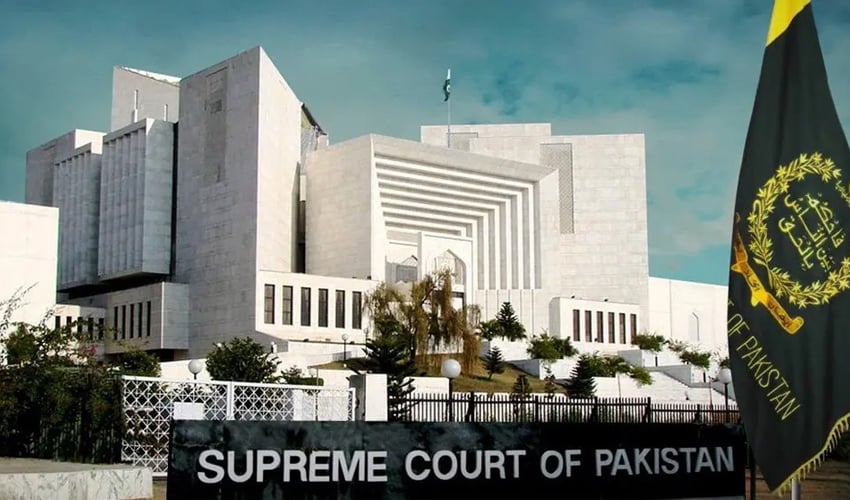

ISLAMABAD: The Supreme Court of Pakistan resumed hearings on petitions challenging the 26th Constitutional Amendment, where Justice Muhammad Ali Mazhar drew comparisons between the Pakistani and Indian judicial systems.
During the proceedings, lawyer Shabbar Raza Rizvi argued that India was the only country with a Constitutional Bench, while other nations had separate Constitutional Courts.
Justice Mazhar Highlights Indian Judiciary’s Structure
Responding to the lawyer, Justice Mazhar noted, “In India too, the Constitutional Bench has special powers.”
He added that in India, the Chief Justice serves as the ‘Master of Roster’, unlike Pakistan, where two committees manage the court roster, and the Chief Justice is not solely in charge.
Bench Composition and Case Background
An eight-member bench, led by Justice Amin-Ud-Din Khan, is hearing the case. Other members include Justice Jamal Khan Mandokhail, Justice Ayesha A Malik, Justice Syed Hassan Azhar Rizvi, Justice Musarrat Hilali, Justice Naeem Akhtar Afghan, and Justice Shahid Bilal Hassan.
The petitions were filed by over three dozen parties, including PTI, Jamaat-e-Islami, Sunni Ittehad Council, several bar associations, and former presidents of the Supreme Court Bar Association (SCBA).
Debate on Articles 184(3) and 191-A
Lawyer Rizvi argued that under the 26th Amendment, the Supreme Court retained constitutional powers under a proviso.
Justice Mazhar responded that Article 191-A transferred constitutional interpretation powers to the Constitutional Bench (CB), adding, “Regular and constitutional benches are two branches of the same tree; their powers are separate.”
Justice Hilali questioned whether the court would need to suspend the 26th Amendment to address the petition, asking, “How will we bypass Article 191-A?”
Full Court Formation Debate
During arguments, Justice Amin-Ud-Din Khan questioned how judges without constitutional interpretation authority could be part of a Constitutional Bench.
Rizvi contended that Article 191-A allows the CB to refer matters for a full court. Justice Mazhar then asked, “To whom should we send this matter of forming a full court?”
Rizvi replied that if the government sent a presidential reference, the matter would go to the Chief Justice of Pakistan (CJP).
Justice Mazhar, however, questioned how the CJP could nominate judges while also being a member of the Judicial Commission of Pakistan (JCP).
Barrister Adnan Khan Seeks Full Court Hearing
Upon conclusion of Rizvi’s arguments, Barrister Adnan Khan, representing petitioner Anas Ahmed, argued for the formation of a full court to hear the constitutional challenges.
Justice Hilali asked, “Are you saying that we should form a full court and send the matter to the CJP?”
Barrister Khan clarified, “A full court is not formed, my lord, the full court is always present; it is just summoned.” He explained that a full court comprises all sitting judges of the Supreme Court.
