
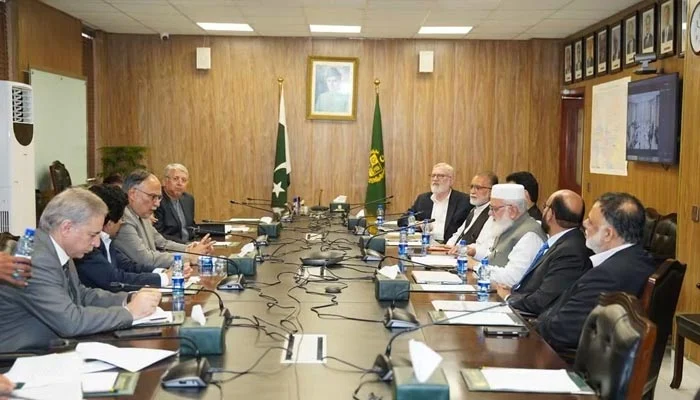

Talks between Jamaat-e-Islami and the federal government have failed to produce a breakthrough on key economic demands.
JI leader Liaquat Baloch said the second round of negotiations was held at Punjab House.
The government committee presented its position on the party’s demands during the meeting.
Federal ministers Ahsan Iqbal, Rana Sanaullah and Ali Pervez Malik represented the government’s position.
JI presented a six-point agenda and held detailed discussions on every demand.
Baloch claimed the government committee could not provide convincing arguments against the party’s proposals.
He said several major issues remained unresolved despite the latest negotiations.
JI Demands Petroleum Levy Removal and Fuel Price Relief
A major point of disagreement involved petroleum prices.
JI demanded a reduction in petrol and diesel prices and called for the complete removal of the petroleum levy.
Baloch described the levy as an additional financial burden on citizens already facing high living costs.
He also alleged that the existing refinery pricing structure was placing further pressure on consumers.
According to Baloch, certain refinery-related payments were significantly increasing the financial burden on the public.
The government did not immediately announce any agreement on reducing the levy or changing petroleum prices following the talks.
Baloch said Prime Minister Shehbaz Sharif had formed a separate committee to examine petroleum-related issues.
The committee is expected to meet on Monday.
JI will be looking for concrete measures from the government before deciding its next political strategy.
IPP Payments and Interest-Based System Also Discussed
Independent power producers were another major issue raised during the negotiations.
JI has repeatedly demanded changes to agreements and payments involving IPPs.
The party argues that electricity consumers are paying excessive costs because of the existing power sector structure.
Baloch said the JI delegation would hold separate discussions with the government’s task force on independent power producers.
The party also renewed its demand for measures to eliminate interest from the country’s financial system.
JI wants the government to implement the Federal Shariat Court ruling concerning the interest-based economic system.
No final agreement was announced on either the IPP issue or the party’s demand regarding interest.
The government delegation, according to Baloch, maintained that it also wanted to provide economic relief to citizens.
However, JI said statements alone would not be enough and demanded practical steps.
JI Warns of Islamabad March and Continued Sit-Ins
Political pressure on the government could increase if the negotiations remain unsuccessful.
Baloch said JI chief Hafiz Naeemur Rehman was expected to announce the party’s next course of action.
This could include a call for a march towards Islamabad.
JI has also warned that its protest sit-ins will continue if the government fails to provide meaningful economic relief.
Baloch linked the party’s demands to wider concerns over unemployment and weak economic activity.
He said joblessness was increasing while economic growth remained under pressure.
The party maintains that high fuel and electricity costs are affecting households, businesses and employment opportunities.
Further negotiations are expected after the government committee on petroleum prices meets and JI engages with the IPP task force.
The outcome of those discussions could determine whether talks continue or the party moves ahead with larger protests.

