
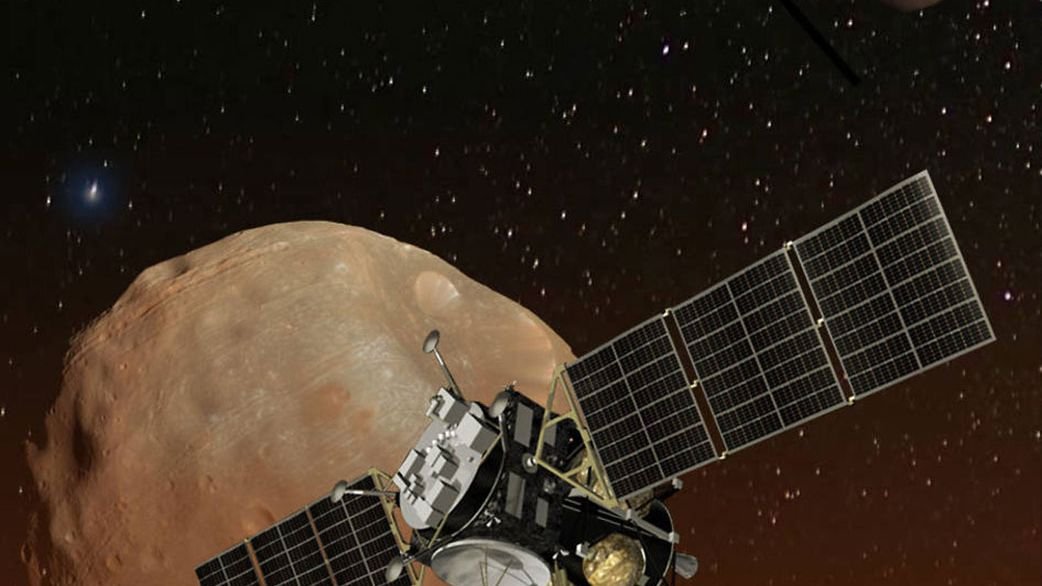

MMX Mission Will Attempt Historic Landing on Phobos and Return Samples to Earth
Japan is preparing an ambitious mission to the moons of Mars that could provide new clues about the formation of the Solar System and the materials that helped make rocky planets habitable.
The Japan Aerospace Exploration Agency is preparing to launch its unmanned Martian Moons eXploration mission, known as MMX, from the Tanegashima Space Center.
The spacecraft is expected to begin its journey in the coming months.
Its primary target will be Phobos, the larger of Mars’ two moons.
MMX is expected to remain around Mars for approximately three years.
During the mission, the spacecraft will attempt to land on Phobos and collect at least 10 grams of material from its surface.
A small rover named IDEFIX will also operate on Phobos and conduct detailed observations.
The rover was developed through international cooperation and is named after the dog from the French comic series Asterix.
MMX will also study Deimos, Mars’ second moon, although the spacecraft will not attempt to land there.
After completing its observations and sample collection, a return capsule will begin its journey back to Earth.
Current plans call for the capsule to land in Australia around 2031.
Scientists hope the returned samples will reveal important information about how Mars and its moons were formed.
Scientists Seek Answer to Mystery Surrounding Origins of Phobos and Deimos
One of the central goals of the MMX mission is to determine how the two Martian moons originated.
Scientists are currently considering two major theories.
The first is known as the giant impact hypothesis.
Under this theory, Phobos and Deimos formed from material thrown into space after a large celestial object collided with Mars.
The second theory suggests the moons were originally asteroids.
According to the capture hypothesis, Mars’ gravity pulled those objects into orbit from the outer Solar System.
Determining which theory is correct could significantly improve scientific understanding of the early Solar System.
Researchers also believe the answer could help explain how water, organic compounds and other important materials reached rocky planets.
The four rocky planets closest to the Sun are Mercury, Venus, Earth and Mars.
Scientists believe materials from the outer Solar System may have played an important role in creating environments capable of supporting life.
French astrophysicist Patrick Michel, who is working on the IDEFIX rover, said the mission could help explain how water, volatile substances and organic compounds were transported into the inner Solar System.
If Phobos and Deimos are remnants of those early delivery systems, their material could contain important evidence about the conditions that eventually made some rocky planets habitable.
Scientists stress that the mission is not expected to find direct evidence of life.
Instead, it could reveal how the materials essential for the emergence of life were distributed across the Solar System.
Mission Could Support Future Human Exploration of Mars
JAXA also sees the MMX project as an important step toward future crewed missions to Mars.
Researchers are studying whether Phobos could eventually serve as a natural staging point for human exploration of the red planet.
Its location and extremely low gravity could make it useful for future missions travelling between Earth and Mars.
JAXA said developing technology for round trips to the Martian system could become essential for long-term human exploration.
However, operating on Phobos presents major engineering challenges.
The moon has extremely weak gravity, making landing far more difficult than on larger planetary bodies.
Akinari Uehara, an engineer with Mitsubishi Electric, said the spacecraft’s landing legs required special development.
The system must absorb the landing impact while preventing the probe from bouncing or falling over.
Japan already has experience with difficult landings and sample-return missions.
Its Smart Lander for Investigating Moon, known as SLIM or the Moon Sniper, landed on Earth’s Moon in 2024.
The spacecraft tipped over after touchdown but continued transmitting data and survived several lunar nights.
Japan has also successfully returned material from an asteroid.
JAXA’s Hayabusa-2 spacecraft delivered 5.4 grams of rock and dust from asteroid Ryugu to Earth in 2020.
That experience is expected to support the complex sampling and return operations planned for MMX.
International Partners Join Japan as China Pursues Rival Mars Sample Mission
MMX is being developed through extensive international cooperation.
Partners include France’s National Centre for Space Studies, the German Aerospace Center, NASA and the European Space Agency.
Several universities and technology companies are also contributing to the mission.
Japan, however, is not alone in the race to return material from the Mars system.
NASA’s Perseverance rover has already collected samples from the surface of Mars since arriving there in 2021.
Those samples were originally intended to be returned to Earth through a separate mission.
However, the US return programme has faced major uncertainty after changes in funding and policy.
China is also preparing its Tianwen-3 Mars sample-return mission.
The Chinese spacecraft is expected to launch around 2028.
Its samples could return to Earth around 2031, potentially before Japan’s MMX capsule arrives.
China has already demonstrated its ability to operate successfully on Mars.
Its Tianwen-1 mission placed the Zhurong rover on the Martian surface in 2021.
The achievement marked a major milestone for China’s rapidly expanding space programme.
The competing missions could make the early 2030s a crucial period for Mars science.
If successful, Japan’s MMX mission could return the first direct samples from one of Mars’ moons and provide valuable evidence about the early history of the Solar System.
The findings could also improve understanding of how water and organic material reached rocky planets, including Earth.

