
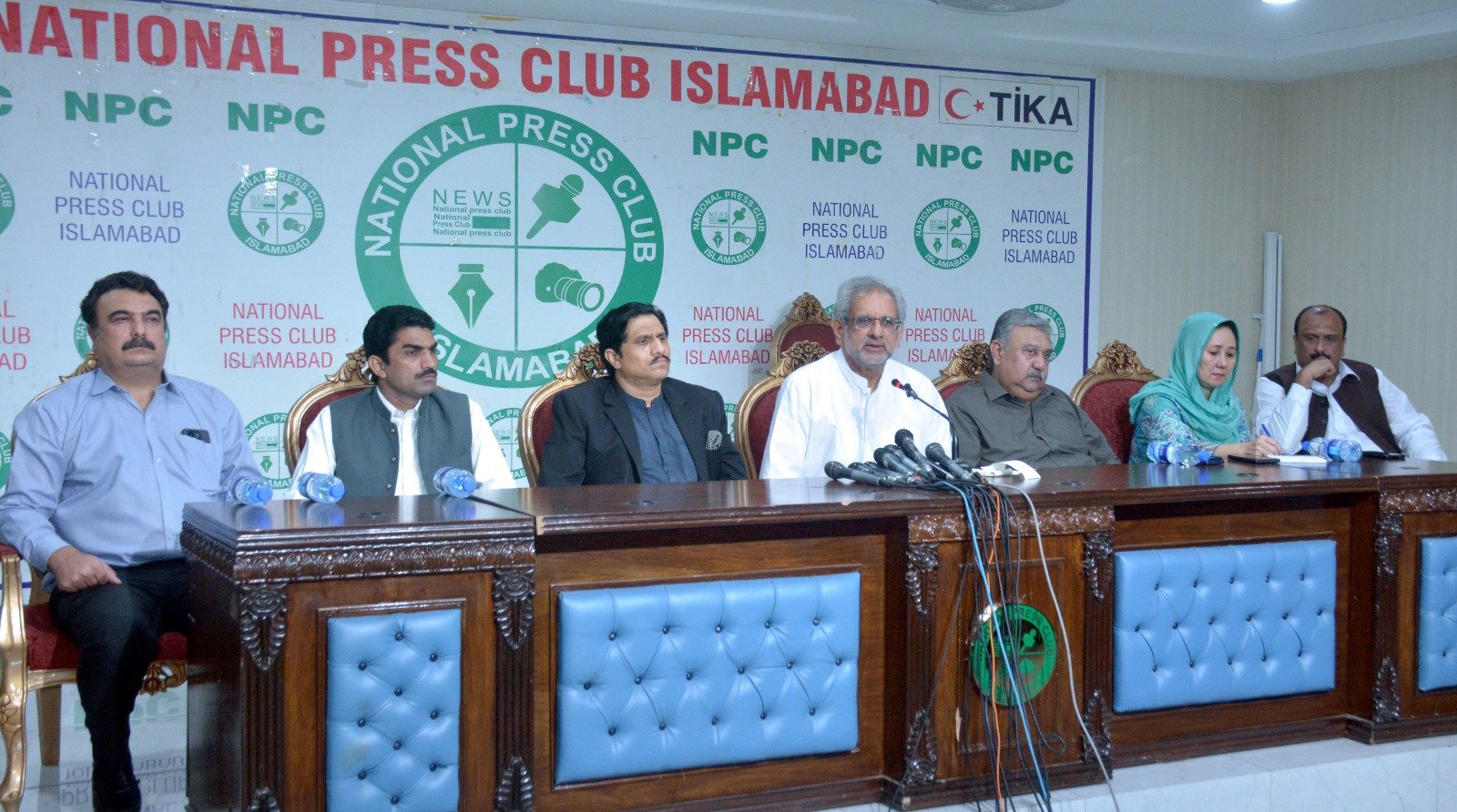

Former Prime Minister and Awam Pakistan Party chief Shahid Khaqan Abbasi has expressed serious concern over Pakistan’s economic, political, and administrative situation. He criticized the government’s economic policies and called for constitutional supremacy, political stability, and national dialogue to address the country’s challenges.
Speaking at a press conference at the National Press Club in Islamabad alongside party Convener Sarfaraz Afzal and other leaders, Abbasi said Pakistan needs institutional reforms rather than political confrontation.
Abbasi Criticizes Government’s Economic Policies
Shahid Khaqan Abbasi said the government lacks an effective economic strategy beyond increasing taxes and borrowing.
He claimed that public spending and corruption continue to rise, while economic policies have failed to improve the country’s financial condition.
According to him, rising utility costs and uncertain tax policies have discouraged businesses from making new investments. He added that investment has fallen to one of its lowest levels in decades.
Concerns Over Income, Poverty and Employment
Abbasi stated that the real income of Pakistani citizens has declined significantly over the past four years.
He claimed purchasing power has dropped by nearly 14 percent, making people financially weaker than before.
He also said the per capita tax burden has almost doubled during the same period.
According to Abbasi, unemployment has reached its highest level in 21 years, while many educated young people remain unable to find jobs matching their qualifications.
He further claimed that reports by international institutions indicate poverty levels are higher than official figures suggest.
Rising Debt and Agricultural Challenges
The former prime minister said Pakistan’s national debt has increased from around Rs45 trillion to nearly Rs85 trillion over the past four years.
He argued that expensive electricity, gas, petrol, and diesel have further increased financial pressure on businesses and households.
Abbasi also criticized the government’s wheat procurement and agricultural policies.
He said poor policy decisions are hurting farmers, increasing flour prices, and forcing Pakistan to import large quantities of wheat.
In addition, he expressed concern over declining food consumption, saying demand for flour, meat, cooking oil, and vegetables has fallen.
He also claimed that nearly 40 percent of children are affected by poor physical and mental development because of malnutrition. Furthermore, he said diseases such as hepatitis and HIV are increasing.
Calls for Constitutional Supremacy and Political Dialogue
Abbasi emphasized that economic recovery cannot be achieved without constitutional supremacy, the rule of law, and meaningful reforms.
He urged the government, opposition, judiciary, establishment, and other national institutions to begin comprehensive political dialogue.
According to him, Pakistan must move away from political confrontation, revenge politics, and politically motivated cases to build national consensus.
He said new elections alone would not solve the country’s problems.
“New elections are not the solution. Constitutional supremacy, the rule of law, a transparent system, and political stability are indispensable.”
Appeal for Political Stability
The Awam Pakistan Party chief also said disagreements among coalition partners reflect weaknesses within the government.
He stressed that all political stakeholders should work together in the national interest and agree on reforms to overcome the country’s economic and political challenges.
Concluding the press conference, Abbasi said political repression, retaliatory actions, and divisions cannot resolve Pakistan’s problems.
He called for political leaders to be allowed to move freely and engage with the public. He also urged all stakeholders to reduce political tensions and take practical steps to address the country’s ongoing economic and political crisis.

