
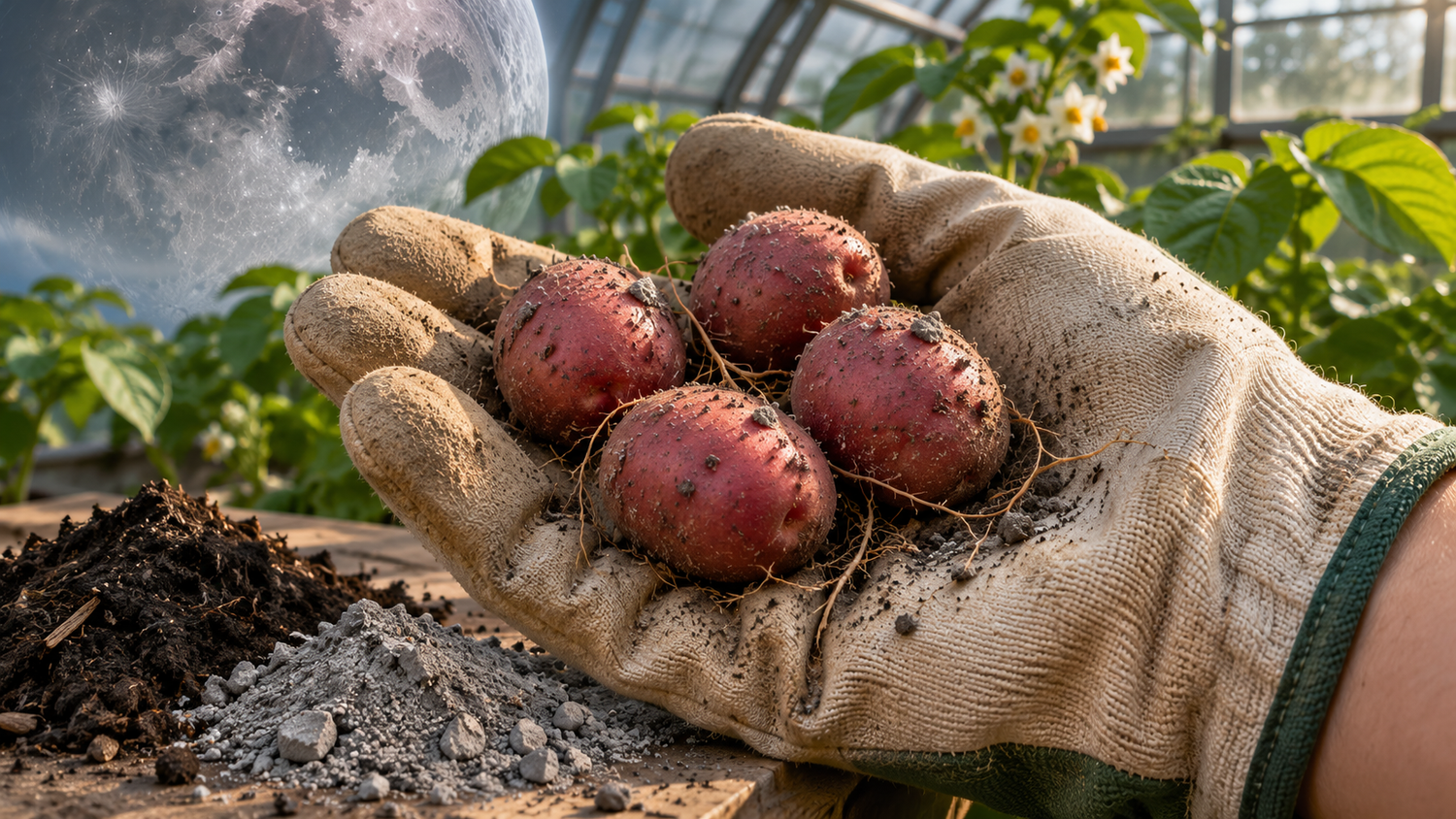

Scientists have successfully grown potatoes in soil designed to mimic the Moon’s surface, raising hopes for future food production in space.
Researchers at Oregon State University found that potatoes can complete their entire growth cycle in simulated lunar soil when scientists add enough organic material.
The NASA-supported study involved a potato variety called Modoc, which produces red-skinned potatoes with white flesh. Researchers published their findings in the journal npj Microgravity on November 19, 2026.
However, the experiment did not use actual lunar soil. Instead, scientists worked with simulated lunar regolith, the rocky dust covering the Moon’s surface.
Organic Waste Helps Potatoes Grow
Unlike Earth’s soil, lunar regolith contains almost no organic matter or nitrogen. It also contains heavy metals that can harm plant growth.
To overcome these challenges, researchers mixed the simulated lunar material with vermicompost. This nutrient-rich substance comes from organic waste broken down by earthworms.
The results showed a clear difference between the mixtures. Potatoes planted in pure lunar simulant barely developed roots or tubers.
However, a mixture containing 5% vermicompost supported some growth. More importantly, increasing the organic material to 30% produced results comparable to potatoes grown in ordinary Earth soil.
Researchers believe vermicompost also helps limit plants’ exposure to harmful heavy metals.
Are Moon-Grown Potatoes Safe to Eat?
The research team examined the potatoes’ nutritional composition and potential toxins.
Their analysis found that the tubers largely maintained their nutritional quality. Scientists also detected no significant increase in major naturally occurring potato toxins.
However, researchers have not tasted the harvested potatoes. They used the samples for laboratory testing instead.
Furthermore, the potatoes in this experiment remained small because scientists grew them in small pots. A separate experiment has since produced potatoes closer to typical supermarket sizes.
Could Future Astronauts Grow Their Own Food?
The findings could support plans by the United States and China to establish long-term human bases on the Moon.
Transporting every meal from Earth would create major logistical and financial challenges. Therefore, growing food locally could help astronauts sustain longer missions.
Scientists also see potential in recycling food scraps and plant waste into compost. This approach could reduce the amount of material future missions need to carry from Earth.
Although lunar farming still faces major challenges, the experiment marks an encouraging step towards sustainable food production beyond our planet.
For the latest updates, visit and follow The Truth International website (www.thetruthinternational.com) and subscribe to the YouTube Channel.

