
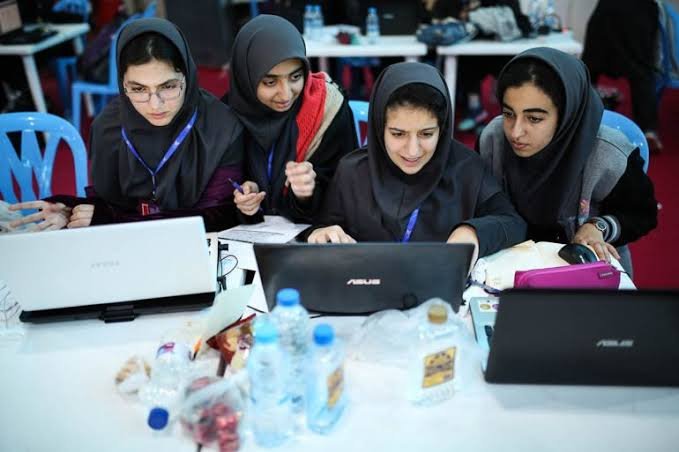

Iranian teenage girls are using robotics competitions to develop technology skills and pursue careers in engineering and artificial intelligence.
At this week’s RoboCup event in Tehran, young participants watched robots they designed compete in autonomous football matches.
The event highlighted Iran’s efforts to develop young technology talent despite economic pressure and international sanctions.
Teenage Girls Take the Lead in Robotics
The competition was held at Tehran’s Grand Mosalla religious complex.
The venue is usually used for prayers and religious gatherings.
Teenage girls gathered around miniature football fields as their robots competed against teams of boys.
Participants included children as young as 10.
For 15-year-old Elina Rezvanian, robotics is more than a competition.
“My ambition is to study robotics at university and to take part in international competitions,” she said.
Rezvanian already knows how to code.
She and four female classmates spent two years designing and developing their robots for the competition.
Robots Compete Without Human Control
The robots were designed to operate autonomously.
They did not rely on remote controls or direct human intervention during matches.
Instead, their movements were controlled by computer code and electronic components.
Some robots used sensors to detect infrared signals from the ball.
More advanced machines used cameras and image-processing technology to identify the ball.
Farhan Daemi, a 24-year-old referee and robotics enthusiast, explained how the technology works.
The robots had to locate the ball, move toward it and attempt to score without direct human control.
Each match consisted of two 10-minute halves.
Young referees monitored the games and intervened when technical problems created disputes.
Iran Focuses on Future Technology Skills
The competition comes as Iran faces significant economic challenges.
Decades of international sanctions have restricted parts of the country’s economic and technological development.
The recent regional war has added further pressure.
Despite these difficulties, Iran continues to invest in emerging technologies and technical education.
The country reportedly trains more than 200,000 engineers each year.
However, Iran also faces a significant brain drain as skilled professionals leave the country.
Robotics, artificial intelligence and drone technology remain among the areas receiving attention.
Schools and youth competitions are also being used to identify and develop future talent.
Thousands Join RoboCup Competition
The 20th edition of Iran’s annual RoboCup featured around 2,000 participants.
Organisers said the competitors were divided into approximately 400 teams.
The event provides young participants with an opportunity to develop programming, engineering and problem-solving skills.
Top performers can also attract attention from Iran’s National Elites Foundation.
The government-backed organisation supports young people considered to have exceptional academic or technical potential.
Girls Seek Greater Opportunities
The competition also provided a platform for female students to demonstrate their technical abilities.
Iranian schools generally separate boys and girls for education, making mixed-gender competition an unusual setting.
For some participants, the event is also about encouraging more girls to enter technology fields.
Teenage participant Avina Maleki said she wanted to see more girls participate in robotics.
She also expressed hope that female teams could eventually outperform male competitors.
The young participants’ ambitions reflect a broader effort to develop technology skills among Iran’s next generation despite the country’s economic and geopolitical challenges.

