
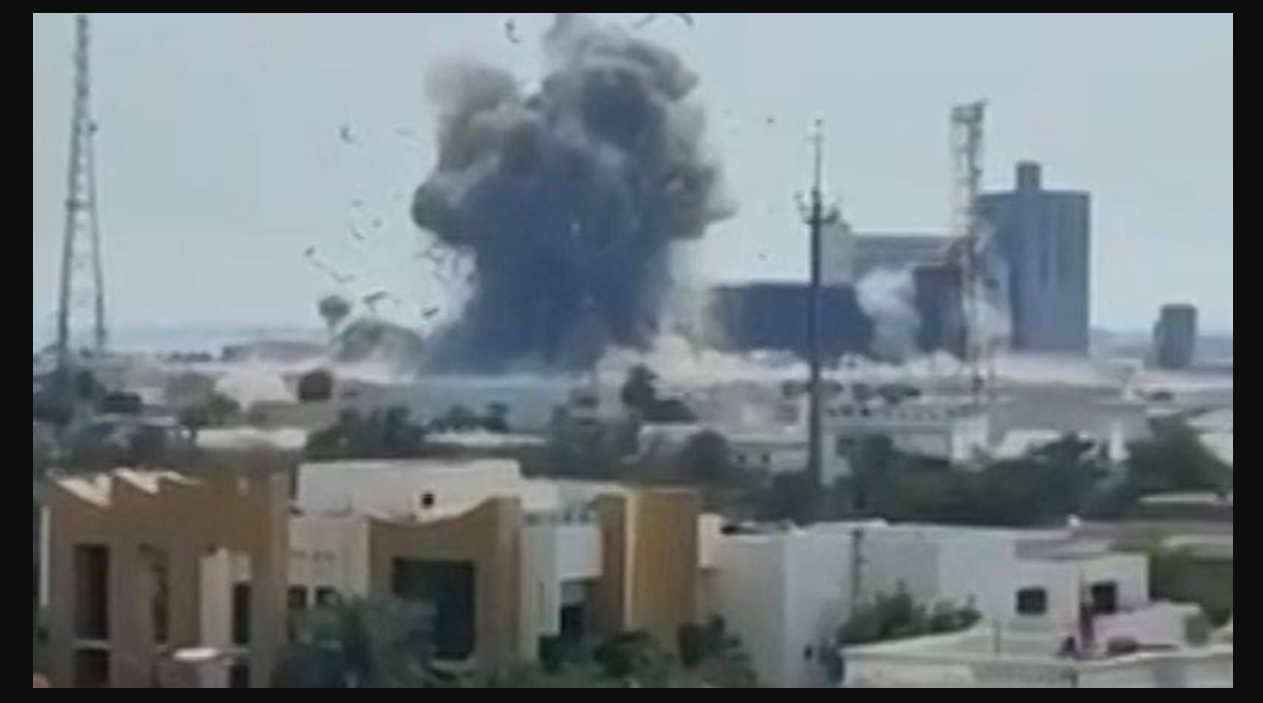

The Middle East witnessed another dangerous escalation on Sunday after Iran launched missiles and drones at US military bases in Bahrain, Qatar and the United Arab Emirates. The attacks came hours after the United States carried out approximately 140 precision strikes on Iranian military targets, further deepening tensions between Washington and Tehran.
At the same time, Iran announced the closure of the Strait of Hormuz “until further notice.” The move followed an incident involving a commercial vessel that Iranian forces said had ignored official navigation instructions while passing through the strategic waterway.
The latest exchange of military action has cast fresh doubt over diplomatic efforts aimed at preventing a broader regional conflict. It has also raised concerns about global energy supplies because the Strait of Hormuz remains one of the world’s busiest oil and natural gas shipping routes.
Iran closes Strait of Hormuz
Iran’s Islamic Revolutionary Guard Corps (IRGC) Navy announced that the Strait of Hormuz would remain closed after its forces intercepted a commercial vessel.
According to Iranian authorities, the vessel ignored repeated warnings and attempted to travel through what they described as an unauthorised route.
The IRGC said warning shots were fired before the ship was stopped.
“Following this incident… the Strait of Hormuz will be closed until further notice and until the end of American interventions in this region.”
Iran also declared that no commercial vessels would be allowed to pass through the waterway until further notice.
The announcement immediately intensified regional concerns because nearly one-fifth of global oil and liquefied natural gas trade passes through the narrow maritime corridor.
United States launches 140 precision strikes
Shortly after the shipping incident, the United States launched a large-scale military operation targeting Iranian military infrastructure.
According to US Central Command (CENTCOM), American forces struck approximately 140 military targets using precision-guided weapons fired from aircraft, drones and naval platforms.
CENTCOM said the operation targeted missile launch sites, drone facilities, naval assets, ammunition depots, coastal surveillance systems and communication networks.
The US military described the strikes as a response to what it called an Iranian attack on a Cyprus-flagged commercial container ship travelling through the Strait of Hormuz.
According to CENTCOM, the vessel suffered extensive damage after catching fire. The engine room was badly affected, while one crew member remained missing.
The remaining crew abandoned the ship and escaped aboard lifeboats.
“In response, the United States is imposing a heavy cost by continuing to degrade Iran’s ability to attack civilian mariners and commercial ships freely transiting the strait.”
US Defense Secretary Pete Hegseth also reacted after the strikes.
“Iran made a poor choice. Now they pay.”
Iran responds with missile and drone attacks
Iran quickly responded by launching ballistic missiles and drones at American military installations across the Gulf.
Iranian state media reported that the Revolutionary Guards targeted US bases and radar facilities in Bahrain, Qatar, Kuwait and Jordan.
Meanwhile, authorities in Bahrain, Qatar and the United Arab Emirates confirmed air raid sirens and explosions.
Officials also stated that their air defence systems intercepted incoming missiles and drones.
The latest military exchange marked one of the most significant escalations since the two countries reached an interim understanding intended to reduce hostilities.
Hormuz dispute remains major obstacle
The Strait of Hormuz has become one of the biggest obstacles to any long-term agreement between Iran and the United States.
Iran insists that it has the authority to regulate shipping through the waterway. It has also indicated that vessels may face new rules and fees in the future.
However, Washington continues to support unrestricted international navigation through the strategic route.
The disagreement has repeatedly triggered military confrontations during recent months.
Analysts warn that any prolonged disruption could affect international energy markets because the Gulf remains a critical supplier of crude oil and liquefied natural gas.
Fresh rhetoric fuels tensions
Political rhetoric also intensified alongside the military escalation.
US President Donald Trump recently declared that the ceasefire between Washington and Tehran was over. However, he also left the door open for future negotiations.
Earlier, Trump warned that any attempt to target him would bring overwhelming American retaliation.
“1000 Missiles are Locked and Loaded and aimed at the Islamic Republic of Iran, with thousands of more to immediately follow, should the Iranian Government act on its threat, pronounced in many corners of the Globe, to assassinate, or attempt to assassinate, the sitting President of the United States of America, in this case, ME!”
Meanwhile, Iran’s new Supreme Leader Mojtaba Khamenei vowed revenge following the killing of his father and predecessor during the conflict.
“Vengeance is the will of our nation and must inevitably be carried out.”
“This matter depends neither on my personal existence nor on that of other officials. Whether we are present or not, it will come to pass.”
He also claimed that Iran had prepared a list of individuals it intended to target.
Diplomacy faces another major setback
Despite the renewed fighting, diplomatic efforts have not completely stopped. Regional mediators continue working to prevent the conflict from expanding further. A Qatari delegation recently travelled to Tehran in an effort to strengthen mediation efforts between both sides.
Iranian Foreign Minister Abbas Araghchi also maintained that Tehran had honoured its commitments under the previously agreed memorandum of understanding.
“There can only be mutual compliance.”
Nevertheless, the latest missile exchanges, American air strikes and the closure of the Strait of Hormuz have significantly complicated diplomatic efforts.
As military activity increases across the Gulf, uncertainty continues to grow over regional security, global shipping and international energy supplies.

