
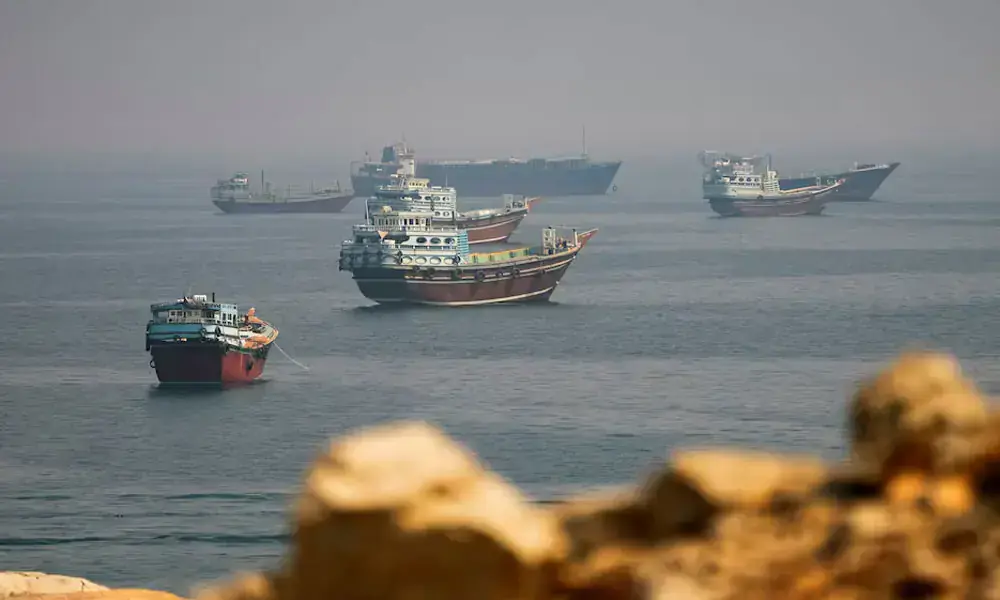

The United States has denied an Iranian claim that its forces seized an American underwater drone in the Strait of Hormuz. At the same time, US President Donald Trump said Washington expects more talks with Iran this week. However, he warned that Tehran had “overplayed” its hand in negotiations.
The developments came as tensions remained high across the Gulf and Yemen, with the Strait of Hormuz still at the centre of the crisis.
US Rejects Iran’s Underwater Drone Claim
Iran’s Islamic Revolutionary Guard Corps (IRGC) Navy said it had captured a US Remus 600 autonomous underwater vehicle operating in the Strait of Hormuz.
According to the IRGC, its forces used intelligence and electronic warfare capabilities to seize the underwater vehicle.
Iranian specialists were reportedly examining the drone to recover information from it.
However, the US military rejected the claim.
US Central Command spokesperson Captain Tim Hawkins said Washington maintained “positive control of all of our operational drone assets”. He described the Iranian claim as “clearly desperate”.
The conflicting claims could further increase tensions around the strategically important waterway.
Trump Expects More Iran Talks
Despite the military tensions, Trump said he expected further negotiations with Iran this week.
Speaking to Axios, Trump said Iranian officials wanted an agreement but had not accepted terms that Washington would support.
“They want to make a deal, but it is not the deal that I want to make,” Trump said, adding that Iran had “overplayed their hand”.
Trump also refused to rule out renewed US military strikes against Iran.
The comments followed indirect contacts between Iranian and US representatives during the United Nations General Assembly in New York.
Iran Seeks Conditions for Hormuz Reopening
Iran has continued to insist that diplomacy remains possible.
Foreign Minister Abbas Araghchi said Tehran had presented conditions for reopening the Strait of Hormuz. He also said Iran was waiting for a formal response through mediators.
Iran previously proposed reopening the waterway and restarting nuclear negotiations within a seven-day framework if Washington eased its military pressure and lifted its blockade.
Trump, however, publicly rejected the proposal.
Despite that rejection, Iranian officials said they were still waiting for the position to be formally communicated through mediators.
Iran Warns Against Renewed US Attack
Meanwhile, Iran’s armed forces said they remained prepared for a possible renewed US attack.
Army spokesperson Mohammad Akraminia said Iranian forces were ready for confrontation. He warned that Washington would face greater damage if it launched another offensive.
Iranian Army Commander-in-Chief Amir Hatami also described the conflict as being at a critical stage.
His comments reflected Tehran’s continued military readiness despite the parallel diplomatic efforts.
Yemen Conflict Adds to Regional Tensions
The crisis has also spread into Yemen, where fighting involving the Houthis has intensified.
The Houthi-run health ministry said a strike on shops at the Mawiya junction in Taiz province killed seven people and injured 40 others, including children.
However, Yemen’s internationally recognised government said its forces had targeted a Houthi military camp and vehicles near the same location. Three military sources told Reuters that Houthi fighters had recently established a camp near the market.
The conflicting accounts could not immediately be independently verified.
France Says Saudi Support Is Defensive
France has also increased military support for Saudi Arabia amid attacks by Yemen’s Houthis.
French Foreign Minister Jean-Noel Barrot said the assistance was “strictly defensive”.
President Emmanuel Macron previously announced that France would send troops, radar units and defence systems to Saudi Arabia.
Barrot said the deployment would depend on Saudi Arabia’s requests, France’s capabilities and developments in the region.
Britain has also agreed to provide defensive air-to-air refuelling support to Saudi Arabia following a request from Riyadh.
US Expands Economic Pressure on Iran
Alongside military pressure, Washington is continuing its economic campaign against Tehran.
US Treasury Secretary Scott Bessent said the administration had imposed financial measures against Iranian banks and aviation service providers.
He also claimed that Turkey and Oman had stopped Mahan Air flights, while the UAE had halted flights by Iranian airlines. Bessent further said major banks in Turkey and the UAE had stopped transactions with Iran.
Iran has rejected the idea that other countries should determine their economic relations with Tehran based on US pressure.
Hormuz Remains at the Centre of Crisis
The Strait of Hormuz remains one of the most important pressure points in the conflict.
Shipping through the waterway has fallen sharply compared with pre-war levels. Preliminary Reuters data showed only two commodity vessels crossed the strait on September 21, compared with a pre-conflict average of about 125 large commercial vessels daily.
Meanwhile, Oman has urged Iran and the United States to resolve their differences through a lasting political settlement.
Omani Foreign Minister Badr Albusaidi said Muscat would continue efforts to safeguard navigation through the strait under international law.
For now, Washington and Tehran remain far apart over the conditions for ending the conflict. However, Trump’s expectation of further talks suggests diplomatic channels remain open even as military tensions continue.
For the latest updates, visit and follow The Truth International website (www.thetruthinternational.com) and subscribe to the YouTube Channel.

