
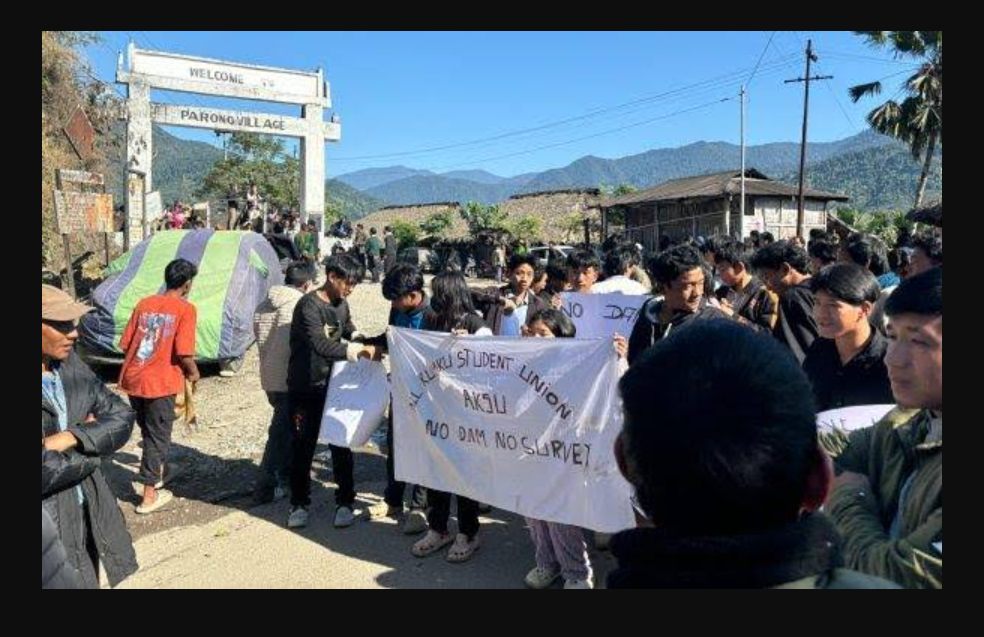

Violent protests have erupted in India’s northeastern Arunachal Pradesh state over a proposed Himalayan mega-dam designed partly to counter China’s upstream hydropower project. Demonstrators clashed with police, damaged government property and set buildings ablaze during unrest late Friday.
The dispute centres on the proposed 11,200-megawatt Siang Upper Multipurpose Project, developed by state-run hydropower company NHPC. Chief Minister Pema Khandu confirmed the violence on Saturday and described extensive damage to public property.
Police Injured as Protesters Attack Buildings
According to Khandu, protesters vandalised NHPC offices, damaged a police station and ransacked the homes of several elected representatives. Around 40 police personnel suffered injuries after demonstrators threw stones during the clashes.
Police fired tear gas canisters to disperse the crowd and control the situation. Meanwhile, the chief minister urged opponents to raise their concerns through dialogue rather than violence.
“The mob destroyed a lot of properties, police station, the NHPC office was vandalised, several elected representatives’ homes were ransacked,” Khandu told reporters.
He also appealed directly to people opposing the dam project.
“Question us, have dialogue with us, instead of violence,” Khandu said.
Why India Wants to Build the Massive Dam
India says the proposed dam is necessary to address concerns over China’s major hydropower development upstream in Tibet. The Chinese project, known as Yaxia, carries an estimated price tag of $167 billion and could become a record-breaking hydropower scheme.
New Delhi fears the Chinese project could affect water flows downstream. Therefore, Indian authorities say the proposed reservoir would help store water and maintain flows into the Brahmaputra River.
However, Beijing has maintained that its project will have no “negative impact” downstream.
The proposed Indian facility would become the country’s largest hydropower project by a substantial margin. Nevertheless, local communities have strongly opposed the plan because they fear losing their homes and land.
Disputed Border Adds to India-China Tensions
The dam controversy comes amid longstanding tensions between India and China over their disputed Himalayan border. Both countries claim territory in the region and maintain tens of thousands of troops along the frontier.
China claims Arunachal Pradesh as part of southern Tibet, while India considers the state an integral part of its territory. Consequently, major infrastructure projects in the region carry both economic and strategic significance.
The proposed dam has therefore become a focal point for concerns about water security, territorial disputes and the impact of development on local communities.
India and China Maintain Contact Over Border Disputes
Separately, India’s Foreign Ministry said Friday that both countries remained in regular contact to manage tensions along their shared border. The statement followed remarks by senior Indian border police official Shatrujeet Kapur about reported “face offs” between Indian and Chinese forces.
Foreign Ministry spokesperson Randhir Jaiswal said Chinese forces sometimes diverged from established patrolling patterns, disturbing the situation in border areas.
“The situation in the India-China border areas gets disturbed from time to time when Chinese forces diverge from established patrolling patterns,” Jaiswal told reporters in New Delhi.
He added that both sides continued using diplomatic and military channels to address unresolved disputes.
“Both sides continue to use existing diplomatic and military mechanisms to resolve outstanding issues and avoid misunderstanding and miscalculation.”
The protests highlight the challenges facing India’s proposed mega-dam, which combines concerns over local displacement with wider questions about water resources and regional security.
For the latest updates, visit and follow The Truth International website (www.thetruthinternational.com) and subscribe to the YouTube Channel.

