
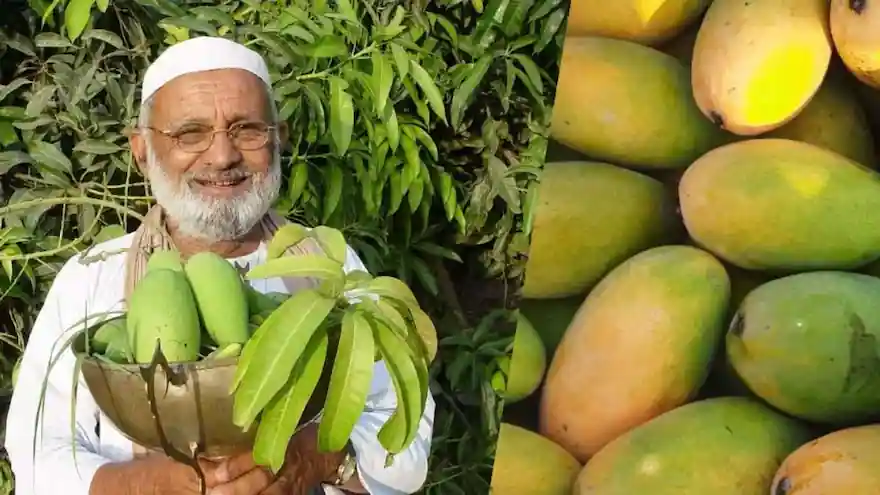

A Self-Taught Horticulturist From Malihabad
Kalimullah Khan from Malihabad in Uttar Pradesh has become one of India’s most remarkable horticulturists without any formal scientific training. Popularly known as the “Mango Man of India,” he has spent decades experimenting with mango cultivation and grafting techniques.
His most famous achievement is a single mango tree that produces more than 350 varieties of mangoes. The tree has attracted farmers, researchers, food lovers, and visitors from different parts of the world.
The 84-year-old Padma Shri awardee has turned his family orchard into a living example of patience, skill, and innovation. His work shows how traditional farming knowledge and personal dedication can create something extraordinary.
The unique tree grows several famous mango varieties, including Alphonso, Kesar, Langra, Dasheri, and Chaunsa. These mangoes differ in taste, colour, size, aroma, and texture. Yet they all grow from the same tree and root system.
How Grafting Made the Miracle Possible
The technique behind this achievement is called grafting. It involves attaching a branch from one plant to another tree so both can grow together. The process is widely used in horticulture, but maintaining hundreds of mango varieties on one tree requires rare expertise.
Khan’s journey began after he failed his Class 7 exams. Instead of continuing formal education, he started spending more time in his father’s orchard. That decision shaped his life and led him toward mango cultivation.
His interest in grafting began in the late 1950s. His early experiments were not successful. One of his first trees was also destroyed by floods. However, the setback did not stop him.
Instead, Khan studied soil, drainage, tree behaviour, and environmental conditions more closely. Over time, his understanding improved and his experiments became more successful.
By the 1980s, he began using an old mango tree in his family orchard for larger grafting experiments. That tree is now around 125 years old and remains the centre of his work.
A Living Archive of Mango Diversity
The tree is special because each mango variety keeps its own identity. Some mangoes are small and fibrous. Others are sweet, pulpy, fragrant, and brightly coloured.
Khan has also developed several hybrid varieties over the years. Some of them have been named after famous personalities, including Sachin Tendulkar, Amitabh Bachchan, Narendra Modi, and Aishwarya Rai.
His orchard is now seen as a living archive of mango diversity. It brings together varieties from different regions of India and preserves flavours that may otherwise remain limited to specific areas.
Mangoes hold a deep place in Indian food culture. They are linked with summer, family traditions, pickles, desserts, drinks, and regional pride. Khan’s work highlights that cultural importance in a powerful way.
His achievements earned him the Padma Shri in Horticulture in 2008. His name is also recorded in the Limca Book of Records. Visitors from India and abroad, including countries such as Iran and Dubai, have travelled to Malihabad to study his grafting methods.
As age and health now limit his daily work, his family continues the legacy. His son Nazimullah Khan helps manage the farm and maintain the grafted trees.
Kalimullah Khan’s story is more than a farming success. It is a reminder that curiosity, patience, and love for food can leave a lasting mark on a country’s agricultural heritage.

