
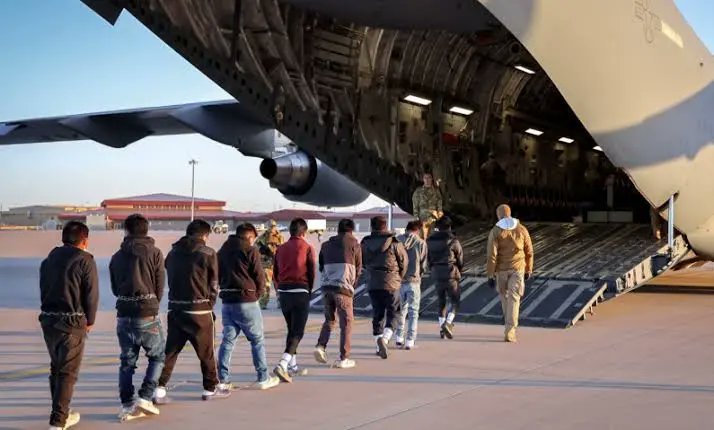

Guyana has agreed to temporarily receive a limited number of migrants deported from the United States under a new arrangement announced by the South American government.
The agreement is part of Washington’s expanding deportation policy under President Donald Trump. The US administration has increasingly relied on third countries to receive migrants who are removed from the United States.
Under the new arrangement, Guyana will accept a limited number of deportees who do not have criminal records.
The Guyanese government said the agreement is based on principles of human rights and international cooperation. However, officials stressed that the arrangement is temporary and does not amount to permanent resettlement.
Guyana Sets Conditions for Deportees
According to a statement from President Irfaan Ali’s office, the arrangement will apply only to a limited number of migrants.
Individuals accepted by Guyana will be relocated voluntarily. They will remain in the country while their immigration status is determined.
The arrangement does not give deportees permanent residency in Guyana.
Officials said the migrants will have several possible outcomes depending on the results of their immigration proceedings.
Those whose cases require them to leave Guyana may return to their countries of origin. Others could relocate to another country of their choice, depending on their circumstances and legal status.
The Guyanese government described the agreement as an extension of its commitment to international cooperation and humanitarian principles.
US Expands Third-Country Deportations
The agreement comes as the Trump administration continues a major crackdown on illegal immigration and expands the use of third-country deportations.
Under this approach, some migrants are removed from the United States and sent to countries other than their countries of origin.
Several countries in Central America and the Caribbean have already agreed to cooperate with Washington on deportation arrangements.
One of the most controversial examples involved Venezuelan migrants who were sent to El Salvador earlier this year. Around 250 Venezuelans were transferred to the country and held at the high-security CECOT prison.
The use of third countries has generated international debate over migrant rights, legal protections and the responsibilities of countries receiving deportees.
Guyana’s agreement appears narrower in scope. Officials have emphasised that only a limited number of people without criminal records will be accepted.
Temporary Arrangement Raises Wider Questions
The Guyanese government has made clear that the agreement should not be interpreted as a permanent settlement programme.
Migrants sent to Guyana will remain there while their immigration cases are processed. Their eventual destination will depend on the outcome of those proceedings.
The arrangement could give Washington another option for carrying out deportations when returning migrants directly to their home countries becomes difficult or complicated.
For Guyana, the agreement also places the country within a growing network of states cooperating with the United States on migration enforcement.
President Irfaan Ali’s government has presented the arrangement through the lens of international cooperation and human rights.
However, the implementation of the agreement is likely to receive close attention. Questions surrounding the treatment, legal status and future movement of deportees could become central to discussions about the policy.
For now, Guyana maintains that the arrangement is limited, temporary and voluntary. The government has also stressed that migrants will not automatically be permanently resettled in the country.
The agreement highlights how US immigration policy is increasingly extending beyond American borders, with third countries becoming an important part of Washington’s deportation strategy.

