
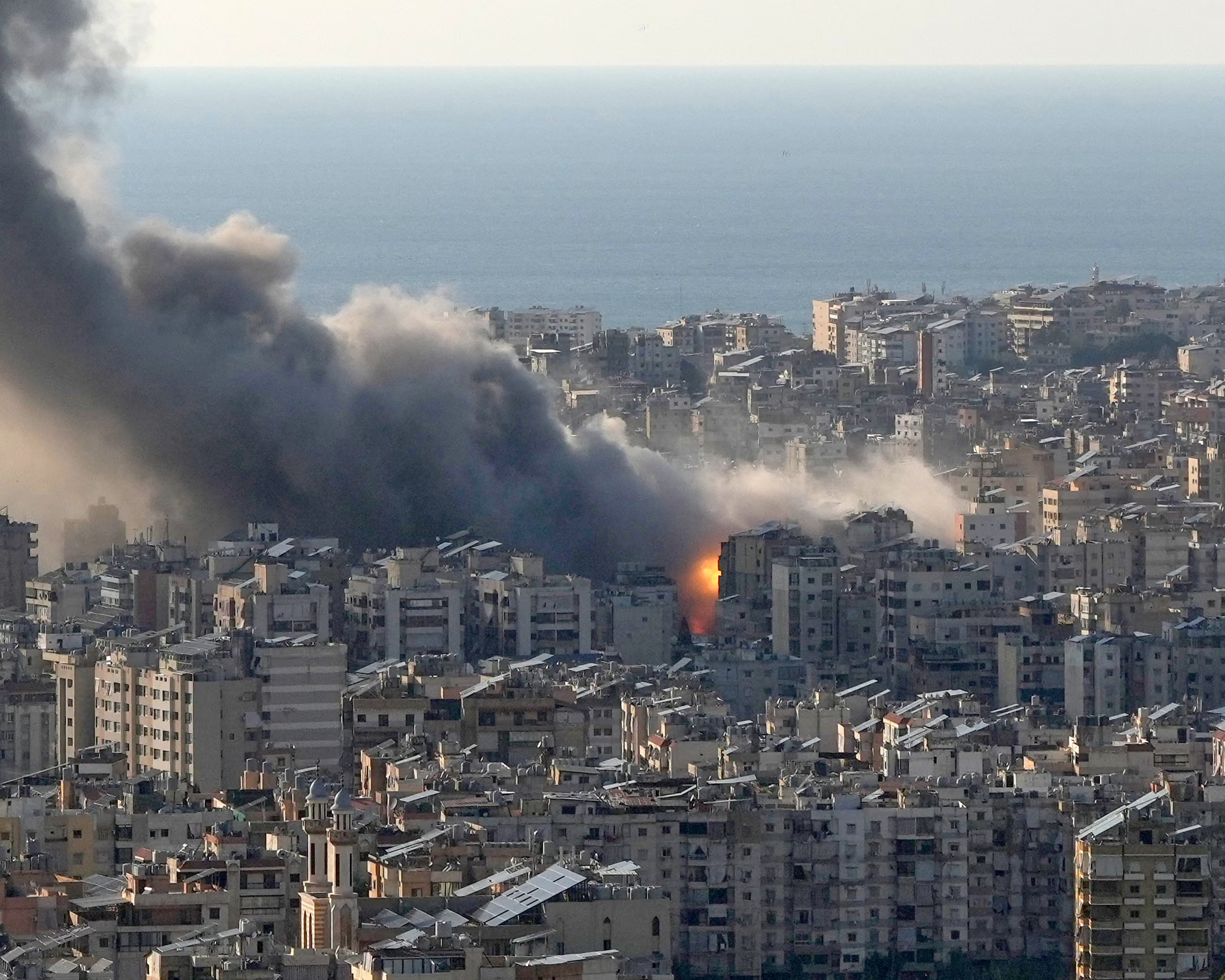

A new international conflict assessment has revealed that the world experienced its highest number of state-based conflicts since the end of the Second World War in 2025, raising serious concerns about global stability.
The annual Conflict Trends report, released by the Peace Research Institute Oslo, recorded 65 conflicts involving at least one state during the year, marking the highest level since 1946.
Researchers warned that violence is not only increasing but also becoming more deadly, with civilians increasingly caught in the crossfire of prolonged and overlapping wars.
Interstate Conflicts Reach Eight-Decade High
The report also highlighted a sharp rise in direct conflicts between states, which doubled from the previous year to reach eight major confrontations.
These included border tensions and military clashes involving India and Pakistan, Afghanistan and Pakistan, and Cambodia and Thailand.
It also documented ongoing wars and escalations such as Russia’s invasion of Ukraine and Israeli military operations in Syria.
Researchers described the global environment as increasingly unstable, with multiple crises unfolding simultaneously across different regions.
Civilian Deaths See Sharp Increase
According to the report, 2025 became the third deadliest year since the end of the Cold War in terms of conflict-related deaths.
Approximately 245,000 people were killed due to political violence or direct fighting.
Out of these, around 76,500 deaths were linked specifically to attacks targeting civilians, a dramatic rise compared with 14,200 in 2024.
The increase in civilian casualties was largely driven by the conflict in Sudan, particularly violence in the Darfur region.
In El-Fasher city, siege conditions and mass killings were estimated to have caused around 60,000 deaths.
Only 1994 and 2021 recorded higher death tolls, linked to the Rwanda genocide and the Tigray war in Ethiopia respectively.
Africa Remains the Most Affected Region
The report found that Africa remained the most heavily impacted region, with 29 state-based conflicts recorded.
Asia followed, while the Middle East, the Americas, and Europe also experienced multiple active conflicts.
Experts noted that several large-scale wars have been occurring at the same time over the past five to six years, creating what they described as a sustained period of global instability.
Experts Warn of a “Continuous Conflict Cycle”
Researcher Siri Aas Rustad described the situation as unprecedented in recent decades, highlighting the lack of any significant global decline in violence.
“Usually I’m able to sort of squeeze something positive out of it, but this year it’s shocking, the numbers.”
She explained that overlapping conflicts are now replacing one another without any real pause, keeping global violence at consistently high levels.
“And that’s different from previously — this continuous high intensity level of conflict globally.”
Rising Fragmentation in Global Cooperation
The report, based on data from the Uppsala Conflict Data Program, categorizes violence into state-based conflicts, non-state conflicts, and one-sided attacks on civilians.
Experts also warned that international cooperation is weakening amid rising geopolitical tensions.
“We are putting a lid on collaboration. The (UN) Security Council doesn’t work at the moment. We get a much more polarised world,” Rustad said.
She also pointed to shifting global politics and rising protectionism, noting increased trade barriers and reduced diplomatic cooperation.
A More Polarized Global Order
The study suggested that the world is entering a new phase of fragmentation, where major powers are increasingly divided and unable to manage conflicts effectively.
Africa remains the most affected region, but rising tensions across Asia and Europe show that instability is becoming truly global.
Researchers concluded that without stronger international cooperation, both state-based wars and civilian suffering may continue to rise in the coming years.

